

How Much Do Rappers Make Per Stream in 2026
TL;DR:
- Rappers earn about $0.004 gross per Spotify stream, but after cuts, many take home less than $0.001.
- Platform payout rates vary significantly, with Tidal paying the highest and geography strongly influencing actual earnings.
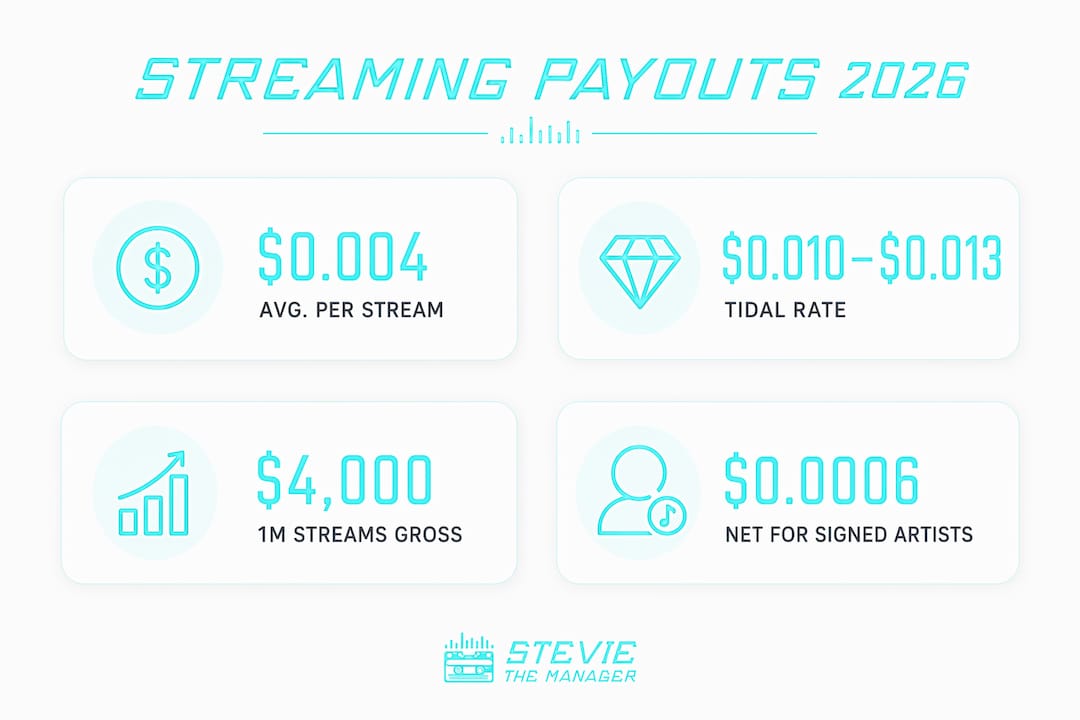
Rappers earn between $0.003 and $0.005 gross per stream on Spotify, averaging roughly $0.004, but the actual take-home figure is almost always far lower. After major label cuts, distributor fees, and advance recoupment, many signed artists pocket as little as $0.0006 per stream. That means 1 million Spotify streams generates around $4,000 gross but sometimes only $600 in an artist’s bank account. Platforms like Tidal, Apple Music, and Amazon Music each pay differently, and where your listeners live matters just as much as how many streams you rack up. This breakdown covers what the numbers actually mean for rappers at every career stage.

How do streaming platforms pay rappers per stream?
Streaming payout rates are not a fixed price per play. Spotify, like most platforms, calculates rates monthly by pooling all subscription and advertising revenue, then dividing it proportionally based on total streams across the platform. That means your per-stream rate in January can differ from your rate in December, even if your stream count stays identical.
Several factors shift that monthly number up or down:
- Subscription tier: A stream from a Spotify Premium subscriber pays more than one from a free, ad-supported listener. Premium revenue is larger and more predictable.
- Listener country: A stream from the United States or United Kingdom is worth significantly more than one from Brazil or Indonesia, because subscription prices and ad rates vary by market.
- Distributor and label contracts: Spotify pays the rights-holder, not the artist directly. That rights-holder could be a major label, an indie distributor like DistroKid or TuneCore, or the artist themselves.
- Catalog activity: Spotify’s 2024 policy change demonetized tracks with fewer than 1,000 annual streams, redistributing those micro-payments to more active catalogs and slightly lifting average payouts for qualifying artists.
Pro Tip: Upload your music through a distributor that passes through 100% of royalties, such as DistroKid or TuneCore, rather than one that takes a percentage cut. That single decision can meaningfully increase your net earnings before any other variable changes.
Understanding this pool-based model is the foundation for everything else. The per-stream figure you see quoted online is always a gross average, not a guaranteed rate.
What are the typical payout rates across major streaming platforms?
Not every platform pays the same, and the differences are significant enough to affect career strategy. Here is how the major platforms compare in 2026:
| Platform | Estimated per-stream rate | 1 million streams (gross) |
|---|---|---|
| Tidal | $0.010 to $0.013 | $10,000 to $13,000 |
| Apple Music | $0.007 to $0.010 | $7,000 to $10,000 |
| Amazon Music | $0.004 to $0.008 | $4,000 to $8,000 |
| Spotify | $0.003 to $0.005 | $3,000 to $5,000 |
| YouTube Music | $0.002 to $0.004 | $2,000 to $4,000 |

Tidal pays the highest per stream at $0.010 to $0.013, but its subscriber base is a fraction of Spotify’s 600-plus million users. An artist earning $0.012 per Tidal stream but only generating 50,000 plays there will still earn far less than from 5 million Spotify streams at $0.004. Scale and rate interact, and neither alone tells the full story.
Apple Music operates on an all-premium subscriber model, meaning every stream comes from a paying customer. That structural difference pushes Apple Music’s per-stream earnings to roughly double Spotify’s average, making it the most financially efficient major platform for artists with an established audience there.
YouTube Music rates sit at the lower end, and it is worth separating YouTube Music streams from standard YouTube video views. Video views on YouTube generate ad revenue through a different system and typically pay even less per play. Rappers with strong visual content on YouTube should track these as separate revenue streams entirely.

The practical takeaway from the 2026 hip-hop streaming race is that platform diversification matters. Releasing exclusively on Spotify because of its audience size leaves money on the table from higher-paying platforms.
Why do rappers often make less than the gross payout suggests?
The gross per-stream figure is what the platform pays to the rights-holder. What the rapper actually receives depends on a chain of deductions that most fans never see.
Here is how that chain typically works for a signed artist:
- Label revenue split: Major label contracts take 50 to 85% of streaming revenue, leaving the artist with 15 to 50% of the gross payout.
- Advance recoupment: If a label advanced $500,000 to record and market an album, streaming royalties go toward paying that back before the artist sees a cent of profit. Many artists recoup slowly or never fully.
- Producer and co-writer splits: Songwriting royalties are divided among all credited writers and producers. A rapper who co-wrote their track with two producers might only own 33% of the publishing.
- Distributor fees: Even independent artists using platforms like DistroKid pay annual fees or per-release charges, though these are far smaller than label cuts.
The math is stark. A major-label rapper generating 1 million Spotify streams at $0.004 gross receives $4,000 at the platform level. After a label taking 70%, that drops to $1,200. If the advance is still unrecouped, the artist may see $0. An independent artist using DistroKid keeps most of that $4,000, netting around $3,040 after minimal fees.
Pro Tip: Before signing any distribution or label deal, calculate your break-even stream count. If a label takes 75% and your advance is $100,000, you need roughly 33 million Spotify streams just to recoup. Know that number before you sign.
The gap between signed and independent rapper earnings per stream is one of the most underreported financial realities in hip-hop. Emerging artists often assume a label deal means more money. Structurally, it usually means less per stream, offset by greater reach and marketing support.
How does geography shape what rappers actually earn?
Listener location is the single biggest variable most aspiring rappers overlook. US and UK streams are worth 5 to 8 times more than streams from emerging markets like India, Nigeria, or Southeast Asia. Two rappers with identical stream counts can have dramatically different earnings based solely on where their fans are located.
Here is why geography drives such a large gap:
- Subscription pricing: Spotify charges $10.99 per month in the US but as little as $1 to $3 in lower-income markets. The revenue pool in each country reflects local pricing.
- Ad revenue rates: Free-tier listeners in the US generate higher ad revenue per stream than free-tier listeners in markets where advertisers pay less per impression.
- Blended rate impact: An artist with 60% of streams from Brazil and India will have a blended per-stream rate well below the $0.004 Spotify average, even if their total stream count looks impressive.
- Marketing targeting: Paid social campaigns targeting US, UK, Canadian, and Australian listeners cost more per click but generate higher-value streams. The return on ad spend calculation changes significantly.
- Playlist placement geography: Editorial playlists on Spotify are region-specific. Landing on a US-facing playlist like RapCaviar generates higher-value streams than placement on a regional playlist with a similar follower count in a lower-paying market.
Geography drives payout variance more than the per-stream rate difference between platforms. A rapper with a strong US fanbase earning $0.004 per stream will outperform a rapper with a Tidal-heavy strategy but a predominantly emerging-market audience.

What strategies can rappers use to maximize streaming revenue?
Streaming income alone rarely sustains a rap career financially. The most effective approach treats streaming as a discovery engine and builds revenue from multiple directions simultaneously.
- Prioritize playlist pitching: Spotify for Artists allows direct pitching to editorial teams before release. A placement on a major playlist can add hundreds of thousands of streams from high-value listeners in a single week.
- Release consistently: Algorithms on Spotify and Apple Music favor artists with regular output. Monthly or bi-monthly releases keep catalog streams active and improve algorithmic playlist placement.
- Distribute independently where possible: Retaining 85 to 100% of streaming revenue through DistroKid or TuneCore versus 15 to 50% under a label deal is a structural income advantage for artists with existing audiences.
- Convert streams to direct revenue: Platforms like Bandcamp allow fans to buy music directly, generating $5 to $15 per sale versus $0.004 per stream. One dedicated fan buying an album generates the equivalent of 1,000 to 3,000 streams.
- Build touring and merchandise income: Streaming as a discovery tool works best when it feeds higher-margin revenue. A rapper with 500,000 monthly listeners who converts 1% to concert tickets at $30 each generates $150,000 from a single tour cycle.
- Understand sync licensing: Placing a track in a TV show, film, or advertisement generates a one-time sync fee plus ongoing performance royalties, often exceeding years of streaming income from a single placement.
Pro Tip: Use Spotify for Artists’ audience data to identify which cities have the highest listener concentrations, then book live shows in those markets first. You are essentially using free platform data to plan a profitable tour.
A 30-day music marketing plan built around these principles gives independent rappers a structured path to growing both streams and the ancillary revenue those streams unlock.
Key takeaways
Rappers earn an average of $0.004 gross per Spotify stream, but signed artists often net as little as $0.0006 after label cuts, making geography, contracts, and distribution choices the real determinants of streaming income.
| Point | Details |
|---|---|
| Gross vs. net earnings | Spotify pays $0.004 gross per stream; signed artists may take home as little as $0.0006 after deductions. |
| Platform rate differences | Tidal pays up to $0.013 per stream; Apple Music averages $0.007 to $0.010, both outperforming Spotify. |
| Geography multiplier | US and UK streams pay 5 to 8 times more than emerging market streams, making audience location critical. |
| Independent advantage | Artists using DistroKid keep roughly $3,040 per million Spotify streams versus $600 to $1,200 for signed artists. |
| Streaming as discovery | Sustainable rap income combines streaming exposure with touring, merchandise, and direct fan sales. |
The number that actually matters is not the per-stream rate
I have spent years watching aspiring rappers obsess over Spotify’s per-stream rate while ignoring the variables that actually determine their income. The $0.004 figure is almost meaningless in isolation. What matters is the rate multiplied by volume, filtered through your contract, adjusted for your audience’s geography, and then compared against what you could earn from the same fans through other channels.

The artists I have seen build real financial stability from music are not the ones chasing streams. They are the ones who understand that streaming changes the rap game by lowering the barrier to discovery, not by replacing traditional income. A rapper with 2 million monthly Spotify listeners who sells out 500-seat venues at $25 a ticket earns more from one weekend of shows than from six months of streaming.
The label versus independent debate is real, but it is not binary. A label deal makes sense if the advance and marketing infrastructure accelerate your career faster than you could independently. It does not make sense if you already have an audience and are simply trading long-term revenue for short-term cash. Read every contract clause about recoupment before you sign anything.
My honest assessment: streaming income is a signal, not a salary. Treat it that way, and you will build something sustainable.
— Stephanos G
Explore hip-hop culture and grow your career with Lit Nightz News

Understanding rapper streaming earnings is one piece of a much larger picture. Hip-hop’s financial ecosystem connects directly to its cultural roots, and knowing where the music comes from helps you understand where the money flows. Lit Nightz News covers the full scope, from the origins and impact of hip-hop culture to the trends shaping hip-hop in 2026 that are redefining how artists earn and connect with fans. If you are an aspiring rapper or industry professional ready to build visibility, the artist promotion services at Lit Nightz News put your music in front of the right audience. The knowledge is here. The platform is ready.
FAQ
How much do rappers make per stream on Spotify?
Rappers earn between $0.003 and $0.005 gross per Spotify stream, averaging about $0.004. After label cuts and distributor fees, signed artists often take home $0.0006 to $0.001 per stream.
Which streaming platform pays artists the most per stream?
Tidal pays the highest rate at $0.010 to $0.013 per stream, followed by Apple Music at $0.007 to $0.010. However, Tidal’s smaller user base means total earnings depend heavily on where your audience actually listens.
How much does 1 million streams pay a rapper?
One million Spotify streams generates roughly $4,000 gross. Independent artists using DistroKid net around $3,040, while signed artists on major labels may receive only $600 to $1,200 after contractual deductions.
Does listener location affect streaming payouts?
Yes, significantly. US and UK streams are worth 5 to 8 times more than streams from emerging markets, because subscription prices and advertising rates vary by country. An artist’s blended per-stream rate reflects the geographic mix of their entire audience.
Can rappers make a living from streaming alone?
Most rappers cannot sustain a career on streaming revenue alone. The most financially stable artists treat streaming as a discovery tool and combine it with touring, merchandise sales, sync licensing, and direct fan purchases for a diversified income model.

Recommended
- How to make money from rap music: a 2026 guide
- How Streaming Has Changed the Rap Game: An Analysis – Stevie The Manager aka Stangr The Man
- The 2026 Hip Hop Streaming Race: Drake, Kanye & Kendrick – Stevie The Manager aka Stangr The Man
- The Richest Rappers in the World: 2026 Rankings

No Comments