

Drake Breaks Michael Jackson’s Record for Most No. 1 Hits
TL;DR:
- Drake has set the record for the most No. 1 songs by a solo male artist on the Billboard Hot 100, with 14 chart-toppers. His achievement resulted from strategic album releases, streaming metrics, and chart saturation, reflecting modern music consumption trends. While culturally different, both Drake’s chart success and Michael Jackson’s legendary legacy highlight distinct forms of influence in music history.
Drake is now the solo male artist with the most No. 1 songs in Billboard Hot 100 history, surpassing Michael Jackson’s long-standing record of 13 chart-toppers. The milestone arrived when “Janice STFU” debuted at No. 1, giving Drake his 14th Hot 100 leader. For music fans and industry followers, this is not just a number. It is a statement about how hip-hop has reshaped the commercial music landscape, and how one artist’s strategic dominance has rewritten what chart success looks like in 2026.

How Drake broke Michael Jackson’s solo male No. 1 record
The record did not arrive quietly. Drake’s 14th Hot 100 No. 1 came packaged inside one of the most calculated album release weeks in modern music history. On May 15, 2026, Drake dropped three albums simultaneously: ICEMAN, HABIBTI, and MAID OF HONOUR. All three debuted at positions one, two, and three on the Billboard 200, a feat with no modern precedent for a solo artist.
“Janice STFU” led the charge on the Hot 100 with first-week figures that covered every metric Billboard tracks. The song generated 40.7 million streams, 2.1 million radio audience impressions, and 3,000 U.S. units sold in its debut week. Those numbers reflect total fan engagement across platforms, not dominance in a single category. That distinction matters when you understand how the chart actually works today.
The triple-album strategy did more than deliver one No. 1. It flooded the Hot 100 with Drake content. That week, Drake placed 42 songs on the Hot 100, breaking Morgan Wallen’s previous single-week record of 37 entries. That kind of chart saturation is only possible when an artist releases enough material simultaneously to give fans dozens of songs to stream, share, and add to playlists at once.
Key facts from Drake’s record-breaking week:
- “Janice STFU” became his 14th Hot 100 No. 1, passing Michael Jackson’s solo male record of 13
- ICEMAN, HABIBTI, and MAID OF HONOUR debuted at Nos. 1, 2, and 3 on the Billboard 200
- Drake placed 42 songs on the Hot 100 in a single week, a new all-time record
- First-week streaming for “Janice STFU” reached 40.7 million plays in the United States
Why chart methodology made this record possible
The Billboard Hot 100 does not work the way it did when Michael Jackson was stacking No. 1s in the 1980s and 1990s. Back then, the chart relied primarily on physical sales and radio airplay. A song had to move units in record stores and dominate radio rotations to reach the top. That system rewarded a different kind of cultural penetration, one built on mass radio exposure and retail presence.
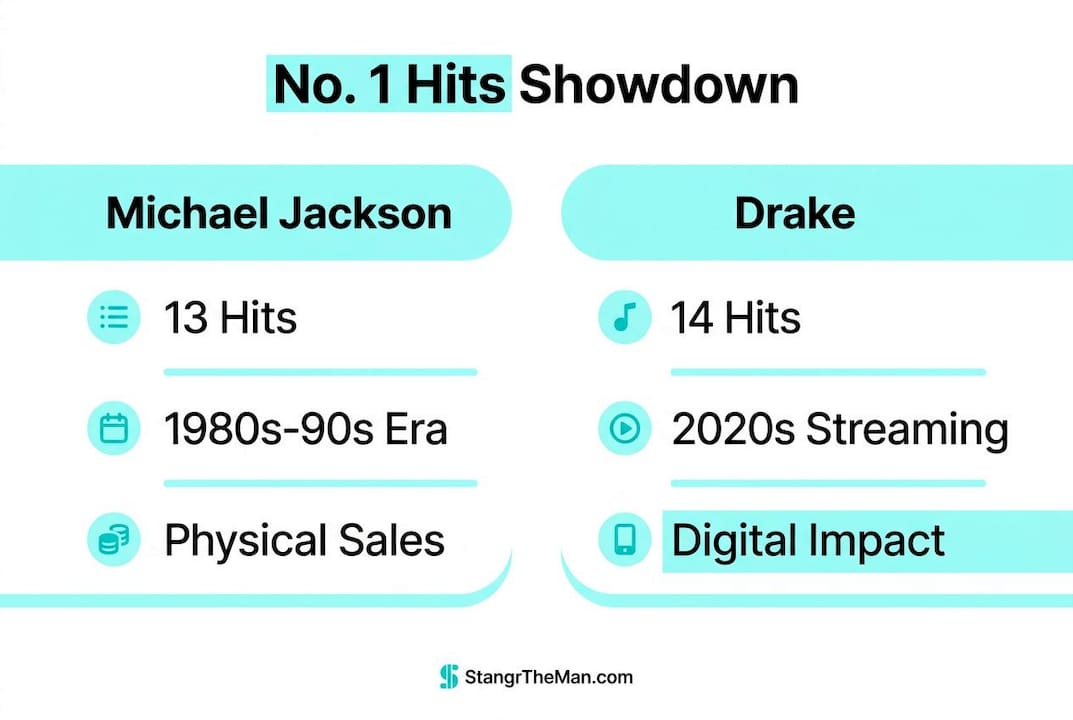
Today, Billboard’s Gary Trust has confirmed that multi-metric consumption drives modern No. 1s. The Hot 100 now combines streaming data from platforms like Spotify and Apple Music, digital download sales, and radio audience impressions into a single weighted formula. This means an artist can reach No. 1 without dominating any single category, as long as total engagement across all three is strong enough.
Here is why that matters for comparing Drake’s record to Jackson’s:
- Streaming multiplies touchpoints. A fan who plays “Janice STFU” ten times in a week contributes ten data points to the chart. In Jackson’s era, buying Thriller once counted once.
- Album releases now function as chart weapons. Releasing 30 or 40 songs at once means every track competes for Hot 100 placement, spreading an artist’s footprint across the entire chart.
- Radio still counts, but it shares weight. Radio airplay remains part of the formula, but it no longer dominates. This opens the door for artists with massive streaming audiences to reach No. 1 even with limited radio presence.
- The methodology reflects how people actually consume music. Streaming data captures real listening behavior, not just purchase intent.
Pro Tip: If you follow chart rankings closely, always check whether a No. 1 was driven primarily by streaming, sales, or radio. The breakdown tells you far more about an artist’s actual audience than the position alone.

Understanding how streaming changed rap is the key to understanding why Drake’s record is both legitimate and a product of its era. The methodology is not a loophole. It is the current standard.
Comparing Drake and Michael Jackson: records, legacy, and cultural weight
Numbers tell one story. Legacy tells another. Drake’s achievement is historic by any chart measure, but the conversation around it immediately split into two camps, and that split is worth examining honestly.

Chart history purists point to the raw count. Drake now holds the solo male record with 14 Hot 100 No. 1s, and Michael Jackson held it with 13. The record is clear. What is less clear is whether chart position alone captures what made Jackson a global phenomenon. Jackson’s No. 1s came from albums like Thriller, Bad, and Dangerous, records that did not just top charts but redefined what pop music could be visually, sonically, and culturally.
Drake appears to understand this tension. His ICEMAN album cover features a rhinestone-studded glove, a direct visual reference to Jackson’s signature look. That choice was not accidental. Drake framed the record-breaking moment as a tribute as much as a takeover, acknowledging the weight of what he was surpassing.
The public and industry reaction reflected that complexity:
- Hip-hop fans celebrated the milestone as proof of the genre’s commercial dominance
- Pop music historians noted the methodological differences between eras
- Industry analysts focused on the triple-album release as a new marketing blueprint
- Cultural commentators asked whether chart records and cultural legacy are even the same conversation
“Legacy discussions often split audiences into chart history purists valuing exact counts and cultural fans valuing artistic influence and imagery.” — CBC coverage of Drake’s record
That split is not a flaw in the conversation. It is the most interesting part of it. Drake’s chart-topping achievements are real. Jackson’s cultural footprint is also real. Both things are true at the same time, and the record does not resolve which matters more.
Where Drake stands on the all-artist No. 1 leaderboard
Breaking the solo male record is significant, but it is worth placing Drake’s 14 No. 1s inside the full picture of Hot 100 history. The Billboard Hot 100 tracks records across multiple categories: solo male, solo female, groups, and all artists combined. Each leaderboard reflects a different competitive context.
Among all artists, Drake’s 14 No. 1s tie him with Rihanna and Taylor Swift for third place on the all-time list. Above them sit Mariah Carey with 19 No. 1s and The Beatles with 20. Those totals are not currently under threat, but the gap is narrowing faster than it would have been possible to predict a decade ago.
| Artist | No. 1 Hits | Category |
|---|---|---|
| The Beatles | 20 | All artists (all-time leader) |
| Mariah Carey | 19 | Solo female (all-time leader) |
| Drake | 14 | Solo male (current record holder) |
| Rihanna | 14 | Tied for third, all artists |
| Taylor Swift | 14 | Tied for third, all artists |
| Michael Jackson | 13 | Former solo male record holder |
The triple-album release strategy Drake used in May 2026 is already being studied as a blueprint. Releasing multiple projects simultaneously concentrates chart bandwidth, reduces dependency on a single song’s performance, and generates enough content to dominate streaming algorithms for weeks. If other major artists adopt this approach, the pace of record-setting across all categories could accelerate significantly.

What this means for emerging artists is more nuanced. The strategy requires a catalog large enough to fill three albums with competitive material, a fanbase large enough to stream all of it simultaneously, and a label infrastructure capable of executing a coordinated global release. That is not a template most artists can replicate, but it signals where the ceiling of chart ambition now sits.
Key takeaways
Drake’s 14th Hot 100 No. 1 is the definitive solo male chart record, achieved through a combination of strategic release mechanics, multi-metric chart methodology, and sustained commercial dominance across two decades.
| Point | Details |
|---|---|
| Record broken | Drake’s “Janice STFU” gave him 14 Hot 100 No. 1s, passing Michael Jackson’s record of 13. |
| Triple-album strategy | Releasing ICEMAN, HABIBTI, and MAID OF HONOUR simultaneously drove 42 Hot 100 entries in one week. |
| Chart methodology shift | Billboard now weights streaming, sales, and radio together, rewarding total fan engagement across platforms. |
| All-artist context | Drake ties Rihanna and Taylor Swift for third all-time; Mariah Carey and The Beatles still lead overall. |
| Legacy vs. numbers | Chart records and cultural legacy measure different things. Both Drake and Jackson hold distinct forms of greatness. |
Why this record deserves more than a headline
By Stephanos G
I have followed chart records closely for years, and the reaction to Drake breaking Michael Jackson’s solo male No. 1 record tells me more about the music industry than the record itself does.
The reflexive response from a segment of fans is to dismiss Drake’s achievement because the methodology has changed. That argument is worth taking seriously for about thirty seconds, and then it falls apart. Every record in every era was set under the rules of that era. The Beatles did not have streaming. Mariah Carey did not have TikTok virality feeding her chart runs. Michael Jackson did not have simultaneous triple-album drops. Drake used the tools available to him in 2026, and he used them better than anyone else has.
What I find genuinely interesting is the deliberate homage Drake built into the moment. The rhinestone glove on the ICEMAN cover is not a coincidence. Drake understands that breaking a record held by an icon requires acknowledging the icon. That is smart cultural positioning, and it is the kind of detail that separates artists who think about legacy from artists who just chase numbers.
The harder question is whether 14 No. 1s in the streaming era carries the same cultural weight as 13 No. 1s in the era of Thriller. My honest read is that it does not, and that is fine. These are different achievements measured by the same metric. Drake’s commercial dominance is real. Jackson’s cultural transformation of music is also real. Treating them as directly equivalent flattens both.
What this record does confirm is that hip-hop’s commercial ceiling has no visible limit right now. Drake’s triple-album drop is already a case study in how to engineer chart history. The next artist to attempt it will have Drake’s playbook to study. That is how records get broken.

— Stephanos G
Explore hip-hop’s rise with Lit Nightz Records & Lit Nightz News
Drake’s record is a product of hip-hop’s four-decade rise from the Bronx to the top of every chart that matters. Understanding that rise gives you the full context behind moments like this one.

At Lit Nightz Records & Lit Nightz News, we cover the culture behind the chart numbers. Start with our deep dive into hip-hop’s origins and impact to understand why a Canadian rapper from Toronto now holds the record once owned by the King of Pop. If you want to understand the forces shaping music in 2026, our coverage of hip-hop trends this year breaks down the five shifts driving the industry right now. And for a look at how artists like Drake build momentum through strategic releases, our guide to artist promotion strategies covers real-world hip-hop examples that go beyond the basics.
FAQ
How many No. 1 songs does Drake have on the Billboard Hot 100?
Drake has 14 No. 1 songs on the Billboard Hot 100 as of 2026, making him the solo male artist with the most chart-toppers in Hot 100 history.
What song gave Drake the record-breaking No. 1?
“Janice STFU” debuted at No. 1 on the Billboard Hot 100, becoming Drake’s 14th chart-topper and breaking Michael Jackson’s solo male record of 13.
Who has the most No. 1 hits on the Billboard Hot 100 overall?
The Beatles hold the all-time record with 20 No. 1s, followed by Mariah Carey with 19. Drake, Rihanna, and Taylor Swift are tied for third with 14 each.
How did Drake chart 42 songs in one week?
Drake released three albums simultaneously on May 15, 2026. That volume of new material gave fans enough content to generate 42 separate Hot 100 entries in a single week, breaking Morgan Wallen’s previous record of 37.
Does Drake’s record compare directly to Michael Jackson’s era?
The records use the same metric but reflect different chart methodologies. Jackson’s era relied on sales and radio; today’s Hot 100 incorporates streaming, which rewards high-volume fan engagement across digital platforms.
Recommended
- Drake Best-Selling Rapper: The Chart-Topping Artist Named #1 Again – Stevie The Manager aka Stangr The Man
- Drake Spotify Milestone: Hip-Hop Icon Makes Streaming History with 120 Billion Plays – Stevie The Manager aka Stangr The Man
- Update NOV 2025 The 12 Diamond Rap Albums That Shook Up the World and Changed the Way We Think – Stevie The Manager aka Stangr The Man
- Kanye West Billion Streams 2026: Closing The Gap With Drake On Spotify – Stevie The Manager aka Stangr The Man

No Comments