

Rap songwriting guide: 5 steps to authentic hip-hop
TL;DR:
- Successful rap songwriting begins with proper tools, mindset, and authentic inspiration.
- Building a focused concept and using literary devices enhances lyric impact.
- Revision, deep listening, and authenticity are crucial for creating memorable rap songs.
Most aspiring rappers have a head full of ideas but struggle to turn them into songs that actually hit. You know what you want to say, but the words won’t line up, the rhymes feel forced, and the whole thing sounds nothing like the music you love. That gap between raw emotion and a finished rap song is where most people quit. But it doesn’t have to be that way. This guide breaks down the entire process, from setting up your workspace to polishing your final verse, so you can write rap songs that sound like you and connect with real listeners.

Table of Contents
- Gather essentials: Tools, mindset, and inspiration
- Build your concept: Finding your theme and story
- Craft compelling lyrics: Imagery, metaphors, and rhyme
- Structure, revision, and rhythm: Shaping your verses
- What most guides miss about rap songwriting
- Take your rap songwriting to the next level
- Frequently asked questions
Key Takeaways
| Point | Details |
|---|---|
| Prepare with the right tools | Starting with basic songwriting tools and a creative mindset ensures a solid foundation. |
| Choose authentic themes | Real-life stories and personal experiences create connection and depth. |
| Use vivid lyrical techniques | Imagery, metaphors, and advanced rhyme schemes elevate your songwriting. |
| Edit and practice for polished rap | Structuring, revising, and refining your verses transform ideas into memorable music. |
Gather essentials: Tools, mindset, and inspiration
Before jumping into the core steps, it’s crucial to set yourself up for success with the right tools and mindset. You don’t need expensive gear to start writing rap. What you do need is consistency and a clear head.
Here’s what every beginner rapper should have ready:
- A notebook or notes app on your phone for capturing ideas the moment they hit
- Access to beats through YouTube, BeatStars, or free downloads to practice writing to rhythm
- A voice recorder (your phone works) to capture freestyle ideas before they disappear
- Headphones so you can listen closely to the music that inspires you
Your mindset matters just as much as your tools. Openness means writing without judging yourself too early. Authenticity means pulling from your real life, not copying what sounds popular. Perseverance means finishing songs even when they feel rough. These three qualities separate artists who grow from those who stay stuck.
Pro Tip: Keep a daily idea log. Even one line a day builds a massive bank of material you can pull from when you sit down to write a full song.
When it comes to inspiration, personal experience is your strongest source. The streets you grew up on, the relationships you’ve had, the wins and losses you’ve lived through. Beyond your own story, study the legends. Eminem’s multisyllabic rhymes and Rakim’s measured delivery are blueprints worth studying closely. Learning how they constructed their bars will teach you more than any formula can.
Here’s a quick comparison of beginner versus advanced tools:
| Tool | Beginner use | Advanced use |
|---|---|---|
| Notebook | Freewriting ideas | Structured verse drafts |
| Phone recorder | Capturing freestyles | Reference for flow edits |
| Beat software | Writing over free beats | Custom production |
| Headphones | Casual listening | Analytical study of technique |
Focus on expressing your unique voice from day one. That’s the foundation everything else builds on. If you’re also thinking about the bigger picture, understanding kickstarting your rap career will help you see where this writing practice fits into your long-term plan.
Build your concept: Finding your theme and story
Once you’re equipped and inspired, the next step is shaping what your rap song is actually about. This is where a lot of writers get stuck because they try to say everything at once. A focused concept always beats a scattered one.

Here’s a simple process for building your song concept:
- Pick one core emotion or experience you want to explore. Anger, pride, grief, ambition. One feeling, one song.
- Define your message. What do you want the listener to walk away thinking or feeling?
- Map out a story arc. Start with a situation, build tension in the middle, and move toward some kind of resolution or realization.
- Decide on your perspective. Are you speaking directly to someone? Telling a story about yourself? Narrating someone else’s experience?
- Write a one-sentence summary of the song before you write a single lyric. This keeps you on track.
A strong story arc is what separates a verse from a song. The beginning sets the scene. The tension in the middle pulls the listener in. The resolution, even if it’s unresolved emotionally, gives the song a sense of completion.
“The best rap content comes from real life. Authenticity isn’t just a buzzword. It’s the reason listeners feel like a song was written specifically for them.”
This idea is backed up by content from real life being consistently preferred by listeners and critics alike. People can feel when something is genuine versus when it’s manufactured.
That said, creative storytelling is still valid. You can write from a character’s perspective or build a fictional scenario as long as the emotional truth underneath it is real. Think of it as method acting for rappers.
For deeper study, explore storytelling in rap to see how the greats built narratives across full albums. You can also find real-world context in life lessons in hip-hop, which shows how personal truth translates into lasting music.
Craft compelling lyrics: Imagery, metaphors, and rhyme
With your theme set, it’s time to turn ideas into lines that stick and flow with power. This is the technical side of rap songwriting, and it’s where most writers either level up or plateau.
The most memorable rap lines use literary devices. These are tools that make language more vivid and emotionally loaded:
- Imagery: Paint a picture with words. Instead of saying “I was broke,” say “I was counting pennies under a broken streetlight.”
- Metaphors: Compare two unlike things without using “like” or “as.” “My mind is a city that never sleeps.”
- Similes: Same idea but with “like” or “as.” “Sharp as a blade, cold as a winter morning.”
- Personification: Give human qualities to non-human things. “The beat told me everything I needed to hear.”
According to imagery and metaphor techniques studied in rap craft, the most impactful lyrics consistently use layered figurative language to create emotional depth.
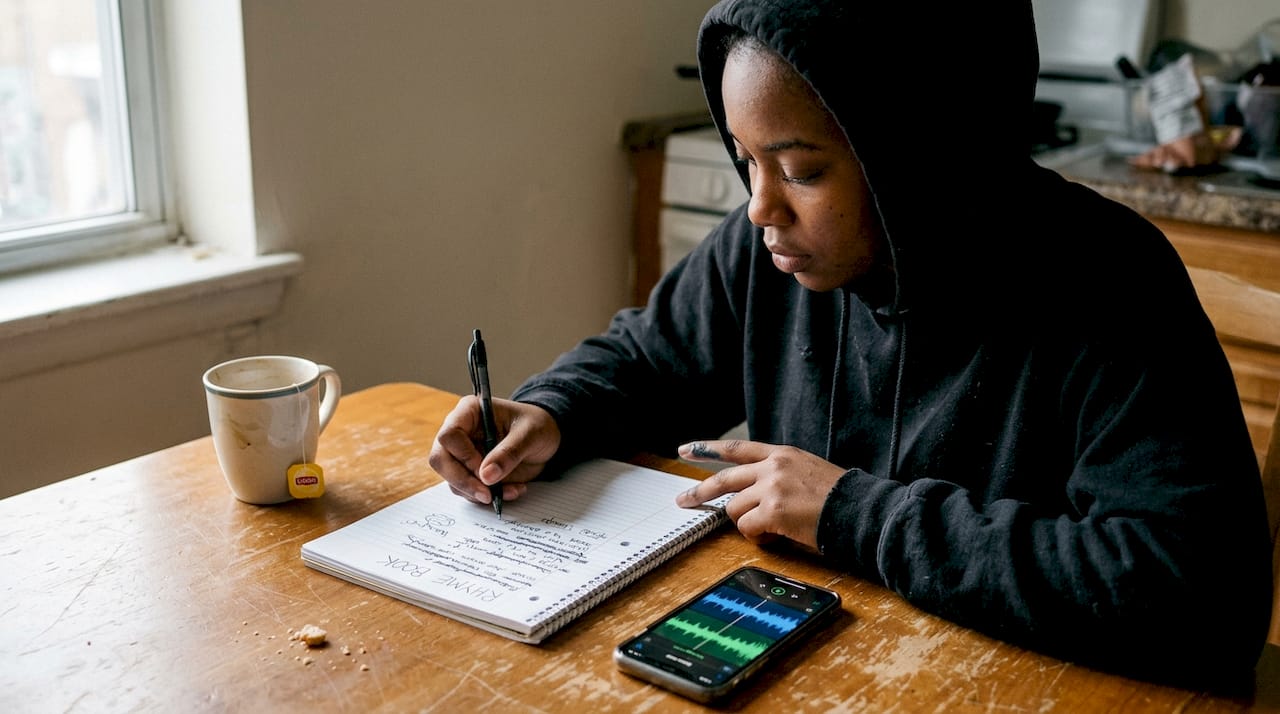
For rhyme schemes, start simple. The AABB pattern means the last word of line 1 rhymes with line 2, and line 3 rhymes with line 4. It’s predictable but effective for building confidence. Once you’re comfortable, push into ABAB patterns, then internal rhymes (rhymes inside the line, not just at the end), and eventually multisyllabic rhymes where multiple syllables match across lines.

Pro Tip: Read your lyrics out loud constantly. If you stumble on a line when speaking it, you’ll definitely stumble on it when rapping it over a beat.
Stat callout: Studies of top-charting rap songs show that tracks with strong metaphor use tend to generate significantly higher listener engagement and replay rates compared to purely literal lyrics.
Learning rhyme schemes in rap in depth will accelerate your technical growth faster than almost anything else. And if you want to see how these techniques play out at the highest level, analyzing masterful lyrics from classic tracks is one of the best study methods available.
Structure, revision, and rhythm: Shaping your verses
Great lines need to be shaped into a cohesive song. Let’s explore how to organize, edit, and polish your rap.
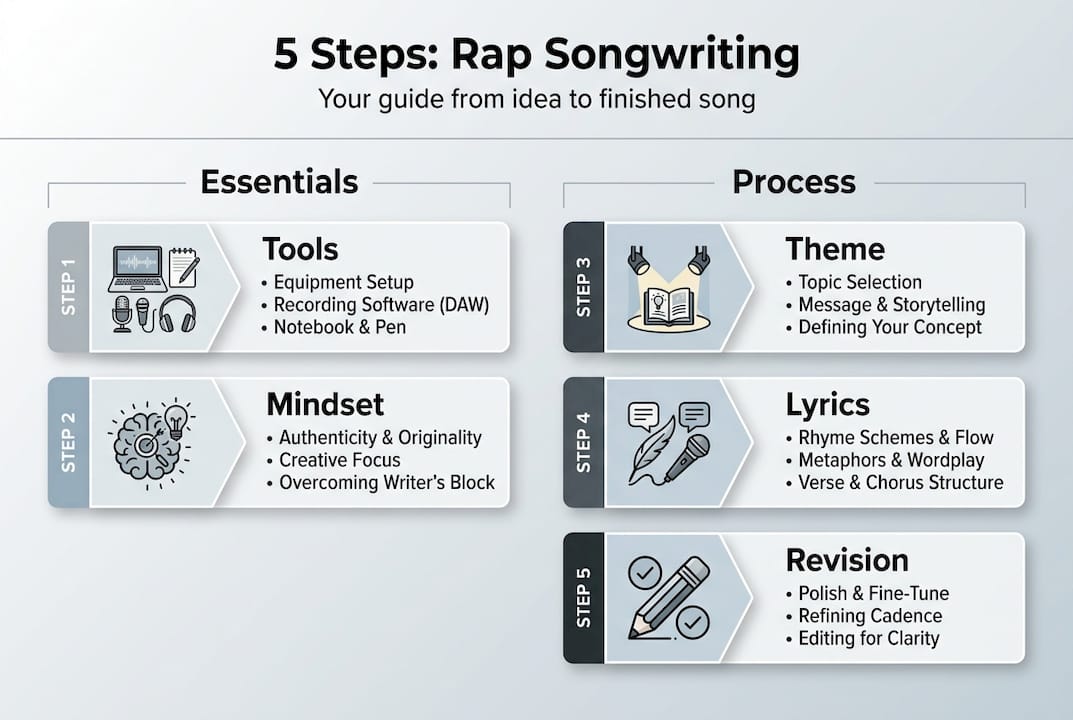
Most rap songs follow a clear structure. Understanding it gives you a framework to work within before you start breaking rules:
| Section | Length | Purpose |
|---|---|---|
| Intro | 4-8 bars | Set the tone and hook attention |
| Verse 1 | 16 bars | Introduce the story or theme |
| Hook/Chorus | 8 bars | Memorable, repeated emotional core |
| Verse 2 | 16 bars | Deepen the story or shift perspective |
| Bridge | 4-8 bars | Add contrast or emotional shift |
| Outro | 4-8 bars | Close the narrative |
One of the most debated questions in rap songwriting is whether to write to a beat or in silence. Some artists write only to beats, letting the rhythm dictate their flow and syllable count. Others write in silence first, focusing purely on the words and story before worrying about how it fits a beat. Both approaches are valid. Writing to a beat keeps your flow natural. Writing in silence often produces more complex, layered lyrics.
Here’s a simple revision process to follow after your first draft:
- Read every line and cut anything that feels filler or forced.
- Check that your rhymes land on the beat naturally when you rap them aloud.
- Look for lines where you can swap a generic word for a more specific, vivid one.
- Make sure the hook is the most memorable part. If it isn’t, rewrite it first.
- Record a rough version and listen back. Your ear will catch what your eyes miss.
Pro Tip: Let a draft sit for 24 hours before your final edit. Distance gives you a clearer perspective on what’s actually working.
For a full breakdown of how to practice these techniques in real time, the beginner rapping techniques guide on this site walks you through it step by step.
What most guides miss about rap songwriting
Most songwriting guides focus on the mechanics and stop there. They’ll tell you to use metaphors and structure your verses, but they skip the part that actually separates good rap from great rap.
Authenticity almost always beats technical skill. You can have perfect rhyme schemes and still write a forgettable song. What listeners remember is truth. They remember the line that felt like it was pulled from their own life.

Revision is also where the real magic happens. First drafts are supposed to be rough. The artists you admire didn’t drop a classic on the first try. They rewrote, recorded, scrapped, and rewrote again. Skipping revision is skipping the most important part of the process.
And here’s something almost nobody talks about: deep listening. Not just playing a song while you scroll, but sitting with rap narratives and studying why specific lines work. Most emerging artists skip this entirely. They listen for enjoyment but not for education. The artists who grow fastest are the ones who treat every great song like a masterclass.
The process is the point. Trust it.
Take your rap songwriting to the next level
You now have a clear roadmap from concept to finished song. But reading about technique and actually building it into your practice are two different things.

At stangrtheman.com, there are resources built specifically for artists at every stage of the writing process. If you’re just getting started, the rapping technique tutorial gives you a hands-on foundation for flow and delivery. For broader context on where your craft fits into the culture, the breakdown of elements of hip-hop culture is worth your time. And when you’re ready to share your music with the world, the music marketing for hip-hop guide will show you exactly how to get your songs in front of the right people.
Frequently asked questions
What tools do I need to start writing rap songs?
You need a notebook or phone to capture ideas, access to beats for practice, and inspiration drawn from your real life and studying legends. Eminem and Rakim’s technique are two of the best starting points for learning what great rap looks like on a technical level.
How important is authenticity in rap songwriting?
Authenticity is the single most important factor in writing rap that resonates. Content from real life consistently connects more deeply with listeners than fabricated narratives.
What rhyme scheme should beginners use?
Start with simple AABB rhyme patterns where every two lines rhyme, then gradually work toward multisyllabic and internal rhymes as your confidence grows.
Should I write lyrics to a beat or in silence?
Both methods work well depending on your goal. Writing to a beat helps you stay in rhythm naturally, while writing in silence lets you focus on developing more complex and layered lyrical ideas.
Recommended
- How to write rap lyrics that express your unique voice
- Step-by-step rapping technique tutorial for beginners
- Start a Rap Career in Canada 2026: 3-7% Growth Path
- Top types of rap styles every hip-hop fan should know
- Mastering checklist for artists: essential audio steps

No Comments