

What makes a great rapper: the hip-hop enthusiast’s guide
TL;DR:
- Great rappers balance technical skill with authentic persona, with a 70/30 ratio favoring mastery for longevity. Mastery involves lyricism, flow, storytelling, and stage presence, all of which must be practiced and cultivated consistently. Genuine emotional expression and adaptability are key to building a lasting legacy beyond technical ability or market hype.
Most people assume what makes a great rapper comes down to technical skill alone. Spit the fastest bars, stack the most complex rhymes, and the world crowns you. But spend any time studying the careers that actually last, and a more complicated picture emerges. The rappers who define eras are not just technically gifted. They carry a persona, tell stories that hit bone-deep, and perform with a presence that makes a room stop breathing. This guide breaks down every dimension of that equation so you know exactly what separates a great rapper from someone who simply raps well.

Table of Contents
- The essential balance: technical skill and persona in rap success
- Mastering the craft: lyrical complexity, flow, and storytelling
- Performance and delivery: bringing lyrics to life on stage
- The creative journey: flow development and emotional authenticity
- Evaluating greatness: criteria and practical tips for aspiring rappers
- Why the conventional wisdom on rapper greatness is backwards
- Explore hip-hop culture and master your craft with Stangr The Man
- Frequently asked questions
Key Takeaways
| Point | Details |
|---|---|
| Balance of skill and persona | Great rappers balance about 70% technical skill with 30% persona for longevity. |
| Technical elements matter | Lyrical complexity, flow, and storytelling structure are core to rap mastery. |
| Performance is vital | Stage presence and delivery heavily influence audience connection. |
| Creativity drives impact | Developing flow first and authentic emotion make verses memorable. |
| Greatness is multi-dimensional | Originality, content, and cultural influence also define a rapper’s legacy. |
The essential balance: technical skill and persona in rap success
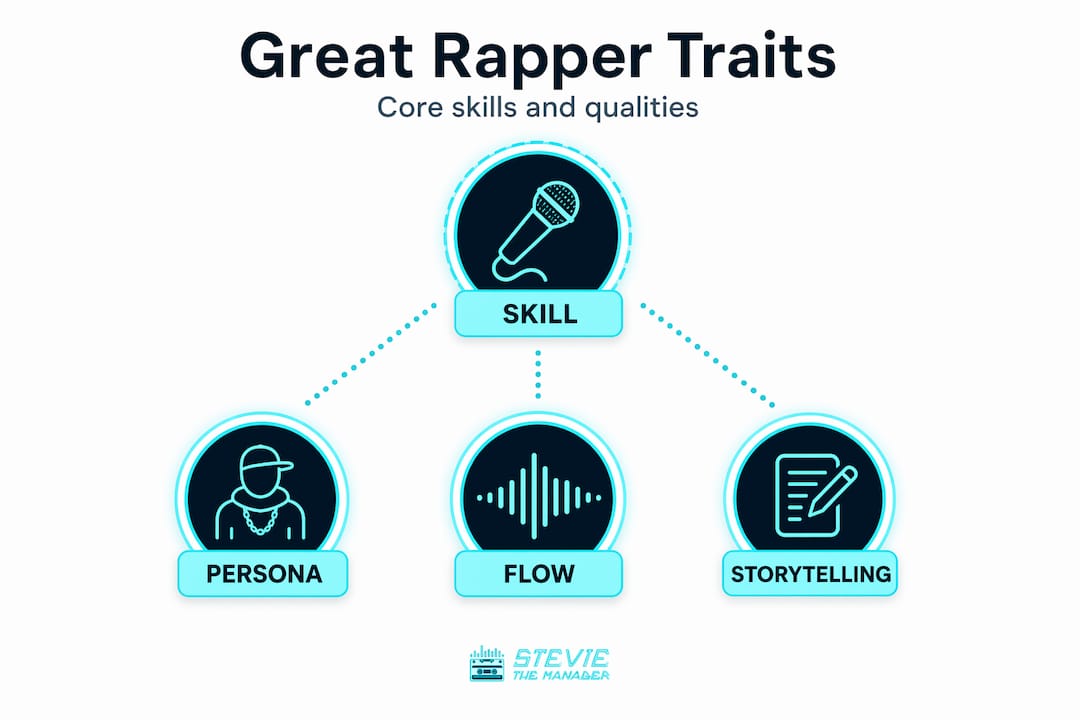
What makes a great rapper is not one thing. It is a ratio. And the data points toward a specific one.
Rappers with a 70/30 split between technical skill and personality achieve greater career longevity than those who balance both at 50/50. That finding matters because it reframes how you should think about developing as an artist. Technical mastery is not the whole game, but it is most of it. Persona amplifies what is already there. It cannot manufacture something that is not.
Think about what this looks like in practice. An artist can build a massive following on personality and image for a cycle or two. Crowds show up, streams climb, the buzz feels real. Then the next wave hits, and without the craft underneath, there is nothing to hold onto. The qualities of a good rapper that create longevity are rooted in skill first.
Key qualities that contribute to this balance include:
- Technical precision: Rhyme schemes, syllable placement, breath control
- Distinctive voice: Tone, cadence, and recognizable delivery
- Authentic persona: An image rooted in real experience rather than manufactured branding
- Cultural awareness: Understanding what the audience cares about and speaking to it honestly
Audiences are also getting better at detecting the difference. Listeners who have grown up on hip hop success lessons drawn from decades of genre evolution can spot spectacle without substance quickly. That audience fatigue is real, and it rewards artists who build on a genuine foundation.
Mastering the craft: lyrical complexity, flow, and storytelling
If technical skill forms the majority of the equation, then lyricism, flow, and storytelling are its three core pillars. Remove any one of them and the structure gets shaky.
Lyricism is not just about using big words or stacking multisyllabic rhymes. It is about saying something that matters in a way that feels inevitable. Complexity in rhyme technique, including internal rhymes, assonance, and double entendres, adds texture. But complexity without meaning is just noise.

Flow is where many aspiring rappers misread the skill. It is not about speed. Flow is rhythm and timing, the way syllables land on beats, the pause before a punchline, the acceleration into a hook. According to hip-hop songwriting standards, top hip-hop verses use 16-bar structures broken into two 8-bar sections for scene-setting, building tension, and resolution. That structure is not a constraint. It is architecture that forces discipline.
Storytelling is what elevates a track from a technical display into something a listener plays for a decade. Here is how elite rappers structure it:
- Establish the world in the opening bars. Ground the listener in a setting, emotion, or conflict.
- Build tension in the middle 8 bars. Introduce stakes, contradiction, or escalation.
- Deliver resolution in the final section. This does not always mean a happy ending. It means landing somewhere that feels earned.
- Layer callbacks. Reference earlier lines or images to reward listeners who are paying close attention.
- Leave space. Great storytellers know what not to say. Silence and implication do work that explicit lines cannot.
Elite rappers like Kendrick Lamar switch flows mid-track, maintaining listener engagement through unpredictable patterns. This is an advanced technique, but you can start practicing it by studying how a single song changes tempo and feel across its verses.
Pro Tip: Record yourself rapping over three different beats with completely different tempos this week. Do not try to force your usual flow onto each one. Let the beat teach you a new pocket. This is one of the most direct ways to improve rapping adaptability fast.
| Element | What it sounds like when it works | Common mistake |
|---|---|---|
| Lyricism | Layered meaning, images that stick | Chasing complexity over clarity |
| Flow | Rhythmic lock with the beat | Rushing syllables to sound fast |
| Storytelling | Verses with beginning, middle, end | Stringing bars without narrative arc |
For a deeper look at building these skills, the hip hop songwriting tips and rap flow rhyme schemes resources on Stangr The Man’s platform go further into the mechanics.
Performance and delivery: bringing lyrics to life on stage
You can write the best verse of the year and still lose the room if your delivery is wrong. This is one of the traits of top rappers that often gets overlooked in conversations about what defines a good rapper.
Performing skills comprised 65% of the curriculum while writing and lyricism made up 35%, according to rapper Mickey Factz, who described the training breakdown he received. That ratio should stop you cold. The institution teaching hip-hop professionally weighted stage craft higher than writing. That is not an accident.
What does strong delivery actually require?
- Audibility: Every word must land clearly. Mumbling as an aesthetic choice is different from losing words to poor mic technique or low breath support.
- Presence: Your body communicates as much as your bars. Eye contact, movement, and stillness all signal confidence or its absence.
- Mindset match: A mismatched mindset or tempo undermines even strong lyrics on stage. If the track is aggressive but your energy is flat, the disconnect is immediate.
- Adaptability: Live situations break. Beats skip, monitors fail, crowds go cold. Great performers absorb that chaos and keep going.
“Performing demands audibility, cool presence, and personality shine.” — Mickey Factz, via The Hip Hop Museum
Delivery is also what turns a good lyric into a quotable moment. The pause before the punchline. The drop in volume before something crucial. The way a voice breaks or hardens at exactly the right moment. These are not accidents in elite performances. They are learned techniques.

Pro Tip: Film yourself performing a full verse with no music. Watch it back with the sound off. If your body language alone does not tell a story or hold attention, that is your next area to develop. Check out this rapping technique tutorial to build on the fundamentals.
The creative journey: flow development and emotional authenticity
Here is something that surprises a lot of aspiring artists. The skills needed for rapping are not always developed in the order you might expect.
Jay-Z develops flow first before filling in lyrics, prioritizing the rhythmic foundation over the words themselves. He is not alone in this. Many elite rappers find their pocket in the beat before a single word is written. The groove comes before the message. This tells you something important about how flow actually functions. It is not a byproduct of lyrics. It is a primary creative element.
Emotional authenticity works the same way. Authentic emotion turns simple verses timeless because audiences detect sincerity in ways they cannot always articulate. A technically perfect verse delivered without genuine feeling lands flat. A simpler verse charged with real emotion sticks for years.
This is the part of the creative process most aspiring rappers underinvest in:
- Write from a real place. The specificity of real experience is what makes a verse feel universal.
- Let the beat influence your emotion. Do not just rap on the track. Respond to it.
- Revise for honesty. Read every line back and ask whether you actually mean it. Cut the bars you wrote to impress and keep the ones that are true.
- Embrace imperfection. Some of the most emotionally resonant deliveries have a raw, unpolished edge that precision would have erased.
The rap lyricism techniques resource on Stangr The Man’s platform explores how emotional themes and cultural context shape the most enduring verses in hip-hop history.
Evaluating greatness: criteria and practical tips for aspiring rappers
If you want to measure how a rapper stacks up, or where your own gaps are, you need a clear framework. Elite rappers like Kendrick Lamar, J. Cole, and Drake excel because of a blend of lyricism, flow, originality, content, and lasting cultural impact. No single one of those criteria defines the whole picture.
| Criteria | Why it matters | How to develop it |
|---|---|---|
| Lyricism | The intellectual backbone of a verse | Study poetry, expand vocabulary, write daily |
| Flow | Rhythmic connection to the beat | Practice freestyling over varied tempos |
| Originality | What separates you from everyone else | Avoid imitation, build from your life |
| Content | What you are actually saying | Read widely, live fully, write with intention |
| Cultural impact | Whether your work shifts the conversation | Engage with your community, be consistent |
Practical steps that directly address the elements of rap success include:
- Develop breath control. Singing teachers and vocal coaches are not just for singers. Breath management is fundamental to sustained delivery.
- Freestyle daily. Even five minutes of unscripted rapping builds the mental muscle for live adaptability and genuine flow.
- Study your influences critically. Do not just listen. Transcribe verses, identify rhyme schemes, and ask why a line works.
- Participate in rap events. Open mics, cyphers, and battles compress years of growth into a single night because the stakes are real.
- Network with intention. The rap world moves on relationships. Collaborate with producers, other emcees, and creatives who challenge you.
Pro Tip: Set a monthly self-evaluation using the five criteria in the table above. Rate yourself honestly on a scale of 1 to 10 in each category, then focus your next month’s practice on whichever score is lowest. This is how you elevate your bars systematically rather than randomly.

Why the conventional wisdom on rapper greatness is backwards
Here is what most conversations about rapper greatness get wrong. They treat technical skill and commercial success as the primary measuring sticks, then wonder why so many technically gifted rappers are forgotten within five years.
The real bedrock is something harder to quantify. Rap is an oral tradition where lyrical talent is foundational, but personas and authenticity shape the legacy that actually survives. Audience fatigue with spectacle over substance is growing, not shrinking. That means the market is slowly correcting toward artists who have something real to say.
What I have seen, watching this genre evolve across decades, is that the rappers who outlast their era are not always the most technically precise. They are the most honest. They found a way to tell their specific story so clearly that it became everyone’s story. That is not a formula you can copy. It is a discipline you build through consistent, honest creative work.
Adaptability matters more than most people admit. The artists who stay relevant are the ones who evolve without losing their core identity. That requires knowing who you are deeply enough that you can change your sound without losing your voice. It is the opposite of chasing trends. Trends are a signal about where the audience is. Great rappers use that signal to find new ways to say what they have always been saying.
The classic hip hop lessons embedded in the genre’s history show this pattern repeatedly. Artists who built on a real foundation kept building. Artists who built on hype had to start over every cycle.
Explore hip-hop culture and master your craft with Stangr The Man
If this breakdown sparked something in you, the platform behind it goes much deeper. Stangr The Man (Stevie The Manager), a Vancouver, BC rapper and founder of Lit Nightz Records, has built a resource hub for artists who want more than surface-level advice.

Start with hip hop culture origins and impact to ground your artistry in the tradition you are building on. Then sharpen the technical side with hip hop songwriting tips that go beyond the basics into real craft. And when you are ready to grow your audience, the music marketing workflow for hip-hop artists in 2026 gives you a step-by-step framework built for how the industry actually moves today. Harnessing knowledge and resources like these will power your growth as a rapper and deepen your connection with hip-hop culture.
Frequently asked questions
What balance between technical skill and persona leads to a successful rap career?
A 70/30 split favoring technical skill over persona has been linked to greater career longevity compared to an even 50/50 balance, suggesting craft should always be the primary investment.

How important is flow compared to lyricism for a great rapper?
Both are non-negotiable. Flow shapes how lyrics interact with the beat rhythmically, while lyricism delivers the content, and elite rappers switch flows mid-track to keep both elements dynamic and engaging.
Can emotional authenticity make simple rap verses successful?
Absolutely. Authentic emotion makes verses timeless because listeners connect with sincerity in ways that technical complexity alone cannot manufacture.
What role does stage presence play in becoming a great rapper?
Stage presence is essential and not secondary to writing. Performing skills comprised 65% of professional rapper training in one documented curriculum, reflecting how much delivery and presence shape whether a rapper’s message actually lands.
How do great rappers typically start their songwriting process?
Many start with rhythm rather than words. Jay-Z develops flow first before writing lyrics, which shows that getting into the pocket of a beat is often more important than having something to say before you start.
Recommended
- Essential elements of a rap album: lyrics to legacy
- Hip-hop songwriting: 7 tips to elevate your bars
- Rap Battles: A Deep Dive into the Culture and Techniques Behind the Mic – Stevie The Manager aka Stangr The Man
- Rap collaboration types: styles, impact & Canadian roots

No Comments