

The true role of managers in rap careers
TL;DR:
- A rap manager acts as a CEO, therapist, and negotiator, crucial to career growth.
- Successful management involves long-term strategy, trust, and adapting to industry shifts.
- Great managers are silent force multipliers shaping rap’s future culture and careers.
Most people think a rap manager books shows, takes calls, and cashes a percentage check. That’s it. But anyone who has watched Paul Rosenberg turn a raw, Detroit rapper named Eminem into a global empire knows the truth is far more complicated and far more powerful. The manager behind a successful rap artist is often the invisible engine driving every major decision, from creative direction to crisis control. This article breaks down the real work, the real strategies, and the real stories that show exactly what great management looks like in hip-hop.

Table of Contents
- What does a manager do in rap?
- Legendary managers in rap: Case studies
- How management styles shape rap careers
- Money, partnership, and evolving deals: The commission debate
- Winning strategies: Lessons for artists and managers
- Perspective: Why good management is hip-hop’s silent multiplier
- Take control of your career with the right management
- Frequently asked questions
Key Takeaways
| Point | Details |
|---|---|
| Multifaceted manager roles | Rap managers oversee artist strategy, branding, business moves, and relationship building. |
| Case studies matter | Real-world stories like Eminem and Macklemore reveal how great managers shape careers. |
| Management style impacts results | A manager’s approach can determine the artist’s growth path and industry influence. |
| Commissions are flexible | Manager-artist deals evolve, often starting at 20% but adjusting as careers develop. |
| Trust is key | Lasting success in rap requires open, adaptable partnerships between artists and managers. |
What does a manager do in rap?
The easiest misconception to kill is that a rap manager is just a middleman with a phone. In reality, the role is closer to a CEO, a therapist, a publicist, and a negotiator all rolled into one. Understanding the music manager essentials specific to hip-hop helps clarify why this job demands a completely different skill set than managing, say, a pop singer or a rock band.
Rap has a unique cultural framework. Artists often come from backgrounds where trust is rare and contracts feel like traps. A manager who cannot connect personally, who cannot prove loyalty before a deal is even on the table, will not last. Good managers need passion, industry knowledge, leadership, trust-building, and the ability to multitask across roles, functioning simultaneously as CEO, coach, and family. In rap especially, that family dynamic is not just a metaphor. It is the foundation.
Here are the core duties a rap manager handles daily:
- Career strategy and long-term vision: Deciding which deals to chase, which to reject, and which doors to knock on before they open
- Label and tour negotiations: Structuring contracts that protect the artist’s masters, publishing rights, and creative control
- Brand-building: Shaping the artist’s public image through media, collaborations, merchandise, and social media presence
- Crisis management: Handling public controversies, legal issues, or internal team conflicts before they spiral
- Team coordination: Managing booking agents, publicists, lawyers, and producers to keep everyone pulling in the same direction
“The best managers I’ve ever seen don’t wait for problems to become fires. They read smoke.” — industry sentiment shared by multiple veteran artist managers
Pro Tip: Chemistry matters as much as credentials. Before signing with any manager, spend real time with them in stressful situations. How someone handles a bad day tells you more than any pitch deck.
Legendary managers in rap: Case studies
Now that we’ve mapped the responsibilities, let’s meet managers who turned these ideas into real-life victories.
Two names come up repeatedly when hip-hop historians talk about transformational management: Paul Rosenberg and Zach Quillen. Their approaches could not be more different, yet both reshaped the careers of their artists and left marks on the culture that still resonate today.

Paul Rosenberg managed Eminem since 1997), founded Goliath Artists, co-founded Shady Records, signed artists like 50 Cent, and eventually led Def Jam as its president. That is not a career summary. That is a blueprint for what happens when a manager becomes a genuine long-term partner. Rosenberg did not just handle logistics. He shaped the narrative around one of the most controversial, commercially dominant artists in music history. He helped position Eminem not just as a rapper but as a cultural event. When the media tried to tear Eminem apart, Rosenberg was the steady hand navigating the storm. When the industry tried to box Em into a corner, Rosenberg helped him build his own house.

Zach Quillen took a completely different road. He managed Macklemore and Ryan Lewis from 2010, focused on a sold-out touring strategy, leveraged social media and YouTube exposure, and partnered with Warner/ADA without signing a full traditional label deal. The result was platinum success built from the ground up, without surrendering creative or financial control. Quillen proved that in the streaming and social media era, a smart independent strategy with relentless touring buzz could compete directly with major label machine power.
| Category | Paul Rosenberg | Zach Quillen |
|---|---|---|
| Core strategy | Long-term empire building | Independent touring and digital growth |
| Label approach | Built and led major labels | Partnered without full label deal |
| Artist development | Deep narrative shaping | Fan-direct engagement and live buzz |
| Breakthrough moment | Eminem’s The Slim Shady LP (1999) | Macklemore’s The Heist (2012) |
| Legacy impact | Built Shady Records, shaped rap’s mainstream | Proved indie artists can win platinum |
“Two managers, two completely different roads, same destination: career-defining, genre-shaping success.”
Both case studies connect directly to how you think about album release strategies and the broader question of how managers shape creative output alongside business outcomes. It is also worth noting that strong management partnerships are not limited by gender or background. Studying female artist-manager partnerships in rap reveals equally powerful examples of strategy, loyalty, and vision driving careers forward.
How management styles shape rap careers
Learning from the greats, let’s compare how different manager strategies lead artists to success along different paths.
The two dominant management philosophies in rap today are the CEO model and the Tour/Indie-first approach. Neither is universally superior. What matters is alignment between manager style and artist goals.
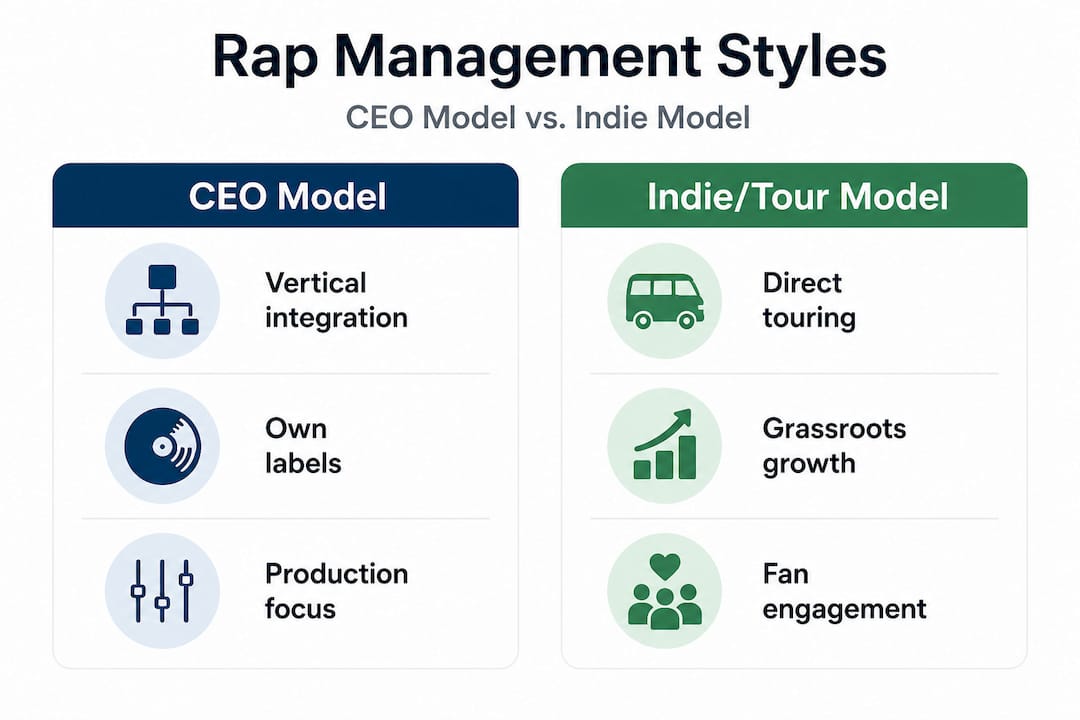
The CEO model focuses on vertical integration. The manager builds around the artist by creating labels, production companies, and brand partnerships that generate revenue streams beyond music. Rosenberg exemplifies this. The long-term partnership model) turns underground talent into global empires through labels and signings, which means the manager is constantly thinking five years ahead, not just the next release.
The Tour/Indie-first approach prioritizes fan ownership and live revenue. Independent success stories like Macklemore highlight how managers can bootstrap success through touring buzz and digital platforms without relying on major label funding or approval.

Here are the key results each style tends to produce:
- CEO model results: Major label partnership opportunities, broader artist signings, publishing company formation, increased brand licensing potential, and mainstream media access
- Tour/Indie-first results: Strong direct-to-fan relationships, touring revenue independence, higher percentage ownership of masters, and greater creative flexibility
- Hybrid approach results: Access to distribution and promotion infrastructure while maintaining profit splits more favorable to the artist
- Long-term flexibility: Managers who document early decisions carefully give artists more options to switch models as their career scales
Keeping up with trends in rap management matters here because the industry in 2026 has shifted dramatically. Playlist pitching, short-form video strategy, and direct social monetization have created entirely new lanes that managers must understand and navigate.
Pro Tip: Early decisions about management style can permanently shape which doors open and which close. If you sign into a CEO model deal at 19, renegotiating for indie flexibility at 25 can cost you years of legal and financial headaches. Know your long-term goals before you commit.
Money, partnership, and evolving deals: The commission debate
With management style chosen, the practical reality of money comes next. Let’s break down how partnership deals actually work in rap.
The standard starting commission in rap management is around 20%. But that number without context is almost meaningless. The real questions are: 20% of what? Gross income or net? Does it include touring? Does it cover merch? What about advances, sync licensing deals, or brand partnerships that existed before the manager came on board?
Here is what most solid management contracts address:
- Included in commission: New recording deals, touring income generated during the management term, new brand partnerships, merchandise lines developed under management
- Excluded or negotiated: Pre-existing income streams, personal appearance fees below a certain threshold, income from businesses the artist owned before signing
- Sunset clauses: Provisions that allow the artist to reduce commission percentages on deals the manager closed, even after the management relationship ends
- Sliding scale structures: Commission rates that decrease as an artist’s gross income crosses certain thresholds, rewarding growth while protecting the artist’s earnings
“A 20% commission is justified early on when a manager is investing time, energy, and relationships into an unproven artist. But as scale increases, sliding scales and clear net-versus-gross definitions become essential. Partnerships that do not evolve with the artist eventually break.”
The trust question is just as important as the contract language. A manager who fights aggressively for every clause but has no personal loyalty to the artist’s vision will still underdeliver. Great music marketing deals require managers who can negotiate hard and still keep the creative partnership intact, which means both sides need to communicate openly even when the numbers are uncomfortable.
Winning strategies: Lessons for artists and managers
Having unpacked the business, here’s how to translate these lessons into your own strategy.

Whether you are an artist looking for management or someone considering stepping into the manager role, the principles that separate good partnerships from bad ones are consistent across career levels and music styles.
Follow these steps to build a productive manager-artist relationship:
- Define your goals before the search: Know whether you want indie freedom, major label access, or hybrid positioning before you sit down with any potential manager
- Vet trust, not just credentials: Look for managers who have handled adversity well, not just success. Ask how they have dealt with a deal falling through or an artist controversy
- Establish communication norms early: Agree on how often you will meet, what decisions require mutual approval, and how disputes will be resolved before any contract is signed
- Measure effectiveness with clear benchmarks: Set specific milestones such as booking a certain number of shows, securing a distribution deal, or growing social following by a target percentage within a defined period
- Revisit the partnership regularly: Schedule formal check-ins every six months to discuss whether the manager’s approach still fits the artist’s current career stage
The pitfalls that kill most artist-manager relationships fall into three categories: one-size-fits-all deal structures that ignore the artist’s specific needs, managers who miss emerging opportunities because they are locked into old-school thinking, and a breakdown in communication that turns small disagreements into contract disputes.
Good managers bring passion, industry knowledge, leadership, and a genuine willingness to grow alongside the artist. Without that foundation, even the most strategically sound management plan will eventually crack.
Understanding the nuances of album rollout insights helps both managers and artists understand how planning, timing, and strategic release windows can maximize every drop and keep fan engagement building consistently.
Pro Tip: A great manager is only as effective as the trust and openness on both sides. Even the best strategy fails if the artist is hiding key information or the manager is not being honest about what is and is not working.
Perspective: Why good management is hip-hop’s silent multiplier
Here is the reality check most people skip over entirely.
The public conversation around rap success almost always focuses on the hit record, the viral moment, the award, or the controversy. What it rarely focuses on is the person in the room at 2 AM renegotiating a touring contract, or the manager who recognized that a specific partnership would actually limit an artist’s long-term brand before anyone else even saw the danger.
Good management in hip-hop is a multiplier. Every win gets bigger when the person managing those wins has the strategic vision to maximize them and the relationships to open the next door. Every setback gets smaller when the manager absorbs the chaos, buffers the artist from unnecessary noise, and keeps the long-term plan on track.
What most industry watchers miss is that the future of rap is being shaped right now not just by producers or A&Rs but by managers who understand culture, community, and the new digital economics of music simultaneously. The strongest managers are seldom in the spotlight. But their ripple effect shapes careers, sounds, and sometimes entire chapters of hip-hop history.

The artists who build lasting legacies almost always have one thing in common. Behind them is a manager who was willing to play the long game without needing public credit for it. That kind of strategic patience and selfless partnership is genuinely rare, and it is the real reason certain careers break through while others plateau.
Take control of your career with the right management
Managers can genuinely change everything, and having access to the right information makes those partnerships even more powerful from the start.
Whether you are an artist trying to identify what to look for in a manager, or someone building their own management practice in hip-hop, the resources available at Stangr The Man’s platform offer direct, experience-grounded guidance. You can start with the deep dive on manager roles to understand the full scope of what effective management looks like in modern rap. From there, the launch plan for albums walks through the exact promotional steps that managers and artists can use together to maximize every release. And if you want to understand the bigger picture of where the industry is heading, the guide on how to promote rap music in 2026 covers the tools and strategies that matter most right now.
Frequently asked questions
What are the top qualities of a successful rap manager?
Great rap managers combine passion, industry smarts, trust-building, leadership, and the ability to juggle many roles. According to Berklee’s breakdown of what makes a good artist manager, they essentially function as CEO, coach, and family member all at once.
Do all rap managers take 20% commissions?
Commissions often start at 20%, but many managers use sliding scales or negotiate different terms as artists grow. The debate around commission structures highlights why net versus gross distinctions and sunset clauses matter enormously as career scale increases.
How do independent rap artists manage without major label deals?
Many succeed by focusing on touring, social media, and creative release strategies with managers guiding their growth. Zach Quillen’s approach with Macklemore and Ryan Lewis is the clearest proof that platinum success does not require surrendering to a traditional label structure.
Are managers really that important in shaping rap music’s culture?
Yes, strong managers enable artists to move from underground buzz to mainstream influence and even build movement-defining labels. Paul Rosenberg’s career shows how a long-term management partnership) can turn underground talent into a global empire through labels, signings, and strategic positioning.
Recommended
- The music manager’s role: essential guide for hip-hop artists
- Top 10 Best Rap Collaborations: When Legends Unite for Iconic Tracks – Stevie The Manager aka Stangr The Man
- What is rap marketing? Strategies, tactics, and wins
- What is rap news? 33% boost for Canadian hip-hop fans

No Comments