
Wu-Tang Clan’s Influence on Hip Hop: The Full Legacy
TL;DR:
- Wu-Tang Clan revolutionized hip-hop with their decentralized business model, allowing members to pursue solo careers under a unified brand. Their cinematic production style, mythological storytelling, and cultural synthesis created a lasting legacy that influences artists and industries today. Recognized by the 2025 Rock and Roll Hall of Fame, they remain a blueprint for artistic independence and cultural innovation.
Wu-Tang Clan is defined as the most structurally innovative collective in hip-hop history, reshaping the genre’s sound, business practices, and cultural identity from a single Staten Island project starting in 1992. The wu tang clan influence on hip hop extends far beyond music. RZA, GZA, Method Man, Raekwon, Ghostface Killah, Ol’ Dirty Bastard, Inspectah Deck, U-God, and Masta Killa built a federated empire that rewrote how artists own their work, tell their stories, and engage with global culture. Their debut album, Enter The Wu-Tang (36 Chambers), dropped in 1993 and immediately signaled that hip-hop had entered a new era. As of 2026, their legacy is not nostalgia. It is a living blueprint.

How did Wu-Tang Clan’s influence on hip hop change the business of rap?

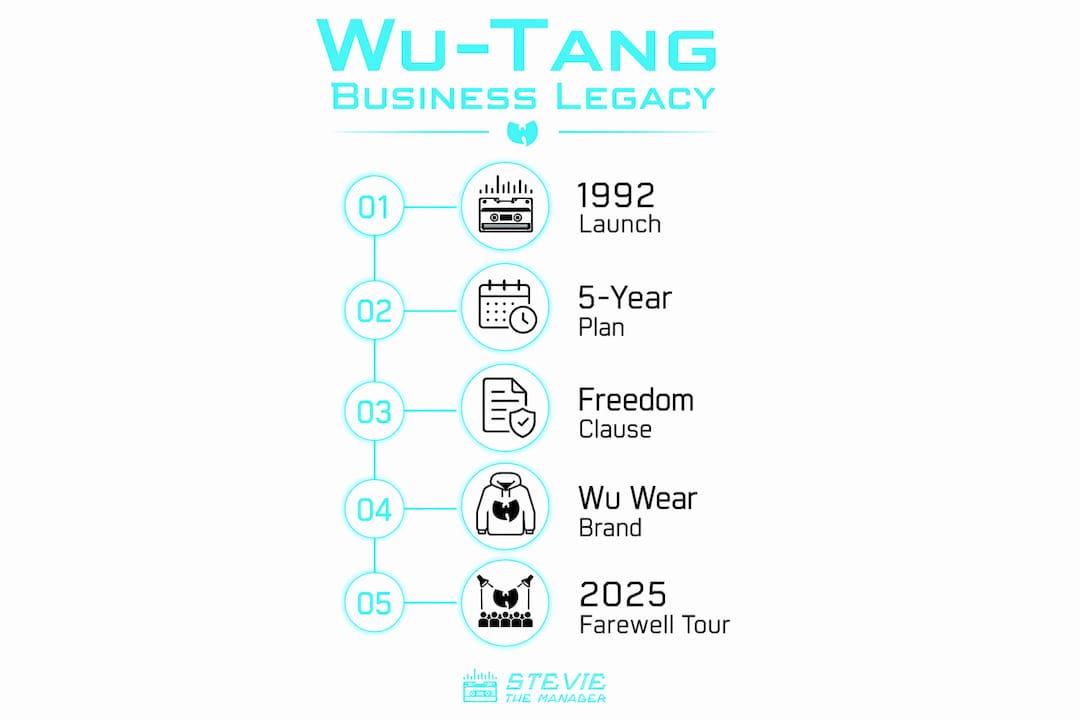
Wu-Tang’s most disruptive contribution was not a song. It was a contract structure. Formed in 1992, the collective pioneered a decentralized model where nine members each signed solo deals with competing labels while maintaining a unified group identity. No hip-hop collective had done this before. The model treated Wu-Tang as a brand and each member as a franchise.
RZA engineered this through what became known as the 5-year plan. He accepted roughly $60,000 in advances rather than chasing large label payouts, trading short-term cash for long-term control over masters and licensing rights. That decision, which most industry insiders at the time considered reckless, gave Wu-Tang ownership leverage that artists today still fight to achieve. RZA also retained a veto over artistic content, beat selection, verse sequencing, and label assignments for the group’s first five years, functioning as what scholars now call a voluntary dictatorship within a democratic collective.
The business architecture included a Freedom of Movement clause that allowed each member to sign with any label independently. Method Man went to Def Jam. Raekwon signed with Loud Records. Ghostface Killah worked with Epic. Yet every solo release carried Wu-Tang’s sonic fingerprint and brand equity, feeding back into the collective’s cultural dominance. This federated model is now standard practice across hip-hop, from Odd Future to YSL Records.
Merchandising followed the same logic. Wu Wear, the group’s fashion brand, generated $25 million annually at its peak, making the Wu-Tang logo a cultural symbol comparable in recognition to Nike’s Swoosh. The brand extended into film, television, and licensing deals years before most artists understood that music was just one revenue stream.
Pro Tip: If you study Wu-Tang’s business model, focus on the Freedom of Movement clause. That single contractual innovation gave each member the ability to build a solo career without diluting the group’s brand, a structure that artists like Kendrick Lamar and J. Cole have replicated in spirit if not in exact form.
The commercial proof of their model’s durability arrived in 2025. Their farewell tour grossed $30.6 million across 27 shows, averaging $1.2 million per performance. That figure places them alongside legacy rock acts in terms of live draw, a remarkable achievement for a rap group that formed in a Staten Island housing project over three decades ago.
| Business innovation | Impact on hip-hop |
|---|---|
| Decentralized solo contracts | Allowed members to build individual careers without leaving the collective |
| RZA’s 5-year artistic veto | Maintained brand cohesion across nine distinct personalities |
| Freedom of Movement clause | Created the federated artist model now standard across rap collectives |
| Wu Wear merchandise brand | Proved hip-hop artists could build fashion empires independent of music sales |
| Master and licensing retention | Established artist ownership as a negotiating priority in rap deals |
What makes Wu-Tang Clan’s sound and lyricism distinctive?
RZA’s production style is the sonic foundation of Wu-Tang’s identity. He built beats from raw, unprocessed drums, minimal loops, and a lo-fi aesthetic that felt deliberately rough against the polished R&B-influenced production dominating early 1990s rap. The grit was intentional. RZA wanted the music to sound like it came from the streets of Staten Island, not a corporate studio.

The most distinctive production choice was the integration of kung fu film samples. RZA pulled dialogue and sound effects from Shaw Brothers films and other Asian action cinema, weaving them into intros, outros, and transitions. This gave Wu-Tang albums a cinematic structure that no other rap group had attempted at scale. Listening to Enter The Wu-Tang (36 Chambers) feels less like a playlist and more like a film score for a street mythology.
“Wu-Tang is for the children.” That line from Ol’ Dirty Bastard at the 1998 Grammy Awards captured something real about the group’s ethos: their music was built to last, to teach, and to resonate across generations.
Lyrically, Wu-Tang members treated rhyming as weaponized wordplay rooted in martial arts philosophy. The sword became a metaphor for the tongue. Verses were structured as battles, with each MC bringing a distinct fighting style to the same track. GZA’s precision on Liquid Swords (1995) contrasted with Ol’ Dirty Bastard’s chaotic unpredictability, yet both felt like expressions of the same school.
Raekwon’s Only Built 4 Cuban Linx… (1995) pushed the lyrical framework further, popularizing mafioso rap and influencing artists including Nas, Mobb Deep, and Jay-Z for more than five years after its release. That album proved Wu-Tang’s sonic universe could expand into subgenres without losing its core identity. The Wu-Tang sound was a philosophy, not a formula.
- RZA’s lo-fi drum programming created a template for gritty East Coast production
- Kung fu film samples introduced cinematic structure to hip-hop albums
- Lyrical themes blended street realism with mythological storytelling
- Each member’s distinct voice created internal contrast that strengthened the collective
- Albums like Liquid Swords and Only Built 4 Cuban Linx… expanded the Wu-Tang universe into standalone classics
How did Wu-Tang reshape hip-hop identity and cultural storytelling?
Wu-Tang’s cultural synthesis is the part of their legacy that scholars most frequently underestimate. The group did not simply borrow from Asian martial arts cinema. They built a complete mythology that fused Black urban experience with Eastern philosophy, Five Percent Nation theology, and cinematic narrative structure. Staten Island became “Shaolin.” Each member took a Wu-Tang name rooted in martial arts tradition. The geography of New York City was remapped as a spiritual battleground.
This mythologizing served a specific purpose. By elevating gang life and street struggle to the level of legend, Wu-Tang gave their community a narrative framework that was both honest about hardship and expansive in its ambition. The Five Percent Nation’s teachings, which emphasize Black self-knowledge and the idea that the righteous few carry wisdom for the masses, ran through their lyrics as a consistent philosophical thread.
- Wu-Tang renamed Staten Island as “Shaolin,” creating a mythological geography rooted in their community
- Five Percent Nation philosophy provided a theological framework for their lyrical content
- Kung fu archetypes gave each member a distinct identity within a shared narrative universe
- Street realism and epic mythology were layered together rather than treated as opposites
- Internal slang and coded language created a tribal oral tradition that fans had to learn to fully access
Wu-Tang also mainstreamed Asian action cinema into American pop culture at a moment when those films were largely dismissed as B-movie entertainment. Directors like Quentin Tarantino and RZA himself later cited this cultural bridge as significant. The group’s 2025 live shows continued this tradition, structured as cinematic experiences with martial arts themes, intermissions, and promotional trailers integrated into the performance itself.

Pro Tip: To fully understand Wu-Tang’s cultural storytelling, listen to the interludes and skits on their albums alongside the tracks. The kung fu dialogue samples are not decoration. They are the connective tissue of the mythology RZA was constructing.
The cross-cultural synthesis Wu-Tang pioneered directly influenced subsequent artists. Kendrick Lamar’s use of Compton as a mythological space in To Pimp a Butterfly and DAMN. follows the same narrative logic. Tyler, the Creator’s Odd Future collective borrowed Wu-Tang’s federated model and internal mythology. The template Wu-Tang created in 1993 remains the most copied structure in hip-hop storytelling.
What is Wu-Tang Clan’s legacy in modern hip-hop and culture?
Wu-Tang’s induction into the Rock and Roll Hall of Fame in 2025 marks a formal institutional acknowledgment of what hip-hop scholars have argued for decades. The group’s foundational role in American music history is now recognized at the same level as Elvis Presley, The Beatles, and Aretha Franklin. That recognition reflects a broader shift in how American cultural institutions treat hip-hop, moving from tolerance to canonization.
The practical legacy runs deeper than awards. Every major hip-hop collective formed after 1993 operates on some version of Wu-Tang’s federated model. Odd Future, ASAP Mob, and YSL Records all allow members to pursue solo careers under a shared brand umbrella. The decentralized collective structure Wu-Tang invented is now the industry standard for group acts in rap.
| Wu-Tang innovation | Modern equivalent |
|---|---|
| Federated solo contracts | ASAP Mob, Odd Future, YSL Records |
| Cinematic album structure | Kendrick Lamar’s To Pimp a Butterfly, Beyoncé’s Lemonade |
| Artist-owned masters | Jay-Z’s Tidal, Chance the Rapper’s independent releases |
| Merchandise as primary brand | Travis Scott’s Cactus Jack, Supreme collaborations |
| Cross-cultural mythology | Kendrick Lamar’s Compton narratives, J. Cole’s Dreamville universe |
Wu-Tang’s influence on fashion, film, and media extends the legacy beyond music. Wu Wear predated the streetwear explosion by a decade. RZA’s film scoring work, including Ghost Dog: The Way of the Samurai and The Man with the Iron Fists, carried the group’s cinematic philosophy into Hollywood. The 2019 Hulu series Wu-Tang: An American Saga introduced their story to a generation that was not alive when 36 Chambers dropped.
The group’s ability to remain culturally relevant across three decades is itself a lesson in brand architecture. Wu-Tang built something that transcends any individual member’s career. That is the rarest achievement in hip-hop, and it did not happen by accident.
Key takeaways
Wu-Tang Clan’s influence on hip hop is total: they transformed the genre’s business model, production aesthetics, lyrical philosophy, and cultural mythology simultaneously, creating a blueprint that every major collective since has followed.
| Point | Details |
|---|---|
| Business model innovation | Wu-Tang’s federated solo contract structure became the standard for hip-hop collectives. |
| Artistic control strategy | RZA’s 5-year veto plan proved that sacrificing advances for ownership creates long-term power. |
| Cultural synthesis | Blending Black urban experience with Eastern philosophy created a mythology that still resonates. |
| Sonic identity | Lo-fi production and kung fu samples gave hip-hop a cinematic structure it had never had before. |
| Enduring legacy | The 2025 Rock and Roll Hall of Fame induction and $30.6 million farewell tour confirm their permanent place in American music history. |
Why Wu-Tang’s model still teaches me something new every year
I have been studying hip-hop culture for a long time, and Wu-Tang Clan remains the group I return to most often when I want to understand how art and business can reinforce each other without either one compromising the other. Most artists treat those two things as opposites. RZA proved they are not.

What strikes me most in 2026 is how far ahead of their time the Freedom of Movement clause actually was. We talk about artist ownership and independence as if these are new ideas born from streaming platforms and social media. Wu-Tang was negotiating those principles in 1992, before the internet existed as a commercial force. That is not just impressive. It is visionary in a way that most music industry commentary still fails to fully credit.
The cultural storytelling dimension is equally undervalued. Wu-Tang did not just rap about their neighborhood. They transformed it into a mythological universe with its own language, philosophy, and geography. That level of world-building is what separates artists who last from artists who trend. Emerging rappers who want longevity should study 36 Chambers not just as a rap album but as a masterclass in narrative architecture. The Rock Hall induction finally gives that work the institutional weight it deserves, but the real curriculum has always been in the music itself.
— Stephanos G
Explore more hip-hop history and culture at Lit Nightz News

Wu-Tang Clan’s story is one chapter in a much larger history that shaped American music and global culture. At Lit Nightz News, we go deep on the origins, elements, and lasting impact of hip-hop culture with the same level of detail and respect the genre deserves. Whether you want to understand the full arc of 90s hip-hop’s golden era or explore why hip-hop became the most influential music movement of the 20th century, the resources are here. Stevie The Manager and the Lit Nightz News team cover hip-hop history, artist strategy, and culture with the authority of people who live it. Dig in and keep learning.
FAQ
How did Wu-Tang Clan change hip-hop’s business model?
Wu-Tang pioneered a decentralized collective structure where nine members signed individual solo deals with competing labels while maintaining a unified group brand. RZA’s 5-year plan, which traded large advances for master ownership and licensing control, became the foundational blueprint for artist independence in hip-hop.
What albums define Wu-Tang Clan’s musical legacy?
Enter The Wu-Tang (36 Chambers) (1993) established their sound, while solo albums including GZA’s Liquid Swords and Raekwon’s Only Built 4 Cuban Linx… (both 1995) expanded the Wu-Tang universe into standalone classics that influenced rap for decades.
Why was Wu-Tang Clan inducted into the Rock and Roll Hall of Fame?
Wu-Tang received their Rock Hall induction in 2025 in recognition of their foundational role in American music history, reflecting a broader institutional shift toward canonizing hip-hop collectives alongside rock and pop legends.
How did Wu-Tang Clan influence hip-hop storytelling?
Wu-Tang fused Black urban experience with Five Percent Nation philosophy and Asian martial arts mythology, renaming Staten Island as “Shaolin” and building a complete narrative universe. That mythologizing approach directly influenced artists like Kendrick Lamar and Tyler, the Creator in how they construct place-based storytelling.

What is Wu-Tang Clan’s cultural impact beyond music?
Wu-Tang mainstreamed Asian action cinema into American pop culture, built Wu Wear into a $25 million annual merchandise brand, and pioneered cinematic concert formats that modern hip-hop touring still follows. Their influence spans fashion, film, and cultural identity well beyond the music itself.
Recommended
- Top 7 Influential 90s Rap Groups You Should Know – Stevie The Manager aka Stangr The Man
- Microphone Legends: The Essential List of Classic Hip Hop Albums and What Earns Them Immortal Status – Stevie The Manager aka Stangr The Man
- Legendary: Wu-Tang Clan Induction Into Billboard’s Hip-Hop Hall of Fame – Stevie The Manager aka Stangr The Man
- Wu-Tang Clan’s Rock Hall Induction: Why It Matters

No Comments