

What Is Resilience in Rap: Culture, Mind, and Music
TL;DR:
- Resilience in rap is a psychological process of transforming adversity into empowering artistic expression through structured stages. It serves as both cultural memory and resistance, helping artists and communities overcome systemic hardships and find meaning. Most importantly, resilience in rap emphasizes ongoing growth, authenticity, and community support as keys to lasting emotional strength.
Resilience in rap is defined as the active process of negotiating, managing, and adapting to significant stress or trauma, then channeling that experience into meaningful artistic expression. This is not a fixed personality trait. It is a trainable psychological process that artists build through repeated cycles of emotional recognition and creative output. Hip-hop has carried this process at its core since the genre’s earliest days in the South Bronx. Lit Nightz News covers this intersection of culture and psychology because understanding it changes how you hear every bar, every hook, and every album that came out of struggle.

What is resilience in rap, and why does it matter?
Resilience in rap is measured by an artist’s ability to overcome documented adversity and convert it into output that connects with listeners. The definition of resilience in rap goes beyond simple toughness. It includes personal hardship, career rejection, systemic inequality, and community trauma, all processed through lyrical storytelling.
The importance of resilience in rap cannot be overstated. Rap is one of the few art forms where the artist’s survival story is the product itself. Listeners do not just consume the music. They recognize their own struggles in the lyrics, which creates a bond that goes deeper than entertainment.
Psychological research confirms that resilience is a trainable muscle, strengthened by actively assigning meaning to hardships. Artists who interpret adversity as meaningful, rather than random, produce content that functions as both therapy and testimony. That dual function is what separates resilience in hip-hop culture from generic motivational messaging.
What psychological stages define resilience in rap music creation?
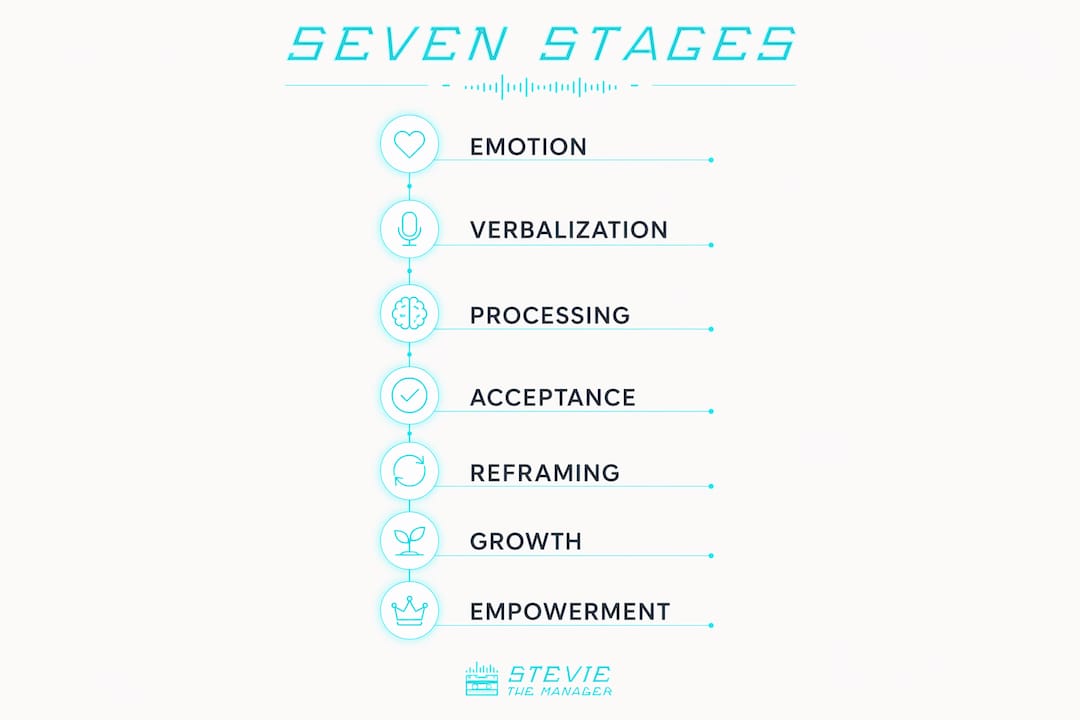
Resilience in rap follows a seven-stage psychological model that moves an artist from raw pain to finished, empowering art. Each stage builds on the last, and skipping one typically results in music that feels hollow or disconnected.
- Emotion Recognition. The artist identifies what they are actually feeling, not just what they think they should feel. This requires honesty that many people avoid in daily life.
- Meaning Assignment. The artist asks why this experience matters. Experts link this stage directly to Viktor Frankl’s survivor psychology, where finding purpose in suffering is the foundation of mental recovery.
- Verbalization. Raw emotion gets translated into words. This is where journaling, freestyling, and voice memos become critical tools.
- Structuring. Words get organized into verses, hooks, and song architecture. Structure gives chaos a container, which itself reduces anxiety.
- Sharing. The finished work reaches an audience. Sharing transforms a private wound into a communal experience.
- Feedback. The artist receives responses, whether praise, criticism, or silence. Each response becomes new data.
- Growth. The artist integrates feedback and lived experience into the next creative cycle. Setbacks become data, and the cycle repeats with greater skill and self-awareness.
Moving through all seven stages consistently is what builds lasting resilience. Artists who stop at verbalization, for example, often report feeling stuck. The act of sharing and receiving feedback closes the emotional loop.
Pro Tip: If you are an artist working through a difficult period, try recording a rough voice memo at stage three before worrying about production. Getting the words out matters more than getting them perfect.
How does rap serve as cultural and psychological resilience?
Hip-hop functions as a living record of lived experience that empowers both individuals and entire communities. This is not a metaphor. It is a documented cultural mechanism. When artists document injustice in lyrics, they create an archive that future generations can reference, learn from, and build upon.

The concept of “affirmation as resistance” sits at the heart of resilience themes in hip-hop. When an artist raps about surviving poverty, police violence, or systemic exclusion, the act of naming those experiences publicly is itself a form of defiance. The lyric says: this happened, I am still here, and I refuse to be erased.
“Hip-hop acts as cultural memory, resistance, and resilience. It empowers individuals and communities by documenting injustice and enabling affirmation as a form of survival.”
Dr. Jaleel Abdul-Adil, a clinical psychologist at the University of Illinois Chicago, describes hip-hop as therapeutic medicine for young people navigating hostile environments. He notes that bravado in rap lyrics often functions as a sophisticated mask for deep self-affirmation. What sounds like bragging is frequently a survival mechanism dressed in confidence.
The communal dimension of resilience in hip-hop culture matters just as much as the individual one. Consider what rap communities provide:
- Shared language. Slang, references, and cadences create belonging among people who might otherwise feel isolated.
- Collective memory. Albums and mixtapes preserve community history that mainstream media ignores.
- Mutual accountability. Underground scenes hold artists to standards of authenticity that commercial pressure often erodes.
- Emotional permission. Hearing an artist express grief or rage openly gives listeners permission to feel those things themselves.
Music also serves as the first form of self-care for many youth facing trauma and systemic oppression. That is a clinical observation, not a marketing claim. It means rap often reaches people before therapists, counselors, or community programs do.
What are the core themes of resilience expressed in rap?
Resilience themes in hip-hop cluster around four pillars that appear consistently across eras, regions, and subgenres. Understanding these pillars helps you hear rap differently, whether you are a fan, an artist, or someone applying these ideas to your own life.
- Authenticity. Artists who speak truthfully about their circumstances, without exaggerating or sanitizing, build the deepest listener trust. Authenticity is not just an aesthetic choice. It is a psychological commitment to facing reality as it is.
- Vulnerability. Sharing fear, failure, and doubt in a genre historically associated with toughness takes real courage. Artists who go there create music that connects through shared struggle rather than just shared taste.
- Community support. The most resilient artists rarely credit only themselves. They name mentors, crews, neighborhoods, and family members who kept them going. That acknowledgment reflects a real psychological truth: resilience is relational, not solo.
- Overcoming systemic inequality. Rap has always named the systems that create hardship, from redlining to mass incarceration to underfunded schools. Naming a system is the first step toward refusing to be defined by it.
How rap expresses resilience through storytelling is equally important. The psychology of rap music shows that narrative structure in lyrics mirrors the same emotional processing techniques used in cognitive behavioral therapy. An artist who raps “I was broke, I worked, I built something” is walking through the same cognitive reframe a therapist might guide a client through in a clinical session.

Rejection is another consistent theme. Independent artists face label rejections, radio blackouts, and streaming algorithm invisibility. The artists who convert those rejections into creative fuel, rather than quitting, demonstrate resilience in its most practical form. Music becomes a vehicle for identity and emotional regulation precisely because it gives the artist control over the narrative when external circumstances feel uncontrollable.
Pro Tip: When you listen to rap with resilience themes in mind, pay attention to the bridge or the third verse. That is usually where the artist drops the most honest, unguarded lines. Those moments are where the real psychological work shows.
How can resilience in rap inform personal development?
Rap creation reflects the same psychological elements that resilience researchers identify as critical: control, connection, and meaning. Artists develop routines, build community connections through their craft, and find purpose in adversity through lyrical storytelling. These are not abstract concepts. They are practical tools anyone can apply.

The parallel between rap creation and therapeutic practice is direct:
| Rap creation process | Therapeutic equivalent |
|---|---|
| Freestyling raw emotion | Expressive journaling |
| Writing and rewriting verses | Cognitive restructuring |
| Performing for an audience | Exposure and vulnerability practice |
| Receiving listener feedback | Peer support and reflection |
| Starting the next project | Building a growth mindset |
Rap creation’s emotional externalization is a clinical mechanism for managing pain. You do not need to be a professional rapper to use it. Writing a verse about something that hurt you, even if no one ever hears it, activates the same meaning-making process that makes resilient artists effective. The act of structuring emotion into language gives the brain a way to process what it cannot simply think its way through.
Resilience in rap also teaches a specific mindset shift: setbacks are not endings. They are inputs. Every artist who has ever been told their sound is wrong, their lyrics are weak, or their market is too small has a choice. They can internalize that judgment, or they can use it as material. The ones who use it as material keep going. That is what what does resilience mean in music ultimately comes down to: the refusal to let adversity write the final verse.
Key Takeaways
Resilience in rap is a seven-stage psychological process that transforms personal and communal adversity into empowering artistic expression, not a fixed trait artists either have or lack.
| Point | Details |
|---|---|
| Resilience is a process | It follows seven stages from emotion recognition to growth, and each cycle builds skill. |
| Hip-hop is cultural medicine | Rap documents injustice and enables affirmation as resistance for individuals and communities. |
| Authenticity drives connection | Artists who speak truthfully about real struggles create the deepest listener bonds. |
| Rap parallels therapy | Freestyling, writing, and performing mirror clinical tools like journaling and cognitive restructuring. |
| Setbacks fuel growth | Resilient artists treat rejection and failure as creative inputs, not final verdicts. |
Resilience in rap runs deeper than most listeners realize
Most people hear a hard rap verse and think: that artist had a tough life. What they miss is the deliberate psychological work happening inside the music. Resilience in rap is an iterative, ongoing creative process, not a one-time comeback story. Every album is a new cycle. Every verse is another pass through the seven stages.

What strikes me most, having followed independent and underground hip-hop closely, is how artists with the fewest resources often demonstrate the most sophisticated resilience. They do not have label budgets or PR teams to manage their narrative. They have their craft, their community, and their willingness to keep going. That combination produces music with a weight that commercial polish rarely matches.
Rap also functions as both self-affirmation and resistance simultaneously. When an independent artist from a marginalized community releases music that names their reality, they are doing two things at once: healing themselves and pushing back against a system that would prefer their silence. That dual function is what makes hip-hop community culture so durable across decades and geography.
My honest view is that most personal development content ignores hip-hop entirely, and that is a significant gap. The genre has been teaching emotional regulation, meaning-making, and community building for over 50 years. Anyone serious about understanding resilience should spend time with the music, not just the self-help shelf.
— Stephanos G
Hip-hop culture resources worth your time
Lit Nightz News covers hip-hop culture from the inside, with a focus on the stories, ideas, and artists that mainstream outlets overlook.

If this article sparked your curiosity about the culture behind the music, the origins and impact of hip-hop is the right place to start. You will find a full breakdown of how the genre developed and why its influence keeps expanding. For a sharper look at where the culture is heading right now, the 2026 hip-hop trends guide covers five key shifts reshaping the scene. Artists building their own path will find practical perspective in the music industry survival tips for independent artists in 2026.
FAQ
What is the definition of resilience in rap?
Resilience in rap is the process of negotiating, managing, and adapting to personal, societal, or career adversity and channeling that experience into meaningful artistic output. It is a trainable psychological process, not a fixed trait.
How does rap express resilience through lyrics?
Rap expresses resilience through authenticity, vulnerability, and storytelling that names real hardships and affirms survival. Artists use lyrical structure to process emotion in ways that parallel clinical therapeutic techniques like cognitive restructuring and expressive journaling.
Why is resilience important in hip-hop culture?
Resilience is the foundation of hip-hop culture because the genre originated in communities facing systemic inequality and limited resources. It functions as cultural memory, communal healing, and resistance, giving both artists and listeners tools to process adversity and affirm their own worth.
Can rap music support mental health and trauma recovery?
Yes. Clinical research, including work by Dr. Jaleel Abdul-Adil at the University of Illinois Chicago, identifies rap as a form of therapeutic medicine that enables emotional externalization and self-affirmation. Hip-hop therapy uses rap creation as a structured mental health intervention.

What are the core themes of resilience in rap lyrics?
The core themes are authenticity, vulnerability, community support, and resistance to systemic inequality. These themes appear consistently across hip-hop’s history and reflect the psychological pillars that resilience researchers identify as central to adaptive recovery.
Recommended
- Hip Hop 2026: Why This Year Marks a Powerful Comeback for the Culture – Stevie The Manager aka Stangr The Man
- The Psychology of Rap: Unraveling the Connection Between Beats, Lyrics, and the Human Mind – Stevie The Manager aka Stangr The Man
- Unveiling the Masterpieces: Exploring Rap’s Most Captivating Narratives – Stevie The Manager aka Stangr The Man
- Unveiling the Evolution: The Future of Rap in the Social Media Era – Stevie The Manager aka Stangr The Man

No Comments