
What Is Music Monetization: A 2026 Guide for Artists
TL;DR:
- Music monetization involves earning income from various streams such as streaming, licensing, merchandise, live performances, and fan subscriptions. Building multiple revenue sources is essential for financial stability, as streaming alone provides limited earnings and depends on volume and geography. Proper registration with collection agencies and infrastructure setup are crucial to maximize income, while focusing on audience growth and infrastructure builds long-term career sustainability.
Music monetization is the process by which musicians, music entrepreneurs, and content creators earn income from their musical works and related activities through multiple revenue streams. The industry term you will encounter in contracts and royalty statements is “music rights monetization,” but most working artists simply call it music monetization. Understanding how to monetize music is no longer optional for anyone serious about a sustainable career. Platforms like Spotify, YouTube, and SoundExchange have made it easier to collect income globally, but they have also made it easier to leave money on the table if you do not know how the system works. This guide breaks down every major income stream, explains how each one pays, and gives you a practical roadmap to build a career that does not collapse when one platform changes its algorithm.

What is music monetization and why does it matter?
Music monetization is defined as the full set of methods an artist uses to convert their creative output into income. It covers everything from streaming royalties and sync licensing to merchandise sales, live performances, and fan subscriptions. The goal is not to find one big payday. The goal is to build a portfolio of income sources that pay at different times and in different amounts, so your career stays financially stable through slow periods.
Independent artists in 2026 succeed by treating their careers as businesses with multiple income sources rather than relying on single viral hits. That shift in mindset is the foundation of everything else in this guide.
What are the main music revenue streams?
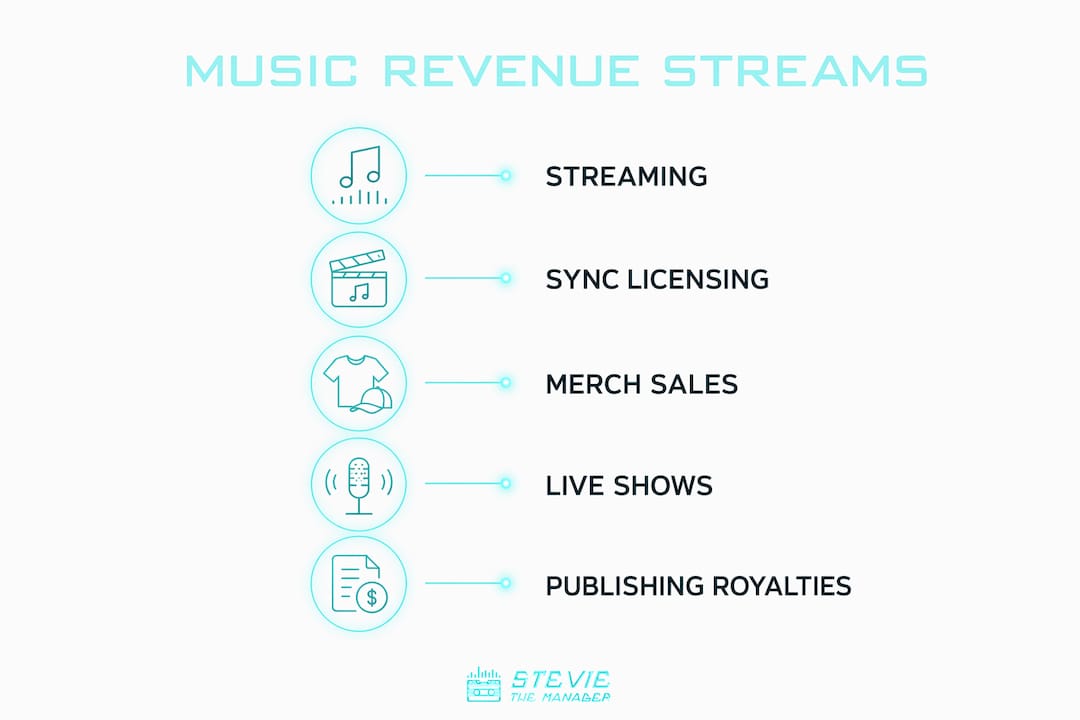
Every working musician draws income from some combination of these six core streams. Understanding how each one works helps you decide where to focus your energy at each stage of your career.
- Streaming royalties: Platforms like Spotify and Apple Music pay per stream. The average payout is $0.003–$0.005 per stream, meaning you need roughly 250,000 monthly streams to gross $1,000. Streaming accounts for about 67% of recorded music income industry-wide, yet it remains the least profitable per fan of any channel.
- Publishing royalties: Your music generates two separate royalty types. Performance royalties go to the songwriter and are collected by PROs like ASCAP and BMI. Mechanical royalties go to the songwriter for reproductions and are collected by the Mechanical Licensing Collective (MLC) in the United States. Many artists collect one and miss the other entirely.
- Sync licensing: This is the placement of your music in TV shows, films, ads, and video games. Sync fees range from $3,000 to $50,000 per placement, plus ongoing performance royalties each time the content airs. It is one of the highest-value streams available to independent artists.
- Merchandise sales: Physical and digital merch carries strong margins when sold directly. Items costing $5–$8 can sell for $25–$35 with 70–80% margins direct to fans. Print-on-demand services lower that margin to 30–40%, but they eliminate upfront inventory risk.
- Live performances: Show income ranges from $100 to over $100,000 per show, depending on career stage and scale. For most independent artists, live shows are the fastest way to generate meaningful cash in the short term.
- Fan monetization: Memberships, subscriptions, and direct sales through platforms like Patreon or Bandcamp yield high margins and more predictable income than streaming. Engaged fan communities convert better into sales than passive streaming audiences, which is why direct-to-fan channels matter more than stream counts.
| Revenue stream | Payout speed | Margin potential | Best for |
|---|---|---|---|
| Streaming royalties | Slow (monthly) | Low | Discovery and catalog income |
| Sync licensing | Delayed (6–18 months) | Very high | Established catalog |
| Merchandise | Fast (direct sales) | High (direct) | Touring and engaged fans |
| Live performances | Immediate | Variable | Active touring artists |
| Fan subscriptions | Monthly | High | Artists with loyal communities |
| Publishing royalties | Quarterly | Medium | Prolific songwriters |
How does streaming music monetization work?

Streaming platforms do not pay a fixed rate per play. They use a pro-rata payout model where your earnings depend on your share of total streams across the entire platform in a given month. If Spotify generates $100 million in revenue and your streams represent 0.001% of all plays, you receive 0.001% of the payout pool. This means your per-stream rate fluctuates based on what every other artist on the platform is doing, not just your own performance.
Geography also affects your payout. A stream from the United States pays more than a stream from a lower-revenue market. Artists who build audiences in high-value markets like the U.S., U.K., and Canada earn more per stream than those with equivalent play counts in other regions.
The practical reality is that streaming functions better as a discovery tool than a primary income source for most independent artists. You need volume that most independent artists do not have to generate meaningful monthly income from streaming alone. Check out this breakdown of rapper streaming earnings to see what real numbers look like in 2026.

Pro Tip: Register your music with both a PRO (ASCAP or BMI) and the MLC before your release date. Royalties that go unclaimed before registration are often unrecoverable.
The most common streaming mistake is treating it as a passive income machine from day one. Build your streaming presence as part of a broader strategy. Use it to grow your audience, then convert that audience into merch buyers, ticket buyers, and paying subscribers.
How to set up your music monetization infrastructure
Getting paid properly requires administrative setup that most artists skip. These are the non-negotiable steps to make sure no money goes uncollected.
- Register with a PRO. Join ASCAP or BMI as a songwriter and publisher. These organizations collect performance royalties every time your music plays on radio, TV, streaming, or in public spaces. You cannot collect these royalties without registration.
- Register with the MLC. The Mechanical Licensing Collective handles mechanical royalties from U.S. streaming services. Registration is free and separate from your PRO membership.
- Register with SoundExchange. SoundExchange collects digital performance royalties for master recordings played on internet radio, satellite radio (SiriusXM), and cable TV music channels. This is a separate royalty from what your PRO collects.
- Set up digital distribution. Use a distributor like DistroKid to get your music onto Spotify, Apple Music, Amazon Music, and other platforms. Your distributor also handles your master recording royalties from streaming.
- Claim your YouTube Content ID. YouTube pays both master and publishing royalties. Claim your Content ID through your distributor or a publishing administrator to collect revenue from user-generated content that uses your music.
- Build direct-to-fan channels. Start an email list from day one. Set up a Bandcamp page or a merch store. These channels give you direct access to your audience without relying on platform algorithms.
- Organize your sync licensing approach. You can pitch music to sync libraries independently or work with a licensing agent. Either way, your music needs to be properly cleared and registered before any placement can pay out.
Most artists neglect to register with multiple collection agencies, resulting in unclaimed royalties that sit in agency accounts for years. Registration is not a one-time task. It requires ongoing maintenance and accurate metadata to keep income flowing.

Pro Tip: Keep a master spreadsheet of every registration, every ISRC code, and every publishing split for each song. One missing ISRC can block royalty collection across multiple platforms simultaneously.
A solid music marketing workflow runs parallel to your monetization setup. Promotion and collection infrastructure work together, not separately.
How to build a sustainable income by stacking multiple streams
The most financially stable artists do not rely on one income source. Artists who build a money stack with 4–6 concurrent income streams achieve more predictable incomes than those who depend on a single channel. Multi-stream income also protects you when one platform cuts its payout rates or an algorithm change tanks your visibility overnight.
Here is how to think about stacking income at different career stages:
- Early stage (0–1,000 monthly listeners): Focus on live shows for immediate cash, direct merch sales to your existing audience, and building your email list. Streaming income will be minimal. Treat it as marketing, not revenue.
- Growth stage (1,000–10,000 monthly listeners): Add fan subscriptions through Patreon or a similar platform. Start pitching sync libraries. Your streaming income grows but still needs support from other sources.
- Established stage (10,000+ monthly listeners): Sync licensing becomes more accessible. Publishing royalties start to accumulate meaningfully. Merchandise scales with your audience. Streaming becomes a real income line rather than a rounding error.
Streaming statistics are vanity metrics for most independent artists. Real sustainability comes from owning direct-to-fan channels and email lists that no platform can take away from you. A fan who pays $10 per month on Patreon generates more annual revenue than 2,000 streams on Spotify.
Sync licensing deserves special attention because of its delayed timeline. Sync income typically takes 6–18 months to accumulate meaningfully after a placement. Budget accordingly and do not count on sync fees to cover next month’s expenses. Think of sync as a long-term investment that pays dividends over years, not weeks.
For a deeper look at income diversification for rap artists, Lit Nightz News has covered the full picture in a dedicated 2026 guide.
Key Takeaways
Music monetization requires stacking 4–6 income streams simultaneously because no single channel, including streaming, provides enough income on its own for most independent artists.
| Point | Details |
|---|---|
| Streaming pays very little per play | You need 250,000 monthly streams to gross $1,000, so treat streaming as discovery, not primary income. |
| Register with all collection agencies | ASCAP or BMI, the MLC, and SoundExchange each collect different royalties that require separate registration. |
| Sync licensing pays the most per placement | Fees range from $3,000 to $50,000, but income takes 6–18 months to arrive after placement. |
| Direct-to-fan channels are most reliable | Fan subscriptions and merch sold directly yield higher margins and more predictable income than streaming. |
| Stack 4–6 income streams | Artists with multiple concurrent revenue sources achieve more stable and predictable careers than single-stream artists. |
Why most artists are leaving money on the table
I have watched independent artists spend months obsessing over stream counts while their publishing royalties sit uncollected in MLC accounts. That is the most common and most preventable mistake in this business. The administrative side of music monetization is genuinely boring. Registering songs, maintaining metadata, updating splits after a collaboration. None of it feels creative. But skipping it is the equivalent of doing the work and then refusing to cash the check.

The other pattern I see constantly is artists chasing viral moments instead of building infrastructure. A song that blows up on TikTok generates a spike in streams. If you have not registered your publishing, set up Content ID, or built an email list to capture that new audience, the spike passes and you are back to zero. The artists who build lasting careers treat every release as a business event, not just a creative one.
Fan-powered income models have changed the math significantly. An artist with 500 paying Patreon subscribers at $5 per month earns $2,500 monthly before a single stream plays. That kind of predictable base income changes how you make decisions about touring, recording, and licensing. You stop chasing the next viral hit and start building the next revenue layer.
Sync licensing is the most underused high-value stream for independent artists. The barrier is not talent. The barrier is catalog size, proper clearances, and patience. Most artists pitch once, hear nothing for three months, and give up. The artists who succeed in sync pitch consistently, maintain clean metadata, and understand that sync payout timelines are measured in quarters, not weeks.
Build the boring infrastructure first. The creative work gets more rewarding when you know it is actually paying you.
— Stephanos G
Build your audience and your income with Lit Nightz News
If you are an independent artist working to grow your reach and build real income streams, visibility is the first step. Lit Nightz News covers hip-hop culture, artist development, and music industry strategy for artists who are building careers from the ground up.

Getting in front of the right audience accelerates every monetization channel you build. More listeners mean more streams, more merch buyers, more sync opportunities, and more fans willing to pay for direct access. Lit Nightz News offers artist promotion and feature opportunities for independent artists looking to grow their presence. If you are serious about turning your music into a business, start by making sure the right people can find you. Explore the digital music promotion guide on the site to see how promotion and monetization work together.
FAQ
What is music monetization in simple terms?
Music monetization is the process of earning income from your music through streams, licensing, merchandise, live shows, and fan subscriptions. It covers every method an artist uses to convert their creative work into revenue.
How much do artists earn from streaming?
Streaming platforms pay an average of $0.003–$0.005 per stream, requiring roughly 250,000 monthly streams to gross $1,000. Payout rates vary by platform and the listener’s geographic location.
What is sync licensing and how does it pay?
Sync licensing is the placement of music in TV shows, films, ads, or video games in exchange for a fee. Placements pay between $3,000 and $50,000 upfront, plus ongoing performance royalties each time the content airs.

Do I need to register with multiple royalty collection agencies?
Yes. ASCAP or BMI collects performance royalties, the MLC collects mechanical royalties from U.S. streaming, and SoundExchange collects digital performance royalties for master recordings. Each agency requires a separate registration to collect its specific royalty type.
What is the best music monetization method for independent artists?
No single method is best. Artists who build 4–6 concurrent income streams, including streaming, merch, live shows, fan subscriptions, and sync licensing, achieve the most stable and predictable income over time.
Recommended
- How to make money from rap music: a 2026 guide
- Music marketing workflow for hip-hop artists in 2026
- Top 6 Music Industry Trends Shaping Rap and Hip-Hop
- How NFT Rappers Are Revolutionizing the Music Industry – Stevie The Manager aka Stangr The Man

No Comments