

Tupac Biography: Life, Legacy, and Cultural Impact
TL;DR:
- Tupac Shakur was a highly influential rapper, actor, and activist shaped by Black Panther politics and street poverty. His music reflected complex themes from social activism to street defiance, evolving through several acclaimed albums. His unsolved murder in 1996 fueled mytholog y, but his legacy remains central to hip-hop and culture today.
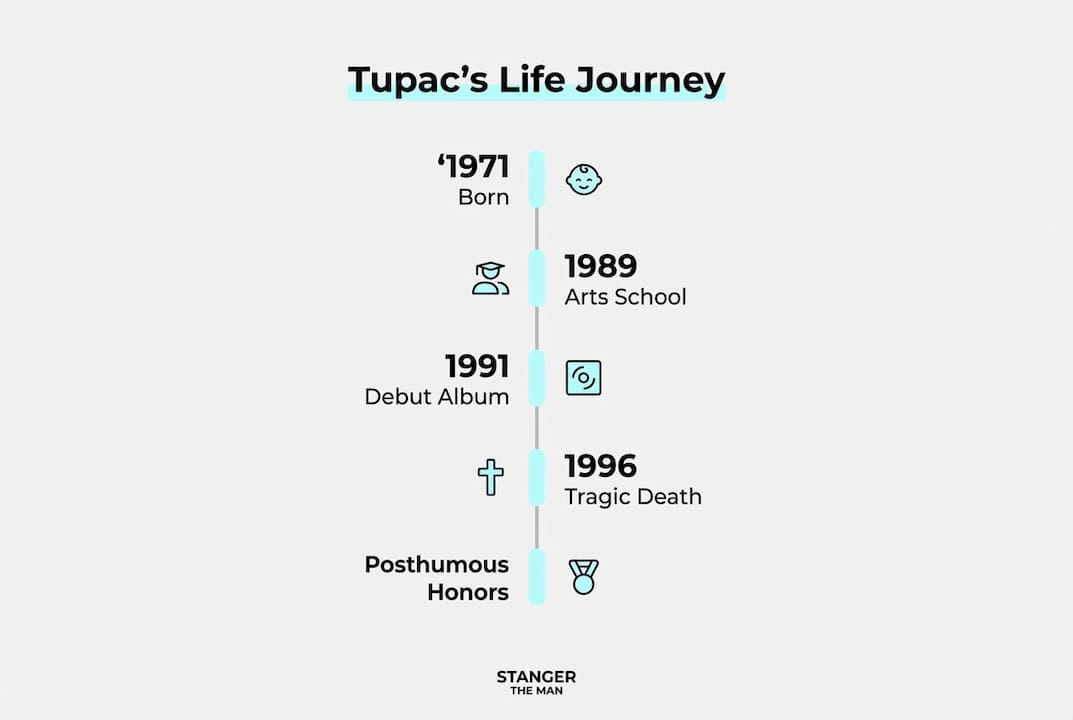
Tupac Shakur is defined as one of the most influential American rappers, actors, and social activists in the history of hip-hop. Born on june 16, 1971, in Brooklyn, New York, he packed more cultural weight into 25 years than most artists achieve in a lifetime. His tupac biography is not just a timeline of albums and controversies. It is the story of a man shaped by Black Panther politics, street poverty, and an extraordinary gift for turning pain into poetry.

What does the Tupac biography reveal about his early years?
Tupac Amaru Shakur was born Lesane Parish Crooks, a name later changed to honor the Peruvian revolutionary Túpac Amaru II. His mother, Afeni Shakur, was a prominent Black Panther Party member who stood trial while pregnant with him. That political inheritance was not background noise. It became the foundation of everything he later rapped about.
The geographic shifts from New York to Baltimore to Marin City shaped his thematic range more than any single event. In Harlem and the Bronx, he absorbed the raw energy of New York street culture. In Baltimore, he attended the Baltimore School for the Arts, where he studied acting, poetry, and ballet. That education gave him tools most rappers never had.
The move to Marin City, California, in 1988 completed his transformation. He encountered West Coast poverty and gang culture firsthand. Each city added a new layer to his voice, from the political sharpness of New York to the lyrical vulnerability of Baltimore to the street defiance of California.
- New York: Exposed him to Black radical politics through his mother’s activism
- Baltimore: Gave him formal arts training and a love of Shakespeare and poetry
- Marin City: Introduced him to West Coast street life and the realities of poverty
- Black Panther roots: Instilled a framework for understanding systemic racism from childhood
Pro Tip: If you want to understand why Tupac’s lyrics hit differently from other rappers of his era, read about the Baltimore School for the Arts. That institution explains his emotional range and his ability to write characters, not just verses.
How did Tupac’s music career develop from roadie to rap icon?
Tupac’s career began with Digital Underground as a backup dancer and roadie before he earned a featured role on the group’s 1991 track “Same Song.” That trajectory matters. He did not arrive famous. He built credibility from the ground up, learning the industry from the inside before stepping to the front.
His debut solo album, 2Pacalypse Now, dropped in 1991 and immediately drew controversy. Vice President Dan Quayle publicly called for its removal from stores after a Texas man cited it during a murder trial. The album addressed police brutality, poverty, and teen pregnancy with a directness that made mainstream America uncomfortable. That discomfort was the point.
The Rock & Roll Hall of Fame notes his evolution from socially conscious rap to defiant gangsta rap and then to vulnerable, poetic styles. Each phase was deliberate, not accidental. Me Against the World in 1995, recorded while he was incarcerated, showed a reflective and emotionally raw side that few rappers had ever exposed publicly.
| Album | Year | Defining Characteristic |
|---|---|---|
| 2Pacalypse Now | 1991 | Socially conscious, politically charged debut |
| Strictly 4 My N.I.G.G.A.Z. | 1993 | Broader commercial appeal, activist themes |
| Me Against the World | 1995 | Introspective, recorded during incarceration |
| All Eyez on Me | 1996 | Double album, West Coast dominance, mainstream peak |
- All Eyez on Me remains his commercial and cultural peak, released in february 1996 on Death Row Records
- Posthumous releases continued for years after his death, reshaping how fans understood his catalog
- Separating lifetime releases from posthumous works is critical to understanding his authentic artistic phases
Pro Tip: Listen to Me Against the World before All Eyez on Me to hear the full emotional arc. Most fans start with the bigger album and miss the depth that came right before it.

What social and political themes drove Tupac’s music and activism?
Tupac’s lasting cultural impact stems from his raw talent and his willingness to address systemic racism, police brutality, and economic inequality head-on. He did not treat these as abstract issues. He named them, described them in detail, and put faces on them. Songs like “Brenda’s Got a Baby” and “Dear Mama” gave voice to people who rarely heard themselves in mainstream music.
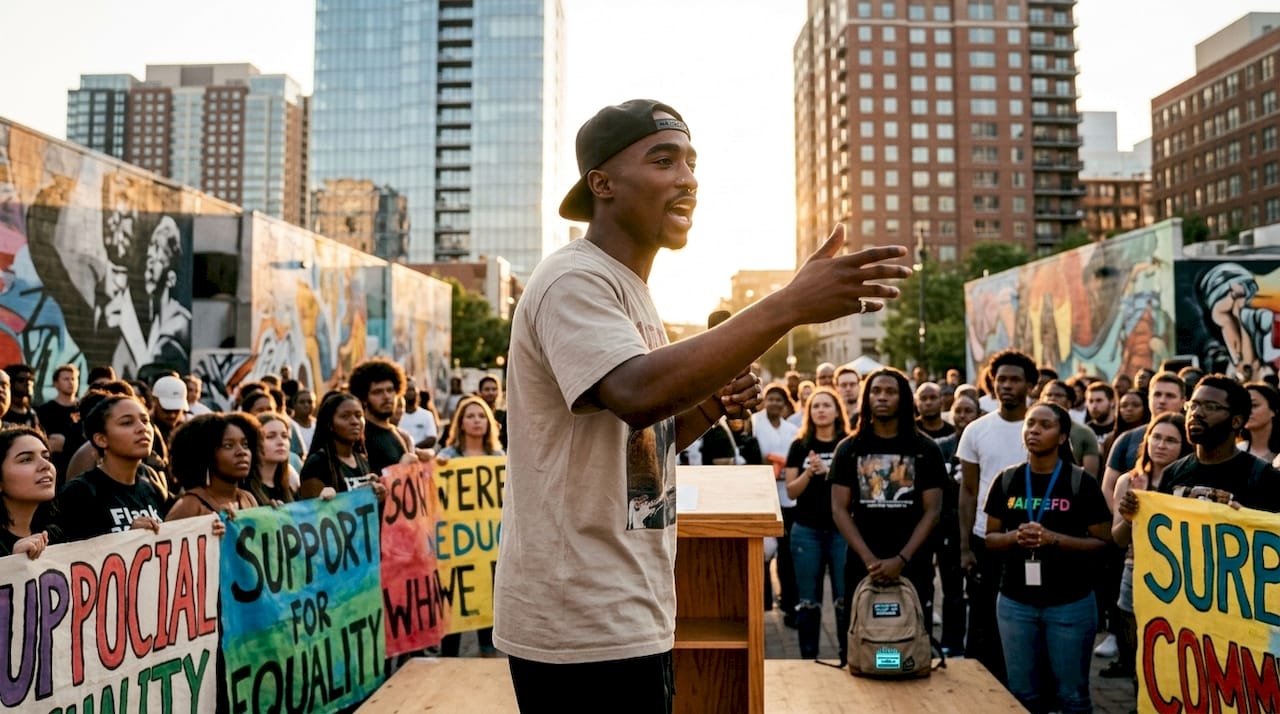
His balance of vulnerability and defiance expanded hip-hop’s emotional range in ways that still influence artists today. He could be furious and tender in the same verse. That duality was not a contradiction. It was a complete picture of what it meant to be young, Black, and poor in America during the 1990s.
Tupac also embraced the concept of THUG LIFE, an acronym he defined as “The Hate U Give Little Infants F***s Everybody.” That reframing turned a street label into a political statement about cycles of poverty and neglect. It was the kind of intellectual move that reflected his Baltimore arts education as much as his street experience.
- Police brutality: Addressed directly in “Trapped” and “Soulja’s Story”
- Black empowerment: Rooted in his mother’s Black Panther philosophy
- Women and family: Explored with rare tenderness in “Dear Mama” and “Keep Ya Head Up”
- Systemic poverty: Documented through character-driven storytelling across multiple albums
His public persona often overshadowed this depth. The legal troubles, the East Coast-West Coast beef, and the tabloid coverage made it easy to reduce him to a caricature. The music told a more complete story.
What happened during the 1996 Las Vegas shooting, and why does it still matter?
Tupac was shot in a drive-by attack on september 7, 1996, while stopped at a red light in Las Vegas after attending the Mike Tyson vs. Bruce Seldon boxing match. He was struck multiple times. Six days later, on september 13, 1996, he died at the University Medical Center of Southern Nevada. He was 25 years old.
The murder remains officially unsolved. No one has been convicted. The investigation has stretched across decades, with renewed attention as recently as 2023 when Las Vegas police executed a search warrant in connection with the case. Lit Nightz News has covered the ongoing legal delays in the Tupac murder trial as the case continues to draw public attention.
| Key Event | Date | Detail |
|---|---|---|
| Boxing match attended | september 7, 1996 | Mike Tyson vs. Bruce Seldon at MGM Grand |
| Drive-by shooting | september 7, 1996 | Multiple gunshot wounds at a Las Vegas intersection |
| Death | september 13, 1996 | University Medical Center of Southern Nevada |
| Murder status | Ongoing | Officially unsolved as of 2026 |
The shooting accelerated the mythology around Tupac rather than ending his story. Conspiracy theories about his survival circulated almost immediately. That mythology reflects something real: fans refused to accept that someone with that much to say could simply be gone.

Pro Tip: Separate the conspiracy theories from the documented facts when researching Tupac’s death. The unsolved nature of the case is real and significant. The “he’s still alive” narratives distract from the genuine injustice of an unresolved murder.
How is Tupac’s legacy preserved in music and culture today?
All Eyez on Me was inducted into the Grammy Hall of Fame Class of 2026, with the induction ceremony planned for may 8, 2026. The Recording Academy reserves that honor for recordings at least 25 years old that demonstrate qualitative and historical significance. That recognition places Tupac’s work alongside the most enduring recordings in American music history.
His influence on modern rap is direct and documented. Artists like Kendrick Lamar, J. Cole, and Drake have all cited Tupac as a primary influence. Kendrick Lamar in particular carries forward the tradition of socially conscious West Coast rap that Tupac helped define. The lineage is clear in the willingness to address race, identity, and systemic failure through personal narrative.
Documentaries and biographies continue to shape how new generations understand his Tupac Shakur life story. The 2017 biopic All Eyez on Me reached wide audiences, though critics noted it prioritized drama over depth. Jeff Pearlman’s biography Only God Can Judge Me, built on 650-plus interviews, offers a more rigorous account that reconciles public perception with documented reality.
- The 90s hip-hop era that Tupac helped define remains the most studied period in rap history
- Posthumous releases including The Don Killuminati: The 7 Day Theory (released under the alias Makaveli) shaped his legacy as much as his lifetime work
- His image appears in murals, tattoos, and academic curricula across the United States and internationally
- Digital platforms have introduced his catalog to listeners born after his death, sustaining his audience across generations
Tupac was inducted into the Rock & Roll Hall of Fame in 2017, his first year of eligibility. That timing reflects how quickly the broader music establishment recognized what hip-hop fans had known for two decades.
Key Takeaways
Tupac Shakur’s life story is inseparable from his music: his Black Panther roots, geographic upbringing, and social activism produced an artist whose work remains as relevant in 2026 as it was in 1996.
| Point | Details |
|---|---|
| Family and political roots | Afeni Shakur’s Black Panther background directly shaped Tupac’s social and political worldview. |
| Geographic influence | New York, Baltimore, and Marin City each contributed distinct layers to his lyrical identity. |
| Artistic evolution | His style moved from socially conscious rap to gangsta rap to vulnerable poetry across five studio albums. |
| Unsolved death | Tupac was shot on september 7, 1996, and died six days later; the murder remains officially unsolved. |
| Enduring legacy | All Eyez on Me entered the Grammy Hall of Fame Class of 2026, confirming his permanent place in music history. |
Why Tupac’s complexity still challenges easy answers
I have spent years reading about Tupac, listening to his catalog in sequence, and watching how new fans react when they move past the greatest hits. The thing that strikes me every time is how badly people want to simplify him. Either he was a thug or he was a prophet. Either the East Coast beef was his downfall or it was manufactured drama. Neither framing holds up.

What actually makes Tupac worth studying is the tension he never resolved. He was raised in radical politics but signed to Death Row Records, one of the most commercially aggressive labels in rap history. He wrote some of the most tender songs about women in hip-hop history and also faced serious legal accusations. He preached Black unity and participated in one of the most destructive rivalries the genre has ever seen. Jeff Pearlman’s biography does not try to smooth those contradictions out. That is exactly why it is worth reading.
The geographic angle is the one most fans underestimate. Baltimore gave him Shakespeare and poetry. Marin City gave him the street. New York gave him politics. No other rapper of his generation had that combination of formal arts training and lived experience. It is why his lyrics work on multiple levels simultaneously.
My advice to any serious hip-hop fan: listen to Me Against the World first. Then read about the Baltimore School for the Arts. Then go back to All Eyez on Me. You will hear a completely different album. The evolution of rap as a genre runs directly through what Tupac built during those five years.
— Stephanos G
Tupac’s story and the culture that produced him
Tupac did not emerge from a vacuum. He came out of a specific cultural moment, shaped by hip-hop’s origins, the crack epidemic, Black radical politics, and the West Coast rap explosion of the early 1990s. Understanding that context makes his music land harder.

Lit Nightz News covers hip-hop’s origins and cultural impact in depth, giving you the full picture behind artists like Tupac. If you want to understand why his music still resonates, start with the culture that built him. Lit Nightz News also tracks why hip-hop remains influential across identity, politics, and art, connecting Tupac’s legacy to the artists and movements shaping the genre right now.
FAQ
Who was Tupac Shakur?
Tupac Shakur was an American rapper, actor, and social activist born on june 16, 1971, in Brooklyn, New York, who became one of the most influential figures in hip-hop history before his death on september 13, 1996.
What influenced Tupac’s music?
His Black Panther family background, formal arts training at the Baltimore School for the Arts, and firsthand experience of West Coast poverty all shaped his lyrical themes. Geographic shifts across New York, Baltimore, and Marin City gave him a wider emotional and political range than most of his peers.
What are Tupac’s most important albums?
2Pacalypse Now (1991), Me Against the World (1995), and All Eyez on Me (1996) are his three most significant studio albums. All Eyez on Me was inducted into the Grammy Hall of Fame Class of 2026.

How did Tupac die?
Tupac was shot in a drive-by attack on september 7, 1996, in Las Vegas and died six days later. His murder remains officially unsolved as of 2026.
Where can I learn more about Tupac’s life story?
Jeff Pearlman’s biography Only God Can Judge Me, built on more than 650 interviews, is the most thorough account currently available. The full Tupac biography on Lit Nightz News also covers his personal history, public perception, and media portrayals in detail.
Recommended
- Tupac Biography: The Untold Story Behind the Hip-Hop Legend [2025 Guide] – Stevie The Manager aka Stangr The Man
- The Delay in the Tupac Murder Trial: What You Need to Know – Stevie The Manager aka Stangr The Man
- Snoop Dogg Reveals Tupac’s Return in a New Video Game
- 18 Classic 90s Hip Hop Songs From The Golden Era To The East vs. West Era – Stevie The Manager aka Stangr The Man

No Comments