Firstly, Steve (STANGR The Man aka. Stevie The Manager) Gwillim was born with both parents in the military in Burnaby, BC Canada. His mom left at 2. He wasn’t in the best financial situation. He played sports like box lacrosse, field lacrosse and soccer. And excelled at them. He attended elementary school there until Grade 7 and then moved to Abbotsford, BC for high school.
He fell in love with rap culture because it paired up with him good. Like, for one, winning a poetry competition in grade 4. Also he had to live with his buddy in high school because of conflicts with his step mom. But he made it work and got out of it in a piece.
His journey as a rap artist is a testament to the indomitable human spirit, as he rose above the shadows of his past. In those formative years, he found himself confined within the walls of psych wards and group homes, battling the depths of depression. The weight of his struggle was further amplified by the haunting presence of voices and hallucinations that threatened to consume him.
But he refused to succumb to despair. With unwavering determination, he embarked on a relentless quest for healing and self-discovery. Seeking solace in therapy and support networks, he confronted his inner demons head-on, refusing to let them define his identity.
Emerging from the depths of darkness, he emerged as a beacon of resilience and inspiration and he beat it. Today, as a rap artist, his lyrics carry the weight of his experiences, shedding light on mental health struggles and offering solace to those who may be fighting similar battles. His music serves as a powerful testament to the strength of the human spirit, a reminder that even in the face of adversity, there is hope and the possibility of triumph.
His first 2 albums, Intensify Thought 1 & 2, were the genre “experimental” trying to mesh pop / motivation rap with trap. He learned a lot. There is much more to come though. Hopefully you like his style and sound. He has said, “I’m ready to take the mic to a new level.”
The Role of Social Media in Music: 2026 Artist Guide
Social media is the primary engine driving music promotion, discovery, and fan engagement in 2026. The role of social media in music extends far beyond posting clips online. It reshapes how artists build careers, how fans find new sounds, and how the industry measures success. Platforms like TikTok, Instagram, and YouTube now function as the front door to music culture. 82% of Gen Z and 70% of millennials discover new music through social media or user-generated content sites. That single statistic reframes every decision an artist or label makes about where to spend time and money.
How does social media transform music promotion and discovery?
Social media has replaced radio as the first place most people hear new music. Only about 33% of younger listeners identify streaming-service recommendations as their primary discovery source. That gap tells you where attention actually lives, and it is not inside a streaming app’s “Discover Weekly” playlist.
Each platform serves a distinct function in music marketing through social platforms.
TikTok operates as a viral discovery engine. A song can go from zero plays to millions of streams in 72 hours when a sound catches on. TikTok viral peaks link to an average 11% increase in on-demand streaming over three days post-viral activity, with 96% of artists showing a significant streaming correlation with social media views. TikTok’s Add to Music App feature alone generated over one billion track saves, proving the platform converts attention into real listening behavior.
Instagram builds the visual identity around an artist. Consistent aesthetic, Reels, and Stories create a brand that fans recognize and trust. It is less about discovery and more about deepening the relationship after a fan finds you elsewhere.
YouTube provides search longevity. A music video or documentary posted today can still rank in search results three years from now. That long shelf life makes YouTube the most durable platform for catalog building.
Short-form video formats across platforms now drive the majority of organic music exposure. The mechanics of short-form video promotion show that 15-to-60-second clips consistently outperform longer posts for initial discovery.
The table below shows how each platform’s primary function differs for music marketing.
Platform
Primary function
Best content type
TikTok
Viral discovery
Short clips, sound trends
Instagram
Brand building
Reels, Stories, aesthetic posts
YouTube
Search and catalog
Music videos, vlogs, documentaries
Facebook
Community and events
Groups, live streams, event pages
Pro Tip:Post the hook of your track in the first three seconds of any short-form video. Algorithms reward watch time, and listeners decide within three seconds whether to keep scrolling.
How has music marketing strategy changed on social media?
The era of spray-and-pray influencer campaigns is over. Music influencer campaigns have shifted from viral hacks to content distribution that emphasizes authentic emotional hooks over forced trends. That shift matters because audiences have developed sharp instincts for spotting paid promotion.
The new playbook follows a more deliberate structure.
Identify micro and niche creators whose audiences already align with the genre or mood of the music. A creator with 20,000 engaged followers in a specific subculture delivers more value than a celebrity with 2 million passive ones.
Build emotional hooks into the content itself. The music should feel like a natural fit for the creator’s existing content, not an obvious insertion. Listeners respond to discovery, not advertising.
Activate fan-generated content. When real fans post about a track without being paid, that signal carries more weight than any sponsored post. Fan accounts and niche meme pages often yield more authentic engagement than high-cost influencer integrations because audiences view community-driven accounts as genuine recommendations.
Focus on algorithmic infiltration over manual discovery.43% of consumers do not actively search for music on social media. They rely on algorithms to surface it. That means the goal is to get into the feed, not to get someone to search for you.
Embed music into culture, not just content. Stealthy music marketing places a track inside trusted subcultural accounts where it feels native. The long-term payoff is cultural association, which outlasts any single viral moment.
Pro Tip:When pitching a niche creator, send them the track with zero instructions. If they connect with it naturally, their post will feel authentic. Scripted posts always read as ads.
What are the best ways artists use social media for fan engagement?
Social media’s real power for artists is not reach. It is intimacy. Artists who share their creative process and personality build trust and intimacy more effectively than those who only post polished promotional content. A studio session clip, a raw vocal take, or a candid moment between recording sessions tells fans who the artist actually is.
Effective fan engagement on social media follows a few clear principles.
Customize content per platform. Posting identical content across all platforms reduces effectiveness. A behind-the-scenes clip works on Instagram Stories. A 60-second performance clip works on TikTok. A 10-minute breakdown of a song’s production works on YouTube. Each platform has its own culture and content expectations.
Use social media as a traffic generator, not a destination.Social media visibility does not always translate into income without funneling the audience to owned platforms. Direct fans to a personal website, an email list, or a Bandcamp page where you control the relationship and the revenue.
Engage niche communities. Genre-specific subreddits, Discord servers, and fan-run pages often produce more genuine engagement than broad campaigns. These communities trust each other, and a recommendation inside one carries real weight.
Balance organic content with targeted paid advertising. Organic reach builds credibility. Paid retargeting converts it. Running a small ad campaign to people who already engaged with your organic content is one of the most cost-effective moves in digital music promotion.
“Social media should be treated as a lead generation tool driving fans to owned websites for conversion and fan retention, not the sales channel itself. Visibility without ownership is borrowed attention.”
This principle separates artists who build sustainable careers from those who chase numbers. A million views on a platform you do not own is a rented asset. An email list of 5,000 engaged fans is yours permanently. For a deeper look at how hip-hop artists specifically approach this, Lit Nightz News covers hip-hop fan engagement tactics in detail.
What are the emerging trends shaping social media’s influence on music?
The social media environment for music is shifting faster in 2026 than at any point in the past decade. Three forces are driving that change simultaneously.
Nearly 75,000 AI-generated tracks are released daily. That volume floods every platform and makes algorithmic discovery less reliable for any individual artist. The result is a renewed value placed on human curation, personal recommendation, and offline engagement. When everything sounds generated, authenticity becomes the scarcest resource.
Regulatory changes are also reshaping the field. Australia’s social media restrictions for younger users signal a broader global conversation about youth access to platforms. If similar policies spread, the pool of younger listeners reachable through social media shrinks. That pushes artists toward owned channels like email newsletters, WhatsApp broadcast lists, and experiential events where age restrictions do not apply.
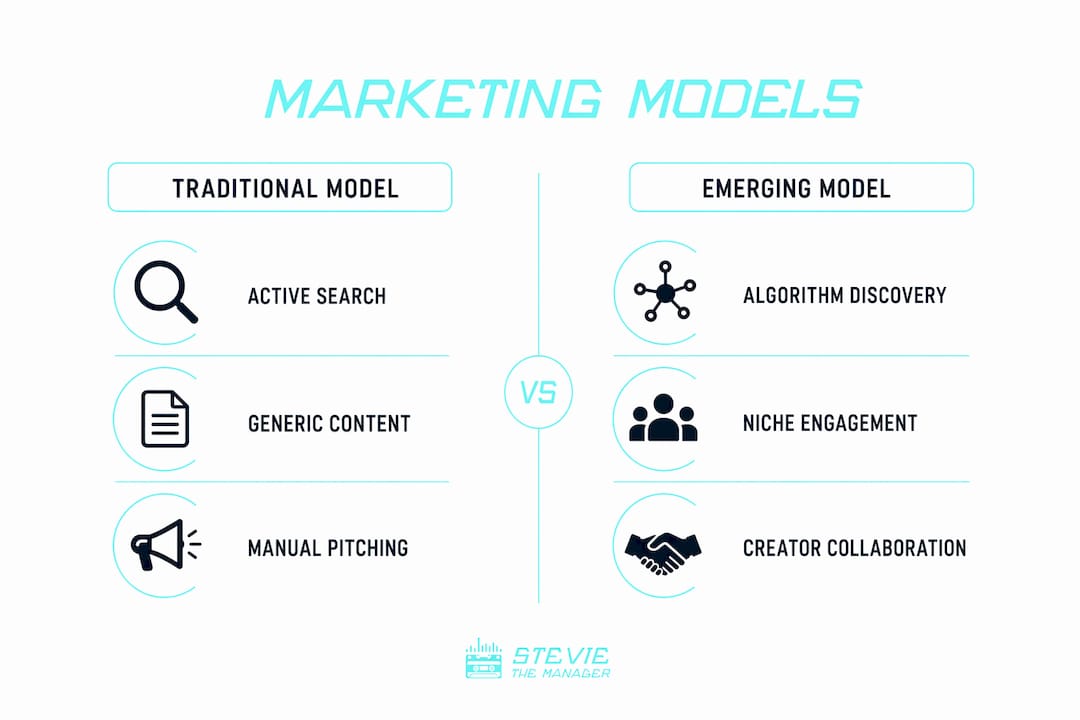
The table below compares the older approach to social media music marketing with the direction things are heading now.
Approach
Traditional model
Emerging model
Discovery method
Active user search
Algorithmic surfacing
Influencer type
Celebrity, broad reach
Micro and niche creators
Content goal
Viral moment
Cultural embedding
Audience ownership
Platform-dependent
Owned channels (email, WhatsApp)
Curation source
Algorithm-driven
Human and community-driven
The artists who will thrive are those who treat social media as one layer of a larger strategy. Viral moments are useful. They are not a career. The music marketing workflow that works long-term combines platform presence with owned audience channels and real-world connection.
Key Takeaways
Social media’s role in music is to drive discovery and fan connection, but sustainable careers require owning the audience beyond any single platform.
Point
Details
Social media leads discovery
82% of Gen Z discover music through social media, far outpacing streaming recommendations.
TikTok drives streaming spikes
Viral TikTok activity links to an average 11% increase in on-demand streaming within three days.
Algorithms surface music passively
43% of listeners rely on algorithms rather than actively searching for new music on social platforms.
Own your audience
Direct fans from social media to email lists or personal websites to build lasting, monetizable relationships.
Authenticity outperforms budget
Niche fan pages and micro-creators consistently outperform high-cost celebrity integrations for genuine engagement.
Social media is a tool, not the whole strategy
Here is what I have come to believe after watching artists rise and fall on the back of social media trends: the platform is never the point. The point is the relationship.
Artists who treat a viral moment as proof of arrival almost always stall out. The ones who use that moment to pull fans into a tighter orbit, whether that is an email list, a Discord server, or a live show, are the ones still building two years later. Social media gives you reach. What you do with that reach determines whether you have a career or just a highlight reel.
The other thing I keep coming back to is platform specificity. Posting the same content everywhere is not a strategy. It is laziness dressed up as efficiency. TikTok rewards spontaneity and hooks. Instagram rewards visual consistency. YouTube rewards depth and search intent. Each platform speaks a different language, and artists who learn all three communicate more clearly than those who shout the same message everywhere.
The AI content flood is also real, and it changes the game for independent artists in a way that actually favors them. When 75,000 tracks drop daily, human personality and genuine story become the differentiator. No algorithm can fake the credibility of an artist who has been consistently showing up, sharing their process, and building real relationships over time. That is the long game, and it is the only one worth playing.
— Stephanos G
Lit Nightz News and Lit Nightz Records: resources for independent artists
Lit Nightz News covers the music industry from the perspective of artists who are actually building something from the ground up.
Lit Nightz Records, the independent label behind StangrTheMan.com, publishes music, promotes emerging hip-hop artists, and shares real industry insight for people who want to grow without waiting for a major label to notice them. Whether you are mapping out your first release campaign or refining how you connect with fans online, the resources here are built for that work. Read the full digital promotion guide to build your reach, or check out the independent artist survival tips for a practical framework built around 2026 realities. This is where independent hip-hop gets serious.
FAQ
What is the role of social media in music promotion?
Social media is the primary channel for music discovery, fan engagement, and artist brand building in 2026. Platforms like TikTok, Instagram, and YouTube each serve distinct promotional functions that together replace traditional radio and press coverage.
How does TikTok specifically impact music streaming?
TikTok viral activity links to an average 11% increase in on-demand streaming within three days, with 96% of artists showing a measurable streaming correlation with social media views.
Should artists focus on going viral or building an audience?
Artists should prioritize building an owned audience over chasing viral moments. Social media visibility does not translate into income without directing fans to owned platforms like email lists or personal websites.
How do algorithms affect music discovery on social media?
43% of listeners do not actively search for music on social media and instead rely on algorithms to surface it. That makes algorithmic infiltration, placing music inside content that feeds naturally into user timelines, the core goal of modern music marketing.
What content formats work best for music marketing through social platforms?
Platform-specific content consistently outperforms identical cross-platform posts. Short hooks and trend-driven clips perform on TikTok, visual storytelling works on Instagram, and long-form documentary or performance content builds lasting search presence on YouTube.
Stangr The Man aka Stevie The Manager is a rapper and hip-hop writer covering the latest rap news, viral moments, and culture. Through StangrTheMan.com, he delivers real-time updates on artists, industry moves, and trending stories shaping hip-hop today. Follow Stangr for the latest hip-hop news and updates.







No Comments