

Rap storytelling explained: origins, techniques, impact
Rap is not just about rhymes and beats. At its core, it is one of the most powerful storytelling traditions alive today, rooted in oral traditions like West African griots and Bronx street culture, where words were the only tool communities had to document their reality. Whether you are a fan trying to understand why certain songs hit differently or an aspiring artist looking to sharpen your craft, knowing how rap storytelling works changes everything. This guide breaks down its origins, core techniques, cultural weight, and how you can use it yourself.

Table of Contents
- What is rap storytelling?
- Roots and evolution of rap storytelling
- Core techniques of rap storytelling
- The cultural significance of rap storytelling
- Applying storytelling to your own rap
- Explore deeper: Culture, identity, and your story in rap
- Frequently asked questions
Key Takeaways
| Point | Details |
|---|---|
| Rap storytelling defined | Rap storytelling is the craft of using rhymes and rhythm to share vivid, impactful narratives. |
| Roots in tradition | This art form draws from deep oral traditions like African griots and Bronx street culture. |
| Techniques for artists | Successful stories use structure, character, and emotion to resonate with listeners. |
| Cultural impact | Rap storytelling gives voice to marginalized experiences and drives cultural dialogue. |
| Modern application | Emerging technology lets artists create more powerful and immersive rap stories. |
What is rap storytelling?
Rap storytelling is the practice of weaving a narrative through lyrics, delivery, and structure. It is not just about clever wordplay or a catchy hook. It is about taking a listener somewhere, making them feel something, and leaving them with a perspective they did not have before.
This sets it apart from other rap styles. Braggadocio rap focuses on self-promotion, flexing wealth, status, and skill. Party anthems prioritize energy and repetition. Storytelling rap, by contrast, prioritizes empathy and social commentary, building worlds and characters that reflect real human experience.
Here are the most common narrative forms you will find in rap storytelling:
- First-person narrative: The artist speaks as themselves or a character they inhabit, pulling you directly into their experience.
- Third-person narrative: The artist narrates events from the outside, like a filmmaker describing a scene.
- Allegory: A surface-level story that carries a deeper meaning, often used to address political or social issues indirectly.
- Linear narrative: Events unfold in chronological order, easy to follow and emotionally direct.
- Non-linear narrative: The story jumps through time, using flashbacks or flash-forwards to build tension and complexity.
“Rap storytelling is not a subgenre. It is a tradition. It is the reason hip-hop has always been more than music.”
If you want to explore rap’s most captivating narratives, you will quickly see how these forms show up across decades and styles.
Roots and evolution of rap storytelling
To understand rap storytelling, you have to go back further than the Bronx. Way further.
West African griots were professional storytellers and oral historians who preserved community memory through spoken word and music. Their role was sacred. They carried the history, values, and identity of entire peoples in their voices. This tradition traveled across the Atlantic through the slave trade and evolved into blues, spoken word poetry, and eventually hip-hop. Rap storytelling draws directly from these oral traditions and the street narratives of the Bronx in the 1970s.
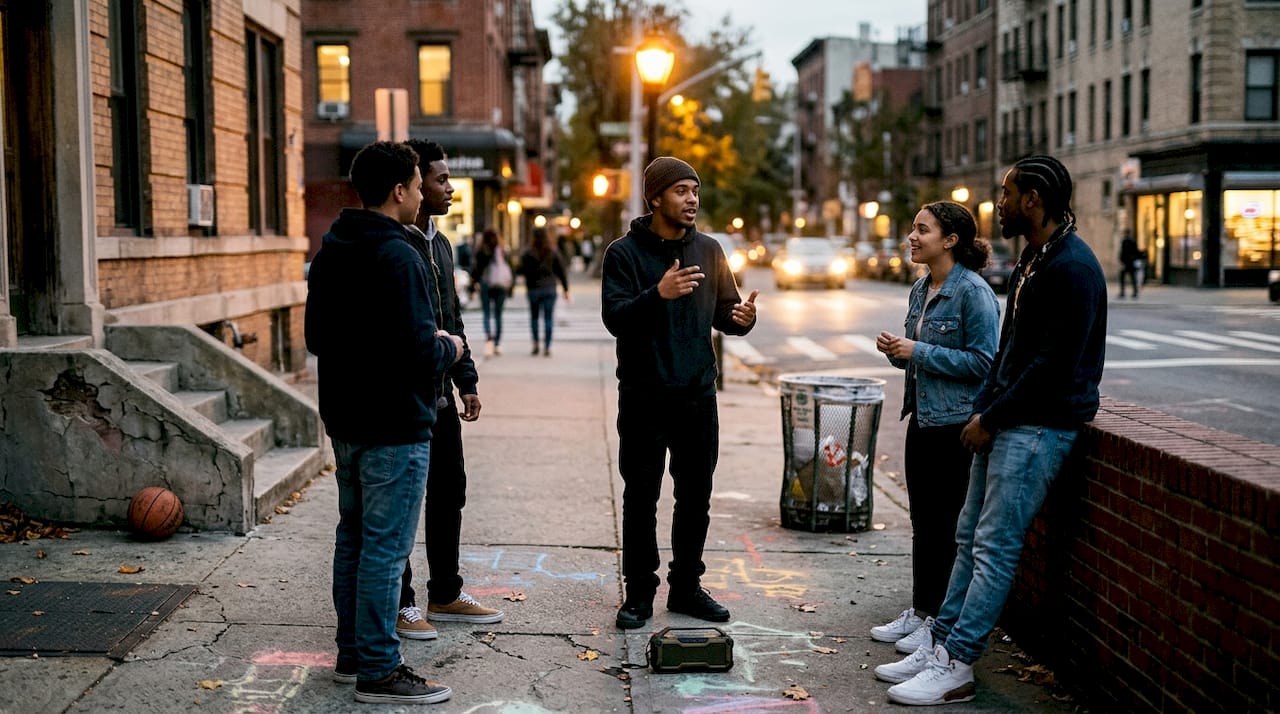
In the Bronx, block parties and cyphers became spaces where young people from marginalized communities told their stories out loud. It was survival. It was identity. It was resistance.

Here is a quick look at how rap storytelling has evolved across key eras:
| Era | Style | Key artists |
|---|---|---|
| 1980s | Conscious rap, social commentary | Grandmaster Flash, KRS-One |
| 1990s | Gritty realism, street narratives | Nas, Biggie, Tupac, Slick Rick |
| 2000s | Introspective and cinematic | Kanye West, Lupe Fiasco |
| 2010s | Concept albums, political rap | Kendrick Lamar, J. Cole |
| 2020s | Visual albums, digital storytelling | Kendrick Lamar, Noname |
The evolution of rap is inseparable from its storytelling tradition. Each era pushed the narrative form further, reflecting the social conditions of its time. Understanding hip-hop’s cultural impact means recognizing that these stories were never just entertainment. They were documentation.
Pro Tip: Study the birth of rap samples to understand how producers built sonic landscapes that gave storytellers the perfect backdrop for their narratives.
Core techniques of rap storytelling
Great rap stories do not happen by accident. They are built with intention, using specific techniques that any aspiring artist can learn and apply.
Here is a step-by-step breakdown of how strong rap narratives are constructed:
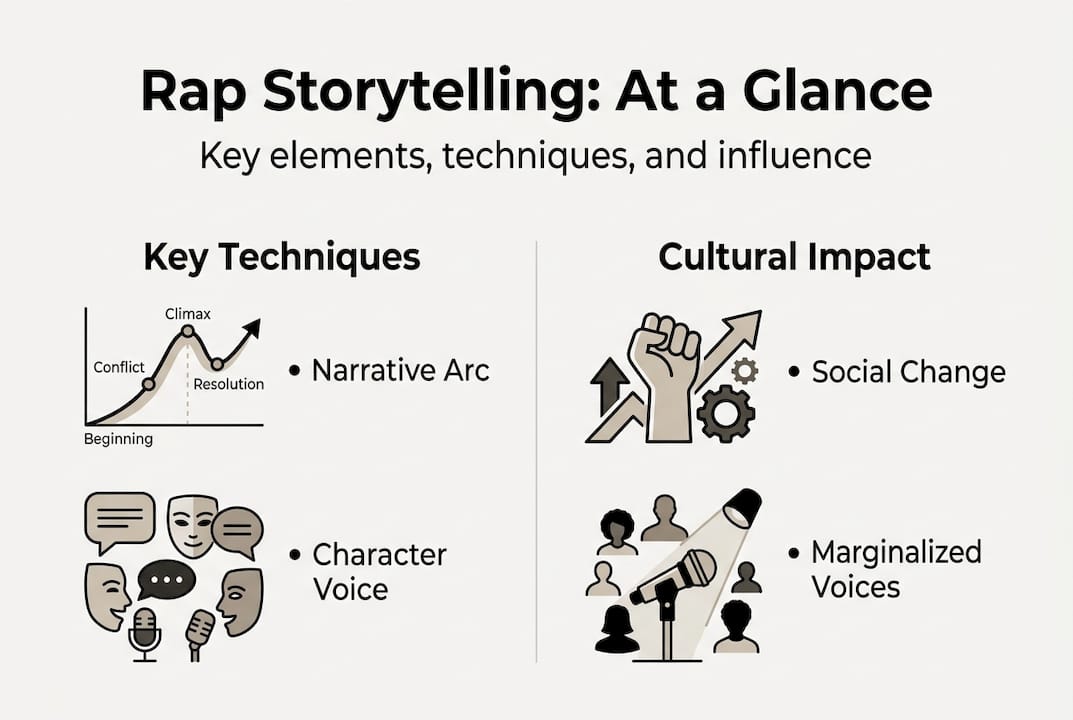
- Set up the world. Introduce the setting, the characters, and the stakes early. Listeners need to know where they are and who they are following.
- Build conflict. Every compelling story needs tension. This could be internal struggle, external pressure, or a moral dilemma.
- Reach a climax. The emotional or narrative peak of the song. This is where the story turns or the truth is revealed.
- Deliver a resolution. Not every rap story has a happy ending, but it needs a conclusion that gives the listener something to hold onto.
Beyond structure, the best storytellers use advanced techniques to deepen their narratives. Perspective shifts let an artist tell the same story from multiple angles, creating empathy for different characters. Time jumps compress years of experience into a few bars. Dialogue makes characters feel real and alive. Non-linear storytelling creates mystery and rewards close listening.
Rap storytelling also amplifies marginalized voices on topics like poverty, racism, and violence in ways that straight journalism rarely achieves. The emotional truth in a well-crafted verse can land harder than any statistic.
Here is a quick comparison of storytelling rap versus standard rap forms:
| Element | Storytelling rap | Standard rap |
|---|---|---|
| Focus | Narrative arc and character | Punchlines, flow, or energy |
| Listener role | Active, following the story | Passive, feeling the vibe |
| Emotional goal | Empathy and understanding | Hype or admiration |
| Replay value | High, new details emerge | Moderate, based on enjoyment |
The psychology of rap explains why these narrative techniques hit so hard emotionally. When you follow a character through struggle and survival, your brain processes it like a real experience. That is why memorable rap stories stay with you for years.
Pro Tip: Write your story out as a short paragraph before you write a single bar. Knowing your beginning, middle, and end before you touch the mic will make your verses sharper and more focused.
The cultural significance of rap storytelling
Rap storytelling is not just an art form. It is a social function. It gives a platform to voices that mainstream media has historically ignored or distorted.

Think about what rap has documented over the decades. Poverty in housing projects. Police brutality in Black neighborhoods. The psychological toll of systemic racism. The resilience of communities that refuse to be erased. These are not just themes. They are lived realities that rap storytelling amplifies for the world to hear.
Here are some of the most consistent themes in rap storytelling and why they matter:
- Poverty and economic inequality: Songs like Nas’s “One Love” or Kendrick Lamar’s “Sing About Me” put human faces on statistics.
- Racism and systemic injustice: Rap has been one of the most consistent critics of racial inequality in American culture.
- Violence and its consequences: Rather than glorifying it, the best storytellers show the full cost of violence on individuals and communities.
- Resilience and survival: Stories of making it through impossible circumstances are central to hip-hop’s emotional core.
- Identity and belonging: Who am I, where do I come from, and where am I going? These questions run through rap storytelling across every era.
“Authenticity is the currency of rap storytelling. Listeners can feel when a story is real, and they can feel when it is not.”
Technology is also reshaping how these stories are told. Visual albums, social media storytelling, and even early experiments with VR are expanding the canvas. The future of rap is one where narrative and visual experience merge in ways that were impossible even a decade ago. And hip-hop’s influence on global culture continues to grow because of this storytelling power.
Applying storytelling to your own rap
Knowing the theory is one thing. Putting it into practice is where the real work begins. Here is how you can start building stronger stories in your own music.
- Identify your central message. What is the one thing you want your listener to walk away feeling or understanding? Every decision in the song should serve that message.
- Create a relatable character. This could be you, someone you know, or a composite. Give them specific details. A name, a neighborhood, a habit. Specificity creates believability.
- Build an emotional arc. Your listener should feel something shift by the end of the song. Take them from one emotional state to another.
- Use sensory details. Describe what things look, sound, smell, and feel like. This is what separates a story from a summary.
- Study the greats. Slick Rick’s “Children’s Story,” Nas’s “One Love,” Kendrick Lamar’s “Sing About Me” are masterclasses. Listen with a notebook.
Modern rap storytelling evolves with technology, and you should take advantage of that. Pair your music with visuals, use social media to extend your narrative between releases, and think about how your story lives beyond a single track.
If you are ready to take your music to the next level, the album release guide at Stangr The Man covers how to build your brand around your story. And if you want to understand how technology in rap is changing the game, that resource will give you a serious edge.

Pro Tip: Record yourself telling your story out loud before writing it as a rap. The natural rhythm of how you speak will often give you the cadence and phrasing that feels most authentic in your verses.
Explore deeper: Culture, identity, and your story in rap
Rap storytelling is a living tradition, and the best way to grow as an artist or a fan is to keep digging into it.

At Stangr The Man, we have built a library of resources that connect the dots between culture, identity, and impact in hip-hop. Whether you want to understand where the genre is heading with our breakdown of hip-hop trends 2026 or explore the deeper roots of hip-hop’s influence on global culture, there is something here for every level of fan and artist. Stevie The Manager built this platform from real experience in the Vancouver rap scene, and every resource reflects that ground-level perspective. Come explore, stay curious, and keep telling your story.
Frequently asked questions
How does rap storytelling differ from other rap lyrics?
Rap storytelling uses narrative arcs and character development to take listeners through an experience, while other styles like braggadocio focus on self-promotion or energy without a structured story. The key difference is that storytelling rap prioritizes empathy over impression.
What are the most common themes in rap storytelling?
The most common themes are poverty, racism, violence, perseverance, and social change. These themes reflect the lived realities of the communities that created and sustained hip-hop culture.
How can technology be used in rap storytelling?
Technology enables visual albums, social media narrative extensions, and immersive digital experiences that expand how a story is told beyond the audio track. Immersive visuals are becoming a core part of how modern rap stories are experienced.
Who are examples of rappers known for great storytelling?
Slick Rick, Nas, Tupac, and Kendrick Lamar are widely recognized as some of the greatest storytellers in rap history, each known for building vivid characters and emotionally resonant narratives across their catalogs.
Recommended
- Tracing the Evolution of Rap: From Its Roots to Global Dominance – Stevie The Manager aka Stangr The Man
- Rap Battles: A Deep Dive into the Culture and Techniques Behind the Mic – Stevie The Manager aka Stangr The Man
- Flow Rhyme Schemes Patterns: Hidden Mathematics Behind Rap’s Greatest Verses – Stevie The Manager aka Stangr The Man
- Unveiling the Masterpieces: Exploring Rap’s Most Captivating Narratives – Stevie The Manager aka Stangr The Man

No Comments