

Jay Z Net Worth 2026: How He Built $2.8 Billion
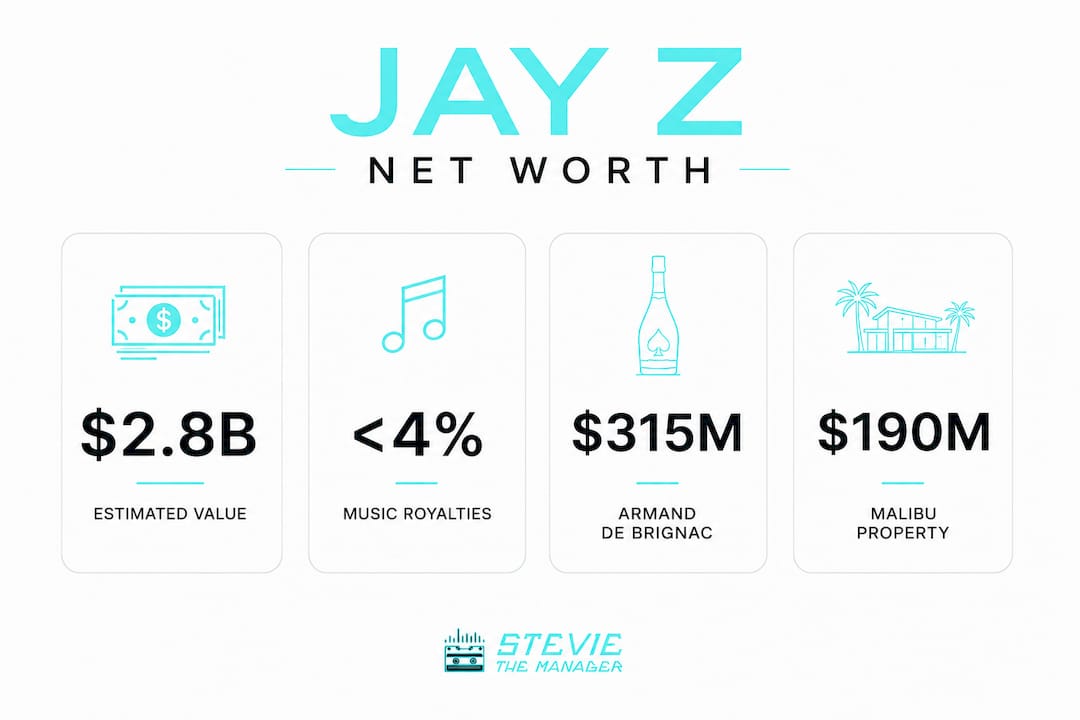
Jay Z’s net worth is estimated at approximately $2.8 billion as of 2026, making him the wealthiest musician on the planet. Less than 4% of that fortune comes from music royalties. The rest sits in equity stakes across luxury spirits brands, tech startups, real estate, and fine art. That single fact reframes everything most fans think they know about how hip-hop wealth actually works. Jay Z did not get rich by selling records. He got rich by owning things.
What is Jay Z’s net worth and where does it come from?
Jay Z’s estimated $2.8 billion fortune is built across five major asset categories: spirits brands, Roc Nation equity, tech investments, real estate, and art. Each category plays a different role in his overall financial picture. Together, they form one of the most diversified wealth portfolios in entertainment history.

Spirits brands: the biggest piece
The spirits portfolio is the heaviest anchor in Jay Z’s wealth. His champagne brand Armand de Brignac and cognac label D’Ussé together carry a combined value over $1 billion. He sold a 50% stake in Armand de Brignac to LVMH for $315 million and offloaded half of D’Ussé to Bacardi for $750 million. Those two deals alone generated over $1 billion in cash exits while he retained significant ownership in both brands.

Roc Nation, tech, and passive income
Roc Nation, his music and sports management company, carries a private valuation around $140 million. It manages some of the biggest names in music and sports, generating consistent management fees and licensing income. On the tech side, his $56 million investment in Tidal turned into a $300+ million exit when he sold the streaming platform. An early $2 million stake in Uber grew to roughly $70 million at peak value. These exits compound into a passive income stream estimated at $150 million annually, most of which flows from equity returns rather than touring or recording.
Pro Tip: Passive income from equity stakes scales without additional labor. That is the core difference between an artist who earns and an owner who compounds.
| Asset Category | Estimated Value / Exit |
|---|---|
| Armand de Brignac (partial sale) | $315 million from LVMH |
| D’Ussé (partial sale) | $750 million from Bacardi |
| Tidal (exit) | $300+ million |
| Roc Nation (private valuation) | ~$140 million |
| Annual passive income | ~$150 million |
How does Jay Z’s investment strategy differ from typical music income?
Most artists build wealth by earning more. Jay Z built wealth by owning more. That distinction separates his financial status from nearly every other artist in hip-hop history.
Music royalties contribute roughly $95 million to his overall fortune. That is real money, but it represents less than 4% of his total assets. His brand acts as a marketing engine that opens boardroom doors most artists never reach. Financial experts note that his cultural influence gave him access to early investment opportunities that amplified his wealth far beyond what any record deal could deliver.
His approach follows a clear pattern:
- Identify a cultural product with luxury appeal and undervalued brand potential
- Take an equity stake rather than accepting a flat endorsement fee
- Build the brand using his name and network as marketing capital
- Execute a partial exit to a major buyer while retaining upside
That playbook worked with Armand de Brignac, D’Ussé, and Tidal. Each deal followed the same logic: own first, sell strategically, keep a stake.
“Calling all billionaires bad is like a cop-out. I’m trying to create generational wealth. That’s the goal.” — Jay Z, as reported by Forbes in march 2026.
Jay Z first crossed the billionaire mark in 2019. His fortune has nearly tripled since then, growing from $1 billion to $2.8 billion in roughly seven years. That growth did not come from new albums. It came from compounding equity in private markets.

Pro Tip: Equity stakes in private companies grow without public market volatility. Jay Z’s exits from Tidal and D’Ussé show how patient ownership creates outsized returns.
Understanding how entertainment brands shape long-term business value is a lesson that applies well beyond music. The same principles of brand equity and strategic positioning drive returns across industries.


How do real estate and art protect Jay Z’s wealth?
Real estate and art serve as stable wealth-preserving anchors that balance the more volatile parts of Jay Z’s portfolio. Venture capital and private equity can swing hard in either direction. Physical assets like property and fine art hold value more predictably over long periods.
His real estate portfolio includes a Malibu compound valued at approximately $190 million. That single property represents a meaningful portion of his total assets. High-end real estate in markets like Malibu tends to appreciate steadily and provides a hard asset floor that paper investments cannot guarantee.
His art collection operates on similar logic. Fine art from blue-chip artists holds value across economic cycles and often appreciates over decades. Jay Z has assembled a collection that functions as both a personal passion and a financial instrument.
Three key reasons real estate and art matter in his portfolio:
- Inflation protection. Physical assets typically rise in value alongside inflation, preserving purchasing power over time.
- Low correlation to stock markets. When public markets drop, real estate and art do not necessarily follow.
- Appraisal flexibility. Private asset values depend on appraisal method and market conditions, which means net worth estimates vary depending on who is doing the math.
That last point matters. Analysts attribute differences in various net worth estimates to conservative valuation practices for privately held assets. A Malibu compound or a Basquiat painting does not trade on an exchange. Its value is an informed estimate, not a confirmed market price.
| Asset Type | Role in Portfolio |
|---|---|
| Malibu real estate | Hard asset floor, inflation hedge |
| Fine art collection | Long-term appreciation, low market correlation |
| Private equity stakes | High growth potential, higher volatility |
| Spirits brands | Brand equity plus recurring revenue |
What can aspiring artists learn from Jay Z’s financial approach?
Jay Z’s financial story is not just a celebrity biography. It is a practical framework that any artist building a career can study and apply at their own scale.
The core lesson is straightforward: equity beats salary every time over the long run. An artist who accepts a flat endorsement check gets paid once. An artist who negotiates an ownership stake gets paid every time the company grows. Jay Z understood this early and structured nearly every major deal around ownership rather than fees.
Here are the key takeaways for artists and fans studying his approach:
- Build a brand before you build a business. Jay Z’s name carried enough cultural weight to get him into rooms most investors never enter. Your brand is your leverage.
- Treat your music career as a marketing platform. Music kept Jay Z visible and credible. It funded early investments and opened doors. But it was never the end goal.
- Diversify across asset classes. Spirits, tech, real estate, and art each behave differently in different economic conditions. Spreading across categories reduces risk.
- Think in decades, not quarters. His Uber investment sat for years before it paid off. His Tidal exit took time to structure. Patience is a financial strategy.
- Understand private asset valuation. Owning a private company is not the same as holding cash. Values fluctuate based on appraisal methods and market conditions. Know what you own and how it is valued.
Pro Tip: You do not need $2.8 billion to apply these principles. Independent artists can start by negotiating for small equity stakes in local businesses, events, or brands they genuinely support.

The independent hip-hop space is producing more artist-entrepreneurs than ever before. Jay Z’s model proves that ownership and music are not mutually exclusive. They are complementary.
Key Takeaways
Jay Z’s $2.8 billion fortune proves that equity ownership, not music royalties, is the primary engine of generational wealth in hip-hop.
| Point | Details |
|---|---|
| Net worth is $2.8 billion | Forbes and independent analysts confirm this estimate as of 2026. |
| Music is less than 4% of wealth | Spirits brands, tech exits, and real estate drive the overwhelming majority of his fortune. |
| Major exits exceeded $1 billion | Armand de Brignac and D’Ussé deals alone generated over $1 billion in cash. |
| Passive income runs $150 million annually | Most income flows from equity returns, not touring or recording. |
| Real estate and art anchor the portfolio | Physical assets protect against market volatility and preserve long-term value. |
Jay Z’s financial legacy is the blueprint hip-hop needed
I have followed hip-hop business stories for years, and Jay Z’s wealth arc is the one that genuinely changed how the industry thinks about money. Not because of the dollar amount, but because of what it represents.
Before Jay Z, the dominant narrative in rap was about earning big and spending bigger. Cars, chains, and champagne were the symbols of success. Jay Z kept the champagne, but he bought the company that made it. That shift from consumer to owner is the most important cultural move in hip-hop business history.
What strikes me most is how patient the strategy was. He did not flip Tidal in six months. He did not dump his Armand de Brignac stake the moment LVMH came calling. He held, built, and exited on his terms. That kind of discipline is rare in any industry, let alone entertainment.
The part that gets overlooked is the risk. Private equity stakes can go to zero. Art markets can stall. Real estate can correct. Jay Z took real financial risk, and he did it without a safety net of inherited wealth or institutional backing. He built from Brooklyn with a microphone and a sharp mind for ownership.
For independent artists watching from the outside, the lesson is not “get rich like Jay Z.” The lesson is “think like an owner from day one.” That mindset costs nothing to adopt. It just requires a long-term view that most people in this industry never develop.
— Stephanos G
Hip-hop culture and the wealth-building conversation
Jay Z’s story does not exist in isolation. It sits inside a much larger cultural shift that hip-hop has been driving for decades.

At Lit Nightz News, we cover the business side of hip-hop alongside the music because the two are inseparable. Understanding hip-hop’s cultural foundations helps explain why artists like Jay Z could turn cultural credibility into financial capital. The same culture that built his audience also built his brand equity. If you want to understand where hip-hop wealth comes from, start with where hip-hop itself comes from. Lit Nightz News publishes regular breakdowns of artist business moves, industry trends, and the cultural forces shaping rap in 2026.

FAQ
What is Jay Z’s net worth in 2026?
Jay Z’s net worth is estimated at approximately $2.8 billion as of 2026, confirmed by Forbes and independent financial analyses.
How does Jay Z make most of his money?
Less than 4% of his wealth comes from music royalties. The majority comes from equity stakes in spirits brands like Armand de Brignac and D’Ussé, tech investments, Roc Nation, real estate, and art.
When did Jay Z become a billionaire?
Jay Z first crossed the $1 billion mark in 2019. His fortune has nearly tripled since then, reaching an estimated $2.8 billion by 2026 through compounding equity growth.
How much does Jay Z earn per year?
His annual passive income is estimated at around $150 million, primarily from equity returns and business ventures rather than music touring or recording.
Why do different sources report different Jay Z net worth figures?
Differences in estimates come from conservative valuation practices applied to privately held assets like Roc Nation and his art collection, which do not trade on public markets and carry inherent appraisal uncertainty.
Recommended
- Jay Z Net Worth 2025: From Brooklyn Streets to Billion-Dollar Empire – Stevie The Manager aka Stangr The Man
- The Richest Rappers in the World: 2026 Rankings
- Kanye West Net Worth in 2026: The Real Numbers
- Kanye West Net Worth 2025: The Shocking Truth Behind the Billion Dollar Debate – Stevie The Manager aka Stangr The Man

No Comments