

Jay-Z Fires Shots at Drake, Ye, and Nicki Minaj at Roots Picnic
TL;DR:
- Jay-Z’s 2026 Roots Picnic freestyle targeted Drake, Ye, and Nicki Minaj with sharp, deliberate bars that reinforced his business and personal perspectives. He defended his family, questioned Drake’s publishing deal, and subtly dismissed Nicki, all while maintaining a restrained and strategic approach that exemplifies his legacy. This live diss challenge reshaped expectations of rap beef, emphasizing artistry, ownership, and positioning within hip-hop’s evolving landscape.
Jay-Z’s 2026 Roots Picnic freestyle is the most pointed public diss set a legacy rapper has delivered on a major festival stage in years. During a 90-minute, 32-song set in Philadelphia, Hov opened with a four-minute a cappella freestyle that took direct aim at Drake, Ye, and Nicki Minaj. It was his first festival appearance in over five years, and he did not ease back in gently. Fans and media reacted immediately, with clips flooding social platforms within minutes of the performance ending.

What were Jay-Z’s specific shots at Drake?
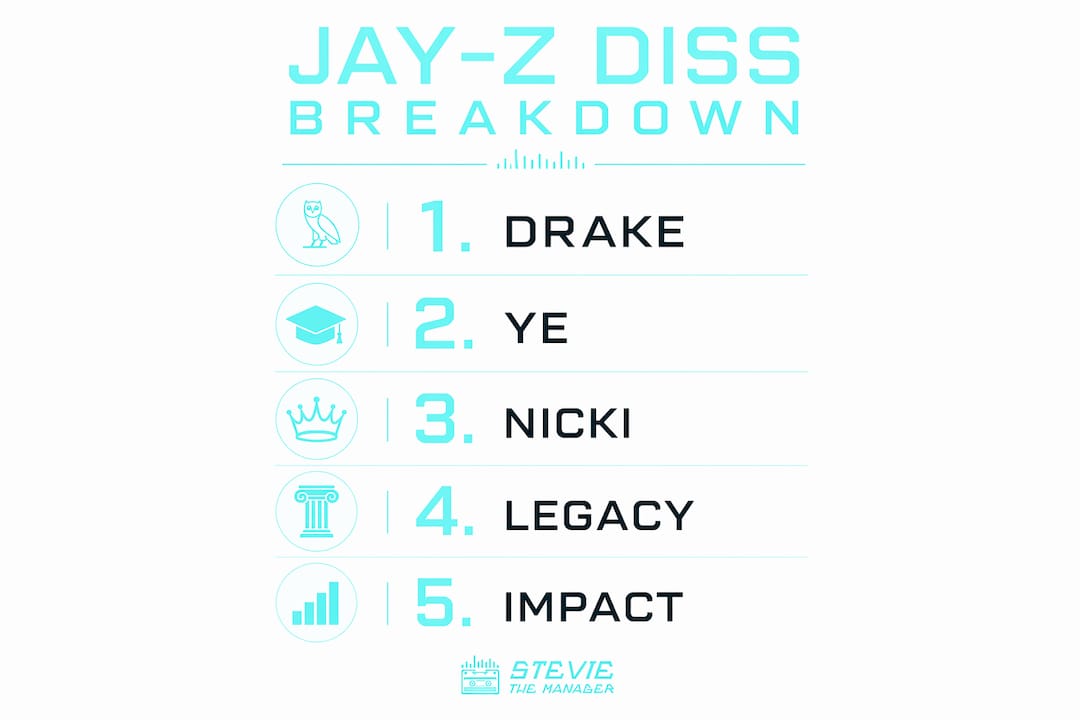
Jay-Z fires shots at Drake, Ye, and Nicki Minaj at Roots Picnic with bars that were precise, not improvised. The Drake section was the sharpest. Jay-Z directly countered Drake’s track Janice STFU, which included the line “The jig is up.” Hov’s response was blunt: “We got up 10,” asserting his chart dominance over Drake’s and labeling him the “wrong chart champ.”
The publishing critique landed even harder. Jay-Z rapped, “Them crackers got your publishing gangsta,” a direct shot at Drake’s contract structure and what Jay-Z frames as a lack of professional autonomy. For Jay-Z, who built Roc Nation partly on the principle of artist ownership, this is not just a diss. It is a worldview. Calling out someone’s publishing deal is the hip-hop equivalent of questioning their entire business judgment.
Here is what made the Drake bars particularly effective:
- Chart counter: “We got up 10” reframes the Billboard conversation entirely, shifting from Drake’s streaming dominance to a longer historical record.
- Publishing shot: Framing Drake’s deal as corporate control undercuts Drake’s self-made image.
- Tone: Cool and factual rather than angry, which made the bars land harder than a rage-fueled attack would have.
Pro Tip: When analyzing rap disses, pay attention to what the artist does NOT say. Jay-Z never mentioned Drake by name in the freestyle, which gives him plausible deniability while the references were obvious to anyone paying attention.
The distinction between ownership and chart success is central to how Jay-Z positions himself. He is not just competing as a rapper. He is competing as a mogul, and that framing makes Drake’s streaming numbers feel like a consolation prize by comparison.
How did Jay-Z address Ye in his Roots Picnic freestyle?
The Ye section of the freestyle was the most personal moment of the entire set. In 2025, Ye made derogatory public comments about Jay-Z and Beyoncé’s children. Jay-Z’s response at the Roots Picnic was measured but unmistakable: “You ever heard of wonder-kin? My children are some of them.”
That single bar does a lot of work. It defends his family without descending into a screaming match. It reframes the attack by positioning his children as exceptional rather than as targets. And it signals that Jay-Z will not let personal slights go unanswered, even from a former collaborator as close as Ye.
What makes this diss particularly complex is the context surrounding it:
- History: Jay-Z and Ye collaborated on Watch the Throne in 2011, one of the most celebrated rap albums of that decade.
- Personal stakes: Attacking someone’s children crosses a line most rap beefs avoid. Jay-Z’s response was proportional but firm.
- Restraint: Jay-Z did not unload a full verse at Ye. One bar was enough, and that restraint communicated confidence.
Pro Tip: The “wonder-kin” bar is a reference to the concept of a wunderkind, a prodigy. Jay-Z is not just defending his kids. He is elevating them above the conversation entirely, which is a more powerful move than a direct insult.

What followed was equally telling. Jay-Z continued performing collaborative hits with Ye during the same set. He separated the personal grievance from the artistic legacy, which is a distinction most artists in a beef situation fail to make. That ability to compartmentalize is part of what makes Jay-Z’s approach to the Jay-Z feud with Drake and Ye so different from typical rap conflict.
What did Jay-Z’s shots at Nicki Minaj entail?
The Nicki Minaj bars were the most cryptic of the three targets, but they were no less pointed. Jay-Z rapped, “That lady back on that stuff / She sounds like she’s in love with ’em / Her Ken can’t even pick they kid, enough of them.” The “Ken” reference is widely read as a shot at Nicki’s husband, Kenneth Petty, and the line about picking up their child implies personal instability.
The phrase “back on that stuff” is deliberately vague, which forces the listener to fill in the blank. That ambiguity is a classic diss technique. It lets the target’s own reputation do the heavy lifting.
Key elements of the Nicki bars:
- “Back on that stuff”: Vague enough to avoid a specific accusation but pointed enough to sting.
- “Her Ken” reference: Pulls Nicki’s personal life into the public arena, targeting her domestic situation rather than her music.
- Tone shift: Compared to the Drake and Ye bars, the Nicki verse felt more dismissive than combative, which carries its own kind of disrespect.
Nicki Minaj had faced a string of public controversies and performance mishaps in the period leading up to the Roots Picnic. Jay-Z’s bars land in that context, amplifying existing narratives rather than creating new ones. The broader implication is that Jay-Z views her current position in hip-hop as diminished, and he is willing to say so on a festival stage in front of thousands of people.
What cultural impact did Jay-Z’s freestyle have on hip-hop?
The Roots Picnic freestyle did not just generate headlines. It forced a real conversation about how rap beef operates in 2026. Live festival disses by major artists like Jay-Z alter the traditional back-and-forth dynamic because there is no editing, no studio polish, and no time to craft a response before the crowd reacts.
Experts have identified what they call a “legacy paradox” in Jay-Z’s approach. He has publicly advocated for peace in hip-hop while simultaneously delivering some of the sharpest disses of 2026. That contradiction is not hypocrisy so much as it is a reflection of hip-hop’s internal tension between community building and competitive survival.
Here is how the Roots Picnic freestyle compares to traditional rap beef formats:
| Format | Traditional rap beef | Jay-Z’s Roots Picnic approach |
|---|---|---|
| Delivery | Studio diss tracks released online | Live a cappella freestyle on festival stage |
| Response time | Days or weeks between tracks | Immediate crowd reaction, no rebuttal window |
| Audience | Streaming listeners globally | Live crowd plus viral social media clips |
| Tone | Often personal and emotional | Calculated, factual, and controlled |
| Risk level | Moderate, can be edited | High, no take-backs in front of thousands |
Jay-Z acknowledged in a 2026 GQ interview that he holds mixed feelings about rap beef’s place in culture, voicing both respect for lyrical sparring and concern about its negative effects. That self-awareness makes the Roots Picnic freestyle even more deliberate. He knew exactly what he was doing and did it anyway.

Social media accelerated the impact significantly. Clips of the freestyle circulated on X, Instagram, and TikTok within minutes, reaching audiences who were not at the festival and who had no prior context for the specific references. That amplification is something social media’s role in rap has fundamentally changed about how beef lands and how long it stays in the cultural conversation.
How does this performance fit into Jay-Z’s legacy and future influence?
The Roots Picnic set was not just a comeback. It was a statement of position. Jay-Z had not performed at a major festival in over five years, and his return was used as a promotional pivot for upcoming Yankee Stadium shows in July 2026. The timing was not accidental.
| Event | Date | Significance |
|---|---|---|
| Roots Picnic freestyle | June 2026 | First major festival in 5+ years, diss bars at Drake, Ye, Nicki |
| Yankee Stadium shows | July 2026 | Major concert series promoted through Roots Picnic momentum |
| Watch the Throne era | 2011 | Last major collaborative peak with Ye |
| Roc Nation founding | 2008 | Established Jay-Z’s mogul identity separate from rap competition |
Jay-Z’s critique of others’ professional entanglements reflects his own history as a mogul who prioritizes ownership. When he mocks Drake’s publishing deal, he is also advertising his own model. That dual function, diss and brand statement, is what separates this freestyle from a simple beef response.
For hip-hop fans tracking the Drake vs Jay-Z dynamic, the Roots Picnic set signals that Jay-Z has no intention of fading into elder statesman status quietly. He is competing on his own terms, and those terms include owning the stage, the narrative, and the business conversation simultaneously.
Key takeaways
Jay-Z’s Roots Picnic freestyle proves that legacy artists can still shape hip-hop’s cultural conversation by combining lyrical precision with mogul-level business critique on a live stage.
| Point | Details |
|---|---|
| Drake publishing shot | Jay-Z targeted Drake’s contract structure, framing it as a loss of creative and financial control. |
| Ye family defense | One bar defending his children was more powerful than a full verse, showing restraint as a weapon. |
| Nicki Minaj dismissal | Vague but pointed bars about personal struggles signaled Jay-Z views her current standing as diminished. |
| Legacy paradox | Jay-Z’s peace advocacy and competitive disses coexist, reflecting hip-hop’s internal contradictions. |
| Strategic timing | The Roots Picnic set doubled as promotion for Yankee Stadium shows, blending artistry with business. |
Why the Roots Picnic freestyle reveals more than just beef
I have followed Jay-Z’s career long enough to know that nothing he does publicly is accidental. The Roots Picnic freestyle looked like a diss set. What it actually was is a masterclass in positioning. Every bar served a dual purpose: address a grievance and reinforce a brand identity. The Drake publishing line was not just shade. It was a reminder of what Jay-Z stands for as a business operator.
What strikes me most is the restraint. One bar for Ye. Vague lines for Nicki. A few sharp facts for Drake. Jay-Z did not need to go long because he was not trying to win a battle. He was making a point about where he stands in 2026 hip-hop, and he made it in four minutes without breaking a sweat.

The uncomfortable truth about this moment is that it exposes how few artists at Jay-Z’s level can still do this convincingly. Most legacy rappers who attempt disses come across as desperate or out of touch. Jay-Z came across as inevitable. That gap between him and his peers is exactly what the freestyle was designed to communicate.
— Stephanos G
Stay connected to hip-hop culture with Lit Nightz News

Lit Nightz News covers the moments that define hip-hop culture, from live performance breakdowns to industry analysis that goes deeper than the headlines. If the Roots Picnic freestyle got you thinking about where hip-hop stands in 2026, start with our full breakdown of hip-hop’s origins and impact to understand the cultural foundation behind moments like this one. For artists looking to build their own presence in this space, Lit Nightz News and Lit Nightz Records offer platforms to amplify your story. Explore why hip-hop remains influential and see how the culture continues to shape identity, business, and music in real time.
FAQ
What did Jay-Z say about Drake at the Roots Picnic?
Jay-Z countered Drake’s “The jig is up” lyric from Janice STFU with bars claiming chart superiority and mocking Drake’s publishing deal, rapping “Them crackers got your publishing gangsta” to question Drake’s professional autonomy.
Why did Jay-Z diss Ye at the Roots Picnic?
Jay-Z responded to Ye’s 2025 derogatory comments about his children with the bar “You ever heard of wonder-kin? My children are some of them,” defending his family while maintaining composure rather than escalating the conflict.
What were Jay-Z’s bars about Nicki Minaj?
Jay-Z rapped that Nicki was “back on that stuff” and that “Her Ken can’t even pick they kid,” referencing her husband Kenneth Petty and implying personal instability in her domestic life.
Was the Roots Picnic freestyle planned or improvised?
The four-minute a cappella freestyle was delivered at the start of a 32-song, 90-minute set, suggesting significant preparation despite its freestyle presentation. The precision of the references points to deliberate construction.
How does this fit into the top rap beefs of 2026?
Jay-Z’s Roots Picnic disses rank among the most significant rap beefs of 2026 because they came from a legacy artist on a live festival stage, targeting three major names simultaneously in a single four-minute set.
Recommended
- Jay-Z Live Performance at Roots Picnic 2026: What His Comeback Means for Hip-Hop – Stevie The Manager aka Stangr The Man
- Kanye West Admits to Copying Drake’s Flow: A Deep Dive into Their Musical Relationship – Stevie The Manager aka Stangr The Man
- Top 5 Rap Beefs of 2026: The Essential Fan Guide
- Drake Drops 3 Surprise Albums and Reignites Kendrick Feud

No Comments