

Home Studio Setup for Rappers: Build It Right
TL;DR:
- A home studio for rappers can be built affordably for around $200, emphasizing gear and room treatment over expensive spaces. Essential components include a DAW, audio interface, microphone, headphones, and acoustic treatment, with room acoustics playing a crucial role in vocal quality. Prioritizing room treatment and proper gear matching ensures professional-sounding recordings without costly professional studios.
A home studio setup for rappers is the combination of a digital audio workstation, audio interface, microphone, headphones, and acoustic treatment that produces professional-quality vocal recordings without a commercial studio budget. You do not need a $10,000 room to make industry-standard rap recordings. A functional home studio can be built for as low as $200 if you already own a computer. That number matters because it reframes the entire conversation: your first investment is gear selection and room treatment, not rent on a recording suite.

What equipment does a home recording studio for rappers need?
The recording chain for rap vocals has six non-negotiable components: a DAW (digital audio workstation), an audio interface, a microphone, closed-back headphones, a pop filter, and some form of acoustic treatment. Every other purchase is optional until these are locked in. Tools like GarageBand (free on Mac), Reaper ($60 license), and FL Studio ($99 and up) cover the DAW category at every budget level. For rap production specifically, FL Studio’s step sequencer and pattern-based workflow make beat building faster than most alternatives.
The audio interface is the hardware bridge between your microphone and your computer. For rap vocals, the interface must deliver at least +60 dB of clean gain to drive dynamic mics like the Shure SM7B without cranking the preamp into noise. Interfaces with 24-bit/192 kHz analog-to-digital conversion, such as the Focusrite Scarlett Solo or the Universal Audio Volt 176, give you headroom that cheaper converters cannot match. Low-latency monitoring is equally critical: hearing your voice in real time without a delay keeps your delivery tight.
Microphone choice splits into two camps. Condenser mics like the Audio-Technica AT2020 capture high-frequency detail and air, which suits melodic rap and sung hooks. Dynamic mics like the Shure SM7B reject room noise more aggressively, which is why it dominates professional rap studios from Kendrick Lamar’s sessions to podcasting setups. Closed-back headphones prevent the beat playing in your ears from bleeding into the mic, a problem that costs hours of re-recording if ignored.
Pro Tip: Buy a pop filter before you buy a shock mount. Plosive sounds from “p” and “b” consonants destroy rap takes far more often than mic vibration does.
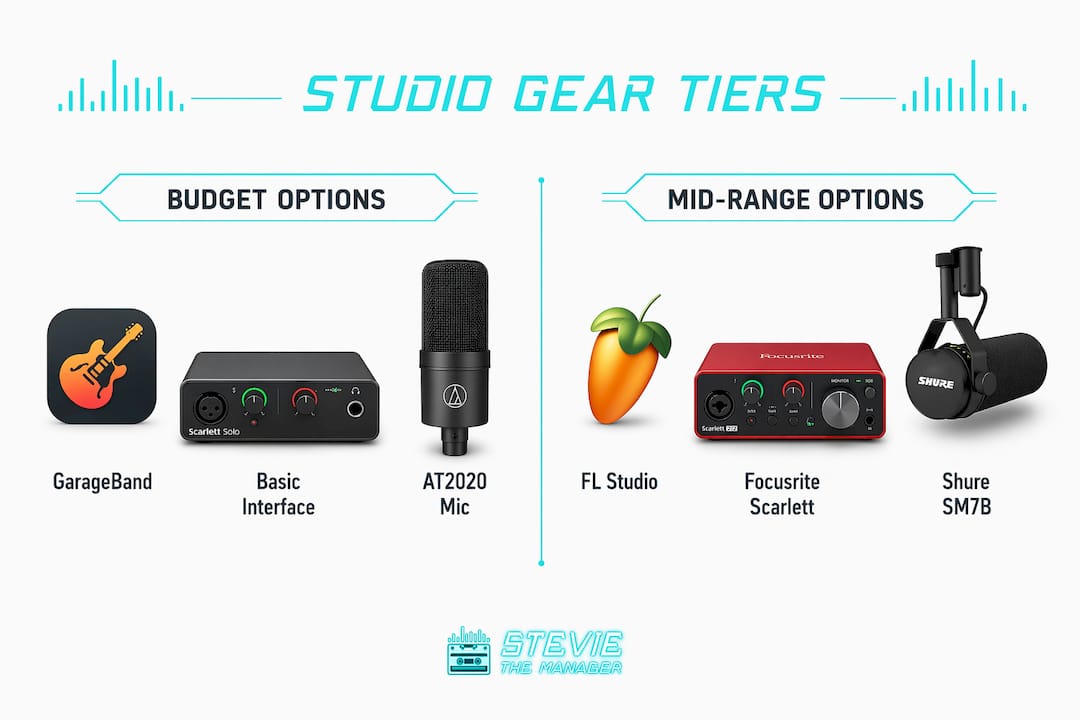
Starter gear comparison by budget tier
| Gear | Budget Option | Mid-Range Option |
|---|---|---|
| DAW | GarageBand (free) | FL Studio ($99) |
| Audio Interface | Focusrite Scarlett Solo ($120) | Universal Audio Volt 176 ($200) |
| Microphone | Audio-Technica AT2020 ($99) | Shure SM7B ($399) |
| Headphones | Audio-Technica ATH-M20x ($49) | Sony MDR-7506 ($99) |
| Pop Filter | Generic nylon ($10) | Stedman Proscreen XL ($80) |
How should you prioritize purchases and build your studio step by step?
The recommended purchase order is DAW first, then headphones, then interface and mic together, then room treatment, and finally studio monitors only after treatment is in place. This sequence is not arbitrary. Each step unlocks the next without wasting money on gear whose quality you cannot yet evaluate.
Here is the stepwise build sequence that works for most aspiring rappers:
- Start with your DAW. Download GarageBand or Reaper and learn the basics of recording, editing, and bouncing audio before spending another dollar.
- Add closed-back headphones. The Sony MDR-7506 or Audio-Technica ATH-M50x give you accurate monitoring for under $150 and double as your recording headphones.
- Buy your interface and mic together. These two items must be matched. A Shure SM7B paired with a Focusrite Scarlett Solo will clip the preamp; pair it instead with the Scarlett 2i2 or a Cloudlifter inline preamp booster.
- Treat your room. Hang absorption panels at the first reflection points on your side walls before you record a single serious take.
- Add a MIDI controller. A 25-key controller like the Akai MPK Mini lets you program beats and melodies without clicking in notes one at a time.
- Buy studio monitors last. Monitors only tell you the truth in a treated room. In an untreated bedroom, they lie constantly.
Budget tiers break down practically as follows. A $200 starter setup covers a free DAW, a used AT2020, a basic interface, and budget headphones. A $500 foundation adds the Shure SM7B or a better interface and proper closed-back cans. A $1,000 capable studio includes room treatment panels, a quality interface with sufficient gain, and a MIDI controller. Second-hand gear stretches every tier significantly without sacrificing quality.

Pro Tip: Resist buying gear you cannot yet hear the difference in. A $1,000 mic in an untreated room sounds worse than a $100 mic in a treated closet. Spend on your room before you spend on your signal chain.
What acoustic treatment do rappers actually need at home?
Acoustic treatment and soundproofing are two different things, and confusing them is the most expensive mistake beginners make. Soundproofing stops sound from leaving or entering a room. Acoustic treatment controls how sound behaves inside the room. For rap vocal recording, treatment is what you need first.
The correct order for treating a home studio is: early reflections first, then the rear wall, then the ceiling, then the corners, then the front wall, and finally the back half of the room. This sequence targets the reflections that color your vocal recordings most aggressively before addressing lower-frequency buildup. Skipping to corner bass traps before handling side-wall reflections produces uneven results.
Here is what each treatment type does in practice:
- Absorption panels at the first reflection points (the spots on your side walls where a mirror would reflect the speaker back to your ears) reduce comb filtering and room coloration on vocals.
- Bass traps in corners absorb low-frequency energy that builds up in room boundaries, tightening the low end of your mix and making kick drums and 808s translate better.
- Diffusers on the rear wall scatter reflections rather than absorbing them, preserving some liveliness in the room without adding flutter echo.
DIY options work well at the budget level. Hanging moving blankets on side walls, recording inside a walk-in closet surrounded by clothes, or building 703 Owens Corning fiberglass panels in wood frames all reduce early reflections meaningfully. A $100 DIY treatment setup consistently outperforms a $1,000 microphone in an untreated room. That is not an opinion; room acoustics matter more than microphone price at every budget level below professional studio grade.
For measurement, Room EQ Wizard (free software) paired with a calibrated measurement mic like the Dayton Audio EMM-6 gives you a frequency response graph of your room. The iterative workflow of treat, measure, record, and adjust produces better results than placing foam randomly and hoping for the best.
Pro Tip: Record a vocal take in your bathroom, then in a closet full of clothes, then in your bedroom. Listen back on headphones. The difference will tell you more about room acoustics than any article can.
Acoustic treatment priority table
| Treatment Type | Priority | Estimated Cost |
|---|---|---|
| Side-wall absorption panels | First | $50 to $200 DIY |
| Rear wall absorption | Second | $50 to $150 DIY |
| Corner bass traps | Third | $80 to $300 DIY |
| Ceiling cloud panel | Fourth | $100 to $250 DIY |
| Diffusers (rear wall) | Fifth | $80 to $200 DIY |
What should rappers look for in audio interfaces and mics?
The Shure SM7B is the benchmark dynamic mic for rap vocals, used on records by artists from Michael Jackson to J. Cole. Its broadcast-quality cardioid pattern rejects room noise from behind and to the sides, which matters enormously in untreated home rooms. The tradeoff is gain hunger: the SM7B needs at least +60 dB of clean gain to reach optimal recording levels, which rules out budget interfaces with weak preamps.

Modern USB-C interfaces with 24-bit/192 kHz conversion, such as the Focusrite Scarlett 2i2 (4th gen) or the PreSonus AudioBox USB 96, give you conversion quality that exceeds what most listeners can hear. The practical benefit is a lower noise floor, which means your vocal sits cleaner in the mix without noise reduction plugins doing heavy lifting. Some interfaces like the Universal Audio Volt 176 include a vintage compressor mode that adds analog warmth to rap vocals on the way in, reducing the need for post-processing.
Common interface mistakes include cranking the gain to compensate for a weak preamp, which amplifies noise along with the signal, and buying a single-channel interface when you plan to record with two mics or add a hardware compressor later. A two-channel interface costs only slightly more and gives you room to grow.
Pro Tip: If your budget forces a choice between the Shure SM7B and a better interface, choose the better interface. A clean preamp with a cheaper mic beats a great mic through a noisy preamp every time.
Interface and mic comparison
| Model | Type | Gain/Spec | Price Range |
|---|---|---|---|
| Focusrite Scarlett 2i2 (4th gen) | Interface | 56 dB, 24-bit/192 kHz | $170 |
| Universal Audio Volt 176 | Interface | 60 dB, vintage comp mode | $200 |
| Shure SM7B | Dynamic Mic | Cardioid, 50 Hz to 20 kHz | $399 |
| Audio-Technica AT2020 | Condenser Mic | Cardioid, 20 Hz to 20 kHz | $99 |
What recording workflow tips help rappers get the best takes?
Clean recording starts before you press record. Set your interface gain so the loudest vocal peaks hit around -12 dBFS on your DAW meter. This leaves headroom for compression and limiting in the mix without clipping the signal. Many beginners set gain too hot chasing a “full” meter, then wonder why their vocals distort under processing.
Record multiple takes of every verse and hook. Professional rap sessions routinely stack four to eight takes of a single bar to find the one with the right energy and timing. Comping (editing together the best lines from multiple takes) is standard practice, not cheating. Tools like the comping feature in Logic Pro X or the playlist system in FL Studio make this fast.
Mic placement follows the 3-to-1 rule: if your primary mic is one foot from your mouth, any secondary mic should be at least three feet away to avoid phase cancellation. For most rap recording, you are working with one mic, so the practical application is positioning your mouth 6 to 8 inches from the capsule at a slight downward angle to reduce plosives. Pair this with your rap vocal mixing workflow for results that translate across speakers.
Pro Tip: Monitor your recording through headphones, not monitors, while tracking vocals. You will catch timing issues and breath noise in real time instead of discovering them during the mix.
Key takeaways
A home studio setup for rappers succeeds or fails on room acoustics and interface gain quality, not on microphone price alone.

| Point | Details |
|---|---|
| Build in the right order | Buy DAW, headphones, and interface before room treatment or monitors. |
| Room beats gear every time | A treated room improves vocal quality more than upgrading from a $100 to a $1,000 mic. |
| Match mic to interface gain | The Shure SM7B needs at least +60 dB of clean gain to record without noise. |
| Treat early reflections first | Side-wall absorption panels deliver the highest acoustic return before any other treatment. |
| Record multiple takes | Comping the best lines from several takes is standard professional practice, not a workaround. |
Why room treatment is the decision that changes everything
I have watched rappers spend $800 on a Neumann TLM 103 and record it in a bedroom with bare walls and a low ceiling. The result sounds like a demo. Then I have heard artists record a $99 Audio-Technica AT2020 in a closet lined with moving blankets and acoustic foam, and the vocal sits in the mix like it belongs there. The difference is not the microphone. It is the room.
The gear obsession in rap production culture is understandable. Equipment is visible, shareable, and feels like progress. Hanging blankets on walls does not make for a great Instagram post. But the structured treatment of early reflection points is the single highest-return upgrade available to any home studio rapper after the core signal chain is in place.
My honest advice: spend your first $500 on a solid DAW, a decent interface, a dynamic mic, and closed-back headphones. Then spend the next $200 on room treatment before you buy anything else. Learn your rapping technique and your room simultaneously. Upgrade gear only when you can clearly hear what the current gear cannot do. That discipline separates artists who build real studios from artists who accumulate expensive equipment that never gets used.
— Stephanos G
Explore the culture behind the music you are making

Building your home studio is only one side of the equation. Understanding the culture that shaped rap music gives your recordings context, direction, and authenticity that no piece of gear can provide. At Lit Nightz Records & Lit Nightz News, we cover the full picture: from technical production advice to the history and trends that define hip-hop as an art form. Dig into the origins of hip-hop culture to understand why the music you are making carries the weight it does. If you want to stay current, our breakdown of hip-hop trends in 2026 connects what is happening in the culture right now to what you should be creating in your studio.
FAQ
What is the minimum budget for a rap home studio?
A functional rap home studio starts at around $200 if you own a computer, covering a free DAW, budget headphones, a basic audio interface, and an entry-level condenser mic. Typical essentials budgets range from $320 to $730 when you include a quality interface, microphone, and accessories.

Do I need soundproofing or acoustic treatment for rap vocals?
Acoustic treatment is what you need first. Soundproofing stops sound from traveling between rooms, while acoustic treatment controls how sound behaves inside your recording space, directly improving vocal clarity and mix quality.
What microphone do most rappers use in home studios?
The Shure SM7B is the most widely used dynamic mic for rap vocals at the professional and prosumer level because it rejects room noise and handles high-energy vocal delivery without distortion. The Audio-Technica AT2020 is the top budget condenser alternative for home recording.
Why should I buy studio monitors last?
Buying monitors before treating your room produces unreliable mixes because untreated rooms exaggerate or mask frequencies, leading to poor mixing decisions. Treat your room first, then add monitors so they give you accurate feedback.
What DAW is best for rap production at home?
FL Studio is the most popular DAW for rap and hip-hop production because of its pattern-based beat workflow and strong plugin ecosystem. GarageBand is the best free starting point for Mac users, and Reaper offers a full-featured paid option at $60.
Recommended
- How to Mix Rap Vocals Professionally: Pro Tips
- Start a Rap Career in Canada 2026: 3-7% Growth Path
- Step-by-step rapping technique tutorial for beginners
- Top 3 Best Studio Equipment for Beginners Rap Alternatives 2026

No Comments