

Future Net Worth Rapper: Wealth Breakdown for 2026
TL;DR:
- Future’s net worth is estimated around $50 million in 2026, mainly from streaming, touring, label ownership, and brand deals. He actively manages his catalog, owns his label, and invests in real estate to sustain wealth growth and reduce industry dependence. His strategy of diversified income streams and control over assets offers a model for long-term financial success in hip-hop.
Future net worth rapper refers to the total estimated wealth of Nayvadius DeMun Wilburn, the Atlanta trap artist known professionally as Future, valued at approximately $50 million as of 2026. That figure reflects more than hit records. It represents a calculated mix of streaming royalties, touring income, label ownership, brand deals, and real estate. Songs like “Mask Off” alone have crossed 2 billion Spotify streams, generating royalties that compound year after year. Understanding how Future built and sustained that wealth gives analysts and hip-hop fans a clear picture of what financial success actually looks like in modern rap.

What are the primary revenue streams behind Future’s net worth?
Future’s income does not come from one source. It comes from at least five distinct channels, each reinforcing the others.
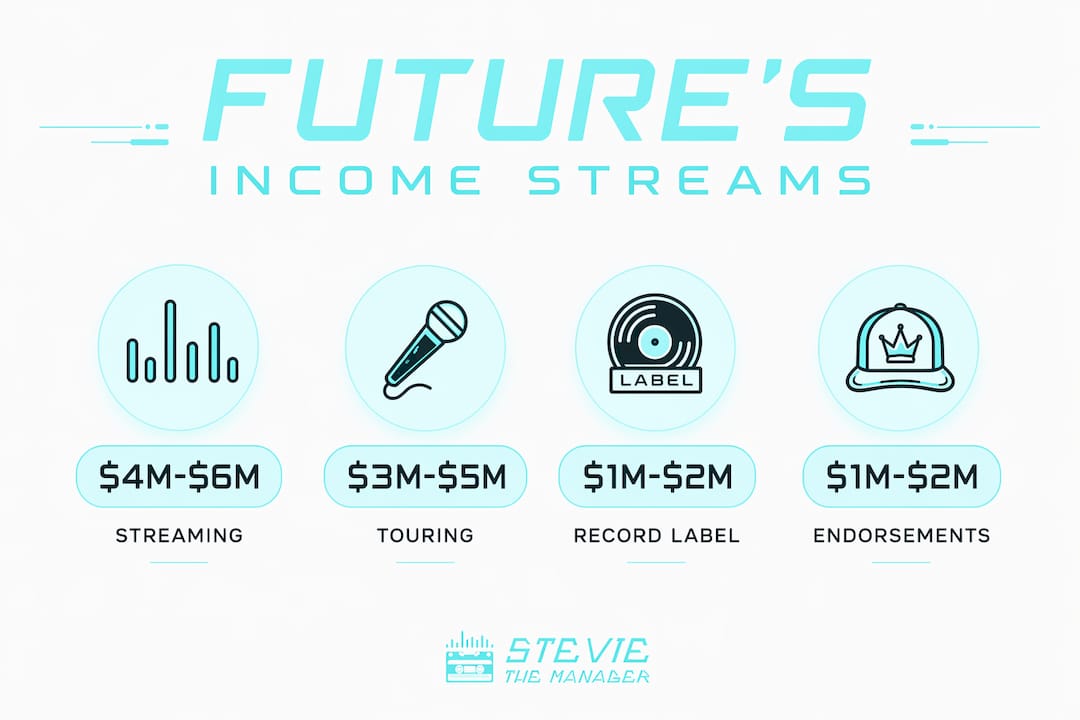
Music streaming and sales form the largest single pillar. Future generates roughly $4–6 million annually from streaming and digital sales. “Mask Off” is the clearest example of catalog power at work. The track continues producing royalties years after its 2017 release, which means Future earns money from a song he recorded nearly a decade ago without any additional effort.
Live touring and private performances add another $3–5 million in peak years. What most fans miss is the private event market. Private performance fees for artists at Future’s level can reach $500,000 to $749,000 per single event. One corporate booking can equal what many artists earn in an entire year of touring.
Freebandz Records, Future’s own label founded in 2011, generates about $1–2 million annually. Owning the label means Future earns on the output of his entire roster, not just his own releases. That is the difference between being an artist and being a business.
Brand partnerships with companies like Reebok and Cîroc contribute an estimated $1–2 million combined each year. Endorsements at this level are not passive. They require appearances, social posts, and product alignment, but the income is reliable and does not depend on chart performance.
The breakdown looks like this:
| Income source | Estimated annual range |
|---|---|
| Music streaming and sales | $4M–$6M |
| Live touring and private events | $3M–$5M |
| Freebandz Records label income | $1M–$2M |
| Brand partnerships | $1M–$2M |
Pro Tip: If you want to understand how streaming income actually works at scale, the breakdown of rapper streaming rates in 2026 shows exactly what per-stream payouts mean for catalog-heavy artists like Future.
How has Future’s career strategy enabled sustained wealth growth?
Future’s financial growth is not accidental. It follows a repeatable pattern built on four decisions.
- Consistent output. Future releases music at a pace most artists cannot match. More releases mean more catalog entries, more streaming inventory, and more licensing opportunities. Creative control paired with prolific output is now considered a blueprint for sustainable hip-hop careers.
- Label ownership. Running Freebandz Records gives Future a cut of every deal his artists sign and every stream they generate. Most artists sign away this leverage early in their careers. Future kept it.
- Catalog stewardship. Future actively manages his digital catalog rather than treating old releases as dead weight. Evergreen hits produce sustained royalty flows that outlast any single album cycle. “Mask Off” is the most visible proof of this, but his broader catalog follows the same pattern.
- Real estate investment. Future purchased a $16.3 million Miami Beach mansion in 2022. Luxury real estate serves as both a lifestyle asset and a long-term capital investment for high-net-worth musicians. Property appreciates independently of music industry cycles, which protects wealth when streaming revenue fluctuates.
Pro Tip: Artists building toward long-term income should read about why music catalogs matter before signing any deal that transfers ownership of their recordings.

The common thread across all four decisions is control. Future owns his label, manages his catalog, and invests in assets outside the music industry. That combination is what separates a high-earning artist from a wealthy one.
What milestones shaped Future’s net worth over time?
Future’s earnings did not climb in a straight line. They spiked during a specific window and have since stabilized at a high baseline.
Future’s career earnings peaked between 2017 and 2019, with annual income reaching $23 million in 2017, $30 million in 2018, and $19.5 million in 2019. That three-year run accounts for a significant portion of his total accumulated wealth. The 2018 figure of $30 million is particularly notable because it placed him among the highest-earning musicians globally that year, not just in hip-hop.
Several factors drove that peak. “Mask Off” released in 2017 and became a cultural moment, not just a chart hit. The track’s placement in film, television, and advertising created licensing income on top of streaming royalties. Collaborations with artists across multiple genres expanded his audience and his booking value simultaneously.
After 2019, annual earnings settled into a lower but still substantial range. The shift reflects a broader industry trend. Streaming-dominated revenue models require active catalog and licensing management to sustain income between major release cycles. Future’s investment in Freebandz and his real estate portfolio cushioned that transition.
The current net worth estimate sits between $40 million and $62 million, with most credible sources settling around $50 million. The range reflects different methodologies, not uncertainty about his success.
What can emerging artists learn from Future’s wealth-building model?
Future’s financial model offers a clear framework for artists at any stage. The core lesson is that music alone does not build lasting wealth. The business around the music does.
Financial success in modern hip-hop depends on diversified income streams and artist entrepreneurship. Future demonstrates this across every income channel he operates. No single revenue source accounts for more than a third of his total income. That spread protects him when any one channel underperforms.
For emerging artists, the practical takeaways are direct:
- Own your masters. Future’s catalog generates passive income because he retained ownership of key recordings. Signing away masters for an advance trades long-term royalties for short-term cash.
- Build a label or publishing entity early. Freebandz started small. The structure matters more than the size. Having a legal entity in place creates the foundation for signing other artists and collecting label-side income.
- Treat brand deals as a revenue category, not a bonus. Partnerships with Reebok and Cîroc are not one-off checks. They are recurring income channels that require active management.
- Invest outside music. Real estate, equity stakes, and other non-music assets protect wealth when streaming rates shift or touring slows.
Pro Tip: The richest rappers in 2026 all share one trait: they built businesses around their music, not just music careers.

Artists who maintain control of their creative output consistently build more durable financial positions than those who trade control for early exposure. Future’s trajectory is the clearest current example of that principle in action.
Key Takeaways
Future’s net worth of approximately $50 million in 2026 is the direct result of owning his label, managing his catalog, and diversifying income well beyond music streaming alone.
| Point | Details |
|---|---|
| Net worth estimate | Future’s wealth is estimated at $40M–$62M, with most sources placing it around $50M as of 2026. |
| Streaming as a foundation | “Mask Off” surpassing 2 billion Spotify streams shows how catalog hits generate income for years after release. |
| Label ownership multiplies earnings | Freebandz Records adds $1M–$2M annually and gives Future income from his entire artist roster. |
| Peak earnings window | Annual income hit $30M in 2018, driven by touring, streaming, and major collaborations. |
| Diversification protects wealth | Real estate, brand deals, and label income reduce dependence on any single revenue source. |
Future’s finances reveal what hip-hop wealth actually requires
What strikes me most about Future’s financial story is how deliberately unsexy the real strategy is. The public narrative focuses on the music, the lifestyle, and the cultural impact. The actual wealth engine is a label founded in 2011, a catalog managed across streaming platforms, and a Miami Beach property purchased as a capital asset.
Most artists I follow closely chase the wrong metrics. They count streams and social followers. Future’s model says count revenue categories. The moment an artist adds a second income stream that does not require them to perform, their financial ceiling changes completely.
The hip-hop industry is shifting fast. Streaming rates fluctuate. Tour markets tighten and open unpredictably. Brand deals come and go with cultural relevance. The artists who will still be financially secure in 2035 are the ones building structures now, not just audiences. Future built those structures during his peak earning years, which is exactly why his net worth holds at $50 million even as his chart dominance has leveled off.
For independent artists watching from the outside, the lesson is not “get famous like Future.” The lesson is “build the business infrastructure before you need it.” Waiting until you have leverage to create leverage is the most common and most expensive mistake in this industry.
— Stephanos G
Hip-hop culture and career strategy at Lit Nightz News
Lit Nightz News covers the financial and cultural forces shaping hip-hop from the inside out. Stangr The Man, an independent underground rap artist and entrepreneur from Vancouver, BC, built this platform to share real industry insight with artists and fans who want more than surface-level coverage.

If Future’s career model sparked questions about how hip-hop actually works as a culture and an industry, the deep-dive on hip-hop culture origins and impact is the right next read. Artists looking to build their own presence can also get featured on Lit Nightz News and connect with a community that takes independent music seriously.

FAQ
What is Future’s net worth in 2026?
Future’s net worth is estimated between $40 million and $62 million as of 2026, with most sources placing the figure around $50 million. The variation reflects different valuation methodologies across reporting outlets.
How does Future make most of his money?
Future’s largest income source is music streaming and sales, generating roughly $4–6 million annually. Live touring, Freebandz Records, and brand partnerships with companies like Reebok and Cîroc add several million more each year.
What is Freebandz Records and how does it affect Future’s earnings?
Freebandz Records is Future’s own label, founded in 2011, which generates approximately $1–2 million annually. Owning the label means Future earns income from his entire artist roster, not just his personal releases.
When did Future earn the most money in his career?
Future’s peak earning years were 2017 through 2019, with annual income reaching $30 million in 2018. That window was driven by the success of “Mask Off,” major tours, and high-value collaborations.
How does Future protect his wealth outside of music?
Future invested in real estate, including a $16.3 million Miami Beach mansion purchased in 2022. High-net-worth musicians commonly use luxury real estate as a long-term capital investment that appreciates independently of music industry cycles.
Recommended
- Richest Rappers in the World: 2026 Rankings
- Highest Paid Rappers 2026: Who’s Really Getting Rich
- The Richest Rappers in the World: 2026 Rankings
- Lil Wayne Net Worth 2025: The Real Story Behind His $170M Empire – Stevie The Manager aka Stangr The Man

No Comments