Biggie Smalls aka Notorious BIG: Life and Legacy
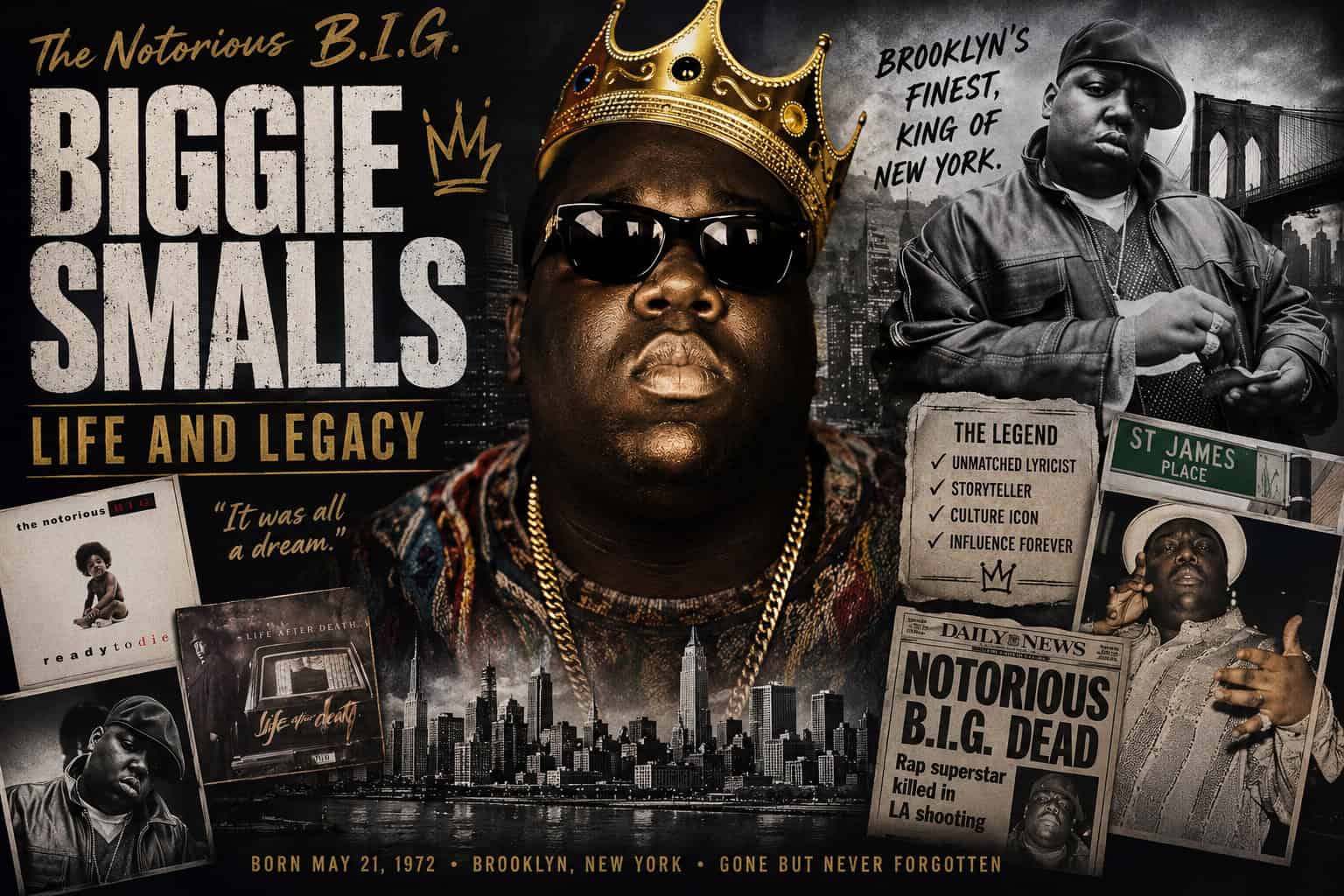
Christopher George Latore Wallace, known worldwide as Biggie Smalls and the Notorious B.I.G., is defined as the most technically gifted storyteller East Coast hip-hop ever produced. Born in Brooklyn on may 21, 1972, he released only two studio albums during his lifetime yet reshaped the entire direction of 1990s rap. His debut, Ready to Die (1994), set a new standard for cinematic street narratives. His posthumous release, Life After Death, arrived days after his murder in march 1997. The Biggie Smalls aka Notorious BIG biography is not just a story about a rapper. It is a story about Brooklyn, survival, and what happens when raw talent meets an era desperate for a voice.

What were Biggie Smalls’ early years like in Brooklyn?
Biggie grew up in the Clinton Hill and Bedford-Stuyvesant neighborhoods of Brooklyn, New York. His mother, Voletta Wallace, emigrated from Jamaica and raised him largely on her own after his father left the family early. She worked as a preschool teacher and kept a strict household, but the streets of 1980s Brooklyn pulled hard in the opposite direction.
His Brooklyn upbringing shaped by Caribbean immigration gave him a dual identity from the start. At home, he absorbed Jamaican culture, discipline, and a strong work ethic. Outside, he absorbed the rhythms of a neighborhood hit hard by poverty, the crack epidemic, and a school system stretched thin by Reagan-era budget cuts.
Biggie showed early academic promise. He attended Queen of All Saints Middle School and later George Westinghouse Career and Technical Education High School, where he shared classrooms with future rap figures Jay-Z and Busta Rhymes. That detail alone tells you something about the concentration of talent in Brooklyn at that time.
By his mid-teens, he had drifted into street life, selling drugs in his neighborhood. He was arrested in 1989 in North Carolina on weapons charges and spent time in jail. That experience, rather than derailing him, pushed him back toward music with sharper focus and more to say.
- Born may 21, 1972, in Brooklyn, New York
- Raised by Jamaican immigrant mother Voletta Wallace in Clinton Hill and Bedford-Stuyvesant
- Attended George Westinghouse High School alongside Jay-Z and Busta Rhymes
- Arrested in 1989; used the experience as creative fuel
- Began rapping seriously in his late teens, freestyling on Brooklyn street corners
Pro Tip: If you want to understand Biggie’s lyrics on a deeper level, read about the specific Brooklyn neighborhoods he came from. The geography is not background detail. It is the subject matter.
How did Biggie develop his rap style and break into the industry?
Biggie was skillfully self-taught, studying mid-1980s rap pioneers through immersion rather than formal training. He absorbed the storytelling precision of Slick Rick, the lyrical density of Rakim, and the street poetry of local Brooklyn MCs. He did not take classes. He listened obsessively, then practiced until his delivery became something entirely his own.

His technical signature was a dynamic vocal delivery that shifted tone and mood within a single verse. He could sound menacing in one bar and darkly funny in the next. That range made his verses feel like short films. Listeners did not just hear a rapper. They heard a character with a full emotional life.
His path into the industry followed a specific sequence:
- Street freestyles: Biggie built a local reputation in Brooklyn through corner cyphers and word-of-mouth battles. His size and presence made him impossible to ignore.
- Demo tape circuit: He recorded early tapes that circulated through Brooklyn and eventually reached music industry contacts in New York City.
- The Source’s “Unsigned Hype” column: His demo tape success landed him a feature in The Source magazine’s “Unsigned Hype” column in 1992, a critical gatekeeper for early 90s rap breakthroughs.
- Meeting Sean “Puff Daddy” Combs: That exposure brought him to the attention of Sean Combs, who signed him to Bad Boy Records in 1993.
- Bad Boy Records launch: His 1993 signing helped Bad Boy Records become a cultural powerhouse during the decade’s rap scene.
Pro Tip: The “Unsigned Hype” column in The Source was one of the few legitimate pathways for unsigned rappers to reach label executives in the early 1990s. Biggie’s placement there was not luck. It was the result of a demo tape polished enough to compete with anyone in the country.

What are Biggie Smalls’ career highlights and musical legacy?
Biggie’s debut album, Ready to Die, dropped in september 1994 and immediately changed the conversation around East Coast rap. The album told a linear story from birth to death, using Biggie’s own life as the raw material. It was not just a collection of songs. It was a structured narrative with a beginning, a middle, and a devastating end.
His cinematic lyrical precision set a narrative standard in hip-hop that producers and MCs still reference today. Songs like “Juicy,” “Big Poppa,” and “Warning” demonstrated his ability to move between vulnerability, humor, and menace without losing coherence. That range is what separated him from his peers.
Key albums and milestones
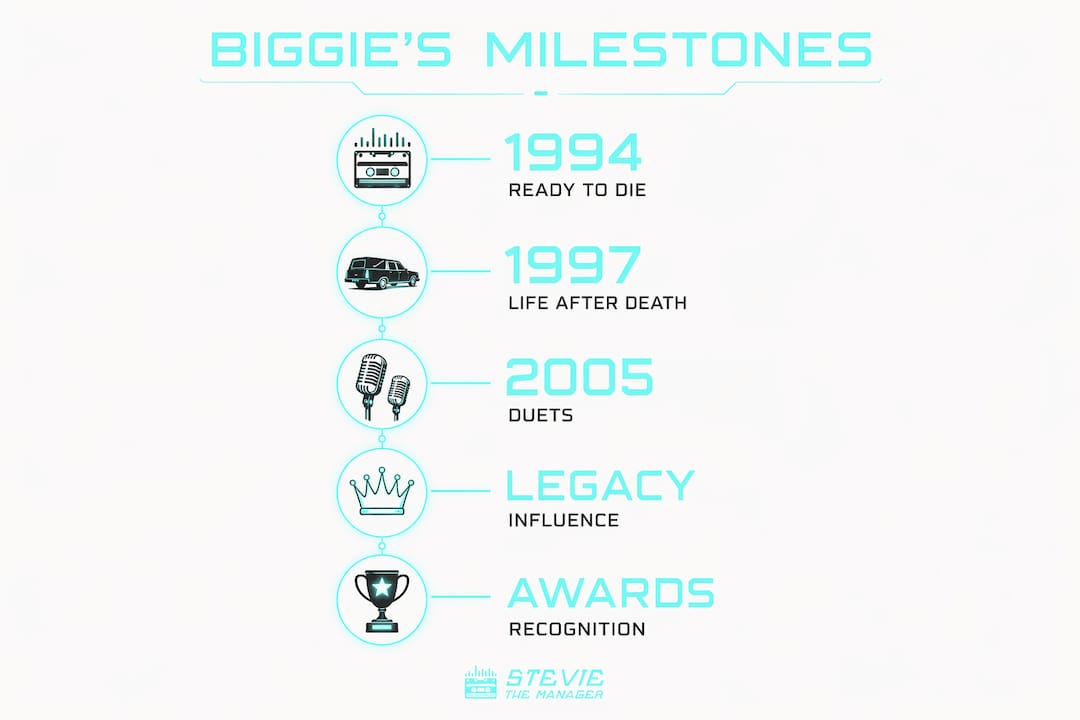
| Year | Project | Significance |
|---|---|---|
| 1994 | Ready to Die | Debut album; redefined East Coast rap storytelling |
| 1995 | “One More Chance” remix | Crossed into mainstream pop radio |
| 1997 | Life After Death | Posthumous double album; certified diamond |
| 1997 | Death, march 9 | Murder at age 24 remains officially unsolved |
Life After Death was released just 16 days after his death. It debuted at number one and went on to achieve diamond certification, a level reached by very few rap albums. The album’s success confirmed that his commercial appeal was not tied to his physical presence. The music carried itself.
His balance of street credibility and mainstream appeal set a template that hip-hop artists still follow. He proved you did not have to choose between the block and the Billboard charts. You could speak to both audiences in the same verse if your craft was strong enough.
- Ready to Die is consistently ranked among the greatest rap albums ever recorded
- Life After Death achieved diamond certification, one of the rarest milestones in music
- Collaborations with artists including Jay-Z, R. Kelly, and 112 expanded Bad Boy Records’ commercial reach
- His work directly shaped the careers of artists who came after him on the East Coast
How does Biggie’s story reflect the realities of 1990s Brooklyn?
Biggie’s life cannot be separated from the place and time that produced him. Reagan-era disinvestment in urban communities, the war on drugs, and mass incarceration reshaped Brooklyn’s neighborhoods throughout the 1980s. By the time Biggie was a teenager, those forces had created the exact conditions his lyrics described: limited economic options, constant police contact, and a street economy that offered short-term money with long-term consequences.
His transition from street hustler to globally influential artist is inseparable from those systemic challenges. He did not escape Brooklyn’s conditions by ignoring them. He turned them into art. That is what made his music feel true to listeners who had lived similar experiences and revelatory to those who had not.
Caribbean immigrant communities in Brooklyn brought their own cultural textures to the neighborhood. Biggie absorbed that influence through his mother and the broader community around him. Scholars who study music as a vehicle for identity point to artists like Biggie as examples of how cultural hybridity produces some of the most original voices in popular music.

“Biggie’s success can only be fully appreciated by understanding the socio-economic forces of his time and place, which also shaped his lyrical vulnerability and authenticity.”
— from It Was All a Dream: Biggie and the World That Made Him
His story became an archetype for 1990s rap precisely because it was specific. He did not write about generic street life. He wrote about his streets, his block, his mother’s apartment. That specificity is what gave his work universal reach. Listeners in Los Angeles, London, and Lagos heard something real in his verses because the details were too precise to be invented.
Key Takeaways
The Notorious B.I.G.’s legacy endures because he achieved what almost no artist manages: he was equally credible on the street and on the radio, and he did it through craft alone.
| Point | Details |
|---|---|
| Self-taught artistry | Biggie studied Rakim and Slick Rick through immersion, developing a vocal range that shifted tone within single verses. |
| Industry breakthrough | The Source’s “Unsigned Hype” column and the demo tape circuit were his gateway to Bad Boy Records in 1993. |
| Two defining albums | Ready to Die (1994) and the posthumous Life After Death (1997) remain benchmarks for East Coast rap storytelling. |
| Socio-political roots | Reagan-era Brooklyn shaped his worldview, and that context is inseparable from his lyrical authenticity. |
| Lasting template | His blend of street realism and mainstream appeal became the blueprint for commercial rap that followed. |
Why Biggie’s artistry still matters in 2026
By Stephanos G
I have spent years studying hip-hop biographies, and the Notorious BIG life story stands apart from almost every other artist narrative I have encountered. What strikes me most is not the tragedy of his death at 24. It is the discipline behind the art.
Biggie is often discussed as a natural talent, as if the gift arrived fully formed. That framing does him a disservice. He was a student of the craft before he was a star. He listened to Rakim and Slick Rick the way a novelist reads Hemingway. He broke down what worked, internalized it, and rebuilt it in his own voice. That process is available to any artist willing to put in the time.
What I find genuinely rare about his career is the dual credibility. Most artists who cross into mainstream success lose something on the street side. Biggie never did. His audience in Bedford-Stuyvesant and his audience on pop radio were both fully convinced he was speaking to them. That is not a marketing achievement. It is a writing achievement.
For aspiring artists today, the lesson is not “be from Brooklyn” or “live a hard life.” The lesson is specificity. Biggie wrote about exact places, exact feelings, and exact moments. That precision is what made his work last. Generic rap does not age well. Specific rap becomes history.
The 90s hip-hop era produced many talented artists, but very few whose work still generates serious academic and cultural discussion nearly three decades later. Biggie is one of them. That tells you everything about the depth of what he built in just a few years.

— Stephanos G
Lit Nightz News: More hip-hop culture and artist resources
Biggie’s story is a masterclass in authentic storytelling, independent hustle, and the power of knowing your craft inside out. At Lit Nightz News, we cover the artists, movements, and industry forces that shape hip-hop from the ground up.

Whether you want to understand the indie rap culture that carries Biggie’s spirit forward, or you are an independent artist looking to build your own path, Lit Nightz News has the content to back you up. We cover everything from music history to current rap trends shaping the industry right now. Dig into our full catalog at Lit Nightz News and keep building your knowledge of the culture.
FAQ
Who was Biggie Smalls, and what was his real name?
Biggie Smalls, also known as the Notorious B.I.G., was born Christopher George Latore Wallace on may 21, 1972, in Brooklyn, New York. He is widely recognized as one of the greatest rappers in hip-hop history.
How did Biggie Smalls get his start in the music industry?
Biggie built his early reputation through Brooklyn street freestyles and the underground demo tape circuit, eventually landing a feature in The Source magazine’s “Unsigned Hype” column in 1992. That exposure led directly to his signing with Bad Boy Records in 1993.
What albums did the Notorious B.I.G. release?
Biggie released one studio album during his lifetime, Ready to Die (1994), and his second album, Life After Death, was released posthumously in 1997, just 16 days after his death.
How did Biggie Smalls die?
Biggie was shot and killed on march 9, 1997, in Los Angeles following the Soul Train Music Awards. His murder at age 24 remains officially unsolved.
What is the legacy of Biggie Smalls in hip-hop?
Biggie’s legacy rests on his cinematic storytelling, his dynamic vocal delivery, and his ability to hold credibility with street audiences and mainstream listeners at the same time. His two albums remain foundational texts in East Coast rap and continue to influence artists worldwide.
Recommended
- The Real Story Behind Biggie Smalls aka Notorious BIG: From Brooklyn Streets to Hip-Hop Legend – Stevie The Manager aka Stangr The Man
- Remembering Young Noble of The Outlawz: A Legacy in Hip-Hop – Stevie The Manager aka Stangr The Man
- 18 Classic 90s Hip Hop Songs From The Golden Era To The East vs. West Era – Stevie The Manager aka Stangr The Man
- Tupac Biography: The Untold Story Behind the Hip-Hop Legend [2025 Guide] – Stevie The Manager aka Stangr The Man

No Comments