
Rap Album Release Strategy: 2026 Guide for Independent Artists
A rap album release strategy is a multi-phase promotional campaign that sequences singles, visuals, platform pitching, and community engagement to build momentum before and after a full project drops. It is not just a release date. It is a system. For independent hip-hop artists, getting this right is the difference between an album that lands and one that disappears inside a week.
The core elements of a well-built album release plan include:
- Singles rollout: 2–4 singles released ahead of the album, spaced to build audience attention without causing fatigue
- Pre-save campaigns: collecting fan commitment before the album is live, which signals engagement to streaming algorithms
- Editorial playlist pitching: submitting to Spotify and Apple Music editorial teams 6–8 weeks before release
- Visual content: cover art, music videos, lyric videos, and short-form clips that communicate your brand
- Community engagement: collaborations, features, and direct fan interaction that build credibility in hip-hop culture
- Post-release sustain: pushing deep cuts, user-generated content, and live clips for 4–8 weeks after the drop
Stangr The Man, the Vancouver-based independent rapper and founder of Lit Nightz Records, operates inside this exact framework. Every project from Lit Nightz Records treats the album as a campaign, not just a catalog upload.
What does a hip-hop album release timeline actually look like?
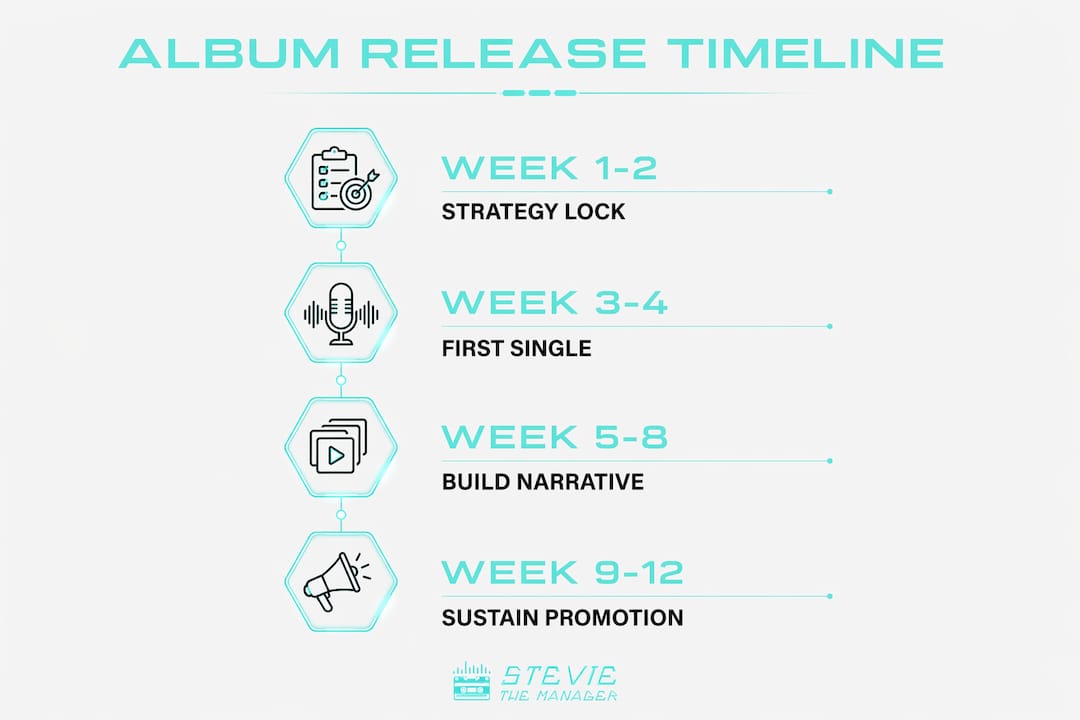
The industry-standard rollout for an independent rap album runs 10–12 weeks from first single to post-release sustain. Each phase has a specific job.
| Week | Phase | Key Actions |
|---|---|---|
| 1–2 | Strategy lock | Finalize singles, narrative arc, and release date |
| 3–4 | Single 1 launch | Upload to distributor, pitch editorial, activate pre-save, tease on social |
| 4–8 | Single 1 promotion + Single 2 prep | Sustain posting, upload Single 2, batch-film promo content |
| 6–8 | Single 2 release | Drop with album reference, vary the sound from Single 1 |
| 10–11 | Album announcement push | Reveal tracklist, cover art, open album pre-saves |
| 12 | Album release | Full drop, release-day posts, track-by-track breakdowns, fan Q&A |
| 2–4 | Post-release sustain | Deep cuts, user-generated content, live clips, retrospective posts |
Singles pacing matters more than most artists realize. Give each single 4–6 weeks to find its audience before the next one arrives. Releasing singles with variety in sound across the rollout prevents listener fatigue and keeps each drop feeling fresh. The first single does the heaviest lifting: it introduces the album era and trains streaming algorithms on who your audience is.
Independent artists who break the traditional Friday-only release pattern can capture attention before the end-of-week flood. Kevin Gates and J.I.D both found success with mid-week drops, dominating discourse before the rest of the week’s releases hit.
Essential marketing tactics that actually work for rap albums
The strongest hip hop marketing strategy for an independent artist is not the one with the biggest budget. It is the one with the clearest narrative and the most consistent execution.
Storytelling across platforms is where most campaigns live or die. Behind-the-scenes footage, studio session clips, and lyric breakdowns give fans something to engage with between drops. A song’s commercial reach increasingly depends on its lore and digital context, with behind-the-scenes content fueling organic spread. Post the process, not just the product.
Key tactics that move the needle for rap album promotion:
- Waterfall release technique: when you drop Single 2, add it to the same product that already contains Single 1. When the album drops, it contains all singles. Each new release inherits streams from previous ones, compounding momentum instead of splitting it.
- Lyric breakdown creators: engaging YouTube essayists and short-form clippers who decode your bars drives organic discovery far more effectively than traditional press outreach for indie artists. Build genuine relationships in comment sections before you need the favor.
- Paid ads with a tight focus: run short-form video ads targeting fans of artists in your lane. Keep the budget modest and test two or three creative variations before scaling.
- Collaborations and features: features signal credibility in hip-hop in ways no other genre matches. Two to four features on a 12-track project is standard. More than that dilutes your presence.
- Pre-save campaigns: introduce the album pre-save link alongside or shortly after the first single announcement. Fans who opt in early become your most activated listeners on release day.
- Press outreach: send pitches to blogs and outlets 6–8 weeks out with a press release, EPK, and a private stream link. Personalize each pitch. A placement on a smaller blog your fans actually read beats a rejection from a major outlet.
Pro Tip: Dr. Marcus Collins, writing for Forbes, frames hip-hop albums as narratives that deepen fan connection well before release day. Build your rollout around a story arc, not just a drop date. The singles, the visuals, the interviews, and the social content should all answer the same question: what is this album about and why does it matter right now?
Music storytelling across platforms is what separates a campaign that builds an audience from one that just announces a release.
How to build visuals on an independent budget
Hip-hop is a visual genre. Releasing music without video support and expecting to compete is not realistic. The good news is that budget does not determine quality as much as consistency and creative direction do.
Key visual content types every rap album campaign needs:
- Cover art: your most permanent visual asset. Invest here first. It appears on every platform, every playlist, and every share.
- Music video or visualizer: release one on drop day. A low-budget video that matches the song’s energy outperforms having nothing at all.
- Short-form teasers: 15-second hook clips with on-screen lyrics, posted across TikTok, Instagram Reels, and YouTube Shorts during the tease phase. This is your highest-value promotional asset.
- Behind-the-scenes footage: studio sessions, video shoots, and recording clips perform well on short-form platforms. Hip-hop audiences care about the craft behind the music.
- Lyric videos: cost-effective, shareable, and useful for driving repeat listens.
- Live session content: freestyles, acoustic takes, and in-studio performances build credibility and showcase skill.
Visual storytelling and compelling artwork are central to how independent hip-hop artists establish authenticity and deepen fan connection within tight budgets. Stangr The Man’s approach at Lit Nightz Records reflects this: consistent visual branding tied to the music’s tone, not a one-off cover design.
Batch your content creation. Film everything you need for the final two weeks of the rollout in one session during week 3. That way, release week is execution, not scrambling.
Unique considerations for independent rap artists in 2026
Independent hip-hop operates by different rules than the mainstream, and the artists who understand that have a real advantage. Hip-hop culture prioritizes community credibility and long-term narrative arcs over general buzz. Chasing hype without credibility in this genre backfires fast.
A few considerations that separate serious independent campaigns from forgettable ones:
- Mixtape vs. album framing: calling a project a mixtape sets looser expectations and gives you room to experiment. Albums carry weight and demand polish. For emerging artists, a mixtape first builds catalog and audience without the pressure of a debut album statement.
- Own your channels: routing fans through your own website captures first-party data that streaming platforms withhold. Email addresses, geographic data, and purchase behavior from your most engaged fans are assets you keep regardless of what any platform does next.
- Lyric clippers as organic discovery: the most effective organic discovery for indie rap now runs through content creators who break down bars and decode lore. Leave something in your lyrics worth decoding. Give clippers raw material.
- SoundCloud still matters: underground credibility, early fan building, and the SoundCloud-to-mainstream pipeline still exist in hip-hop. Use it for loose singles and early releases before your official DSP drop.
- Post-release is not optional: sustained post-release promotion prolongs an album’s lifecycle. J.I.D’s team pushed “Surround Sound” for over two years after The Forever Story dropped until it became a triple-platinum social media sensation. The album is not the finish line.
Pro Tip: Treat your album release as a brand architecture event, not just a music drop. Capturing first-party data through your own site transforms the project into a career asset that compounds beyond streaming revenue. Stangr The Man and Lit Nightz Records build around this principle: own the fan relationship, not just the release.
Innovative album rollouts in hip-hop consistently show that the artists who build narrative discipline over time outperform those who rely on a single viral moment. Consistency and patience are the actual strategy.
Key Takeaways
A successful rap album release strategy is a multi-phase system built around timed singles, narrative storytelling, visual content, and sustained post-release promotion tailored to hip-hop culture.
| Point | Details |
|---|---|
| Singles-first approach | Release 2–4 singles spaced 4–6 weeks apart before the album to train algorithms and warm audiences. |
| 12-week rollout standard | Plan from first single to post-release sustain across a full 12-week campaign window. |
| Visuals are non-negotiable | Every release needs a music video or visualizer on drop day; audio-only releases are invisible in hip-hop. |
| Own your fan data | Route engaged fans through your own website to capture first-party data streaming platforms withhold. |
| Post-release sustain | Push deep cuts, user-generated content, and live clips for 4–8 weeks after the album drops. |
FAQ
How do you release a rap album successfully?
Release 2–4 singles spaced 4–6 weeks apart before the album, pitch editorial playlists 6–8 weeks in advance, and run a pre-save campaign. Plan a 12-week rollout and sustain promotion for at least 4 weeks after the drop.
Why do rappers release albums on Fridays?
Friday is the global release day standard set by the music industry to align with chart tracking cycles and editorial playlist updates on platforms like Spotify and Apple Music. That said, mid-week releases on Tuesday or Wednesday can help independent artists dominate conversation before the Friday flood hits.
What is the waterfall release strategy in hip-hop?
The waterfall technique adds each new single to the same product that already contains previous singles, so when the album drops it inherits streams from every prior release. This compounds streaming momentum instead of splitting listener attention across separate releases.
Should an independent rapper release a mixtape or album first?
Start with a mixtape. It sets looser expectations, gives you room to experiment, and builds catalog without the pressure of a debut album statement. Save the album for when you have an audience already expecting it.
How long should post-release promotion last?
Plan for at least 4–8 weeks of post-release activity. Focus each week on a different angle: deep cuts, user-generated content, live performance clips, and retrospective posts to keep the album in circulation and feed streaming algorithms with fresh engagement signals.
Recommended
- How to release music and win as an indie rap artist
- How to release a hip-hop album in Canada: 2026 guide
- Hip-Hop Album Release Guide: Build Your Brand and Drop Hits
- Rap album promotion workflow: 8-week launch plan

No Comments